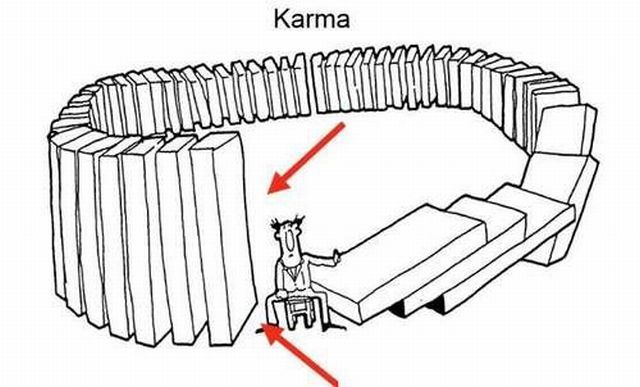
Action – Reaction

The mind… will re-act from the past (in any situation in life), because whenever it is faced with something in the moment, in the now, in rush all these memories, all these experiences. And whether one likes it or not, it is a purely mechanical process; we may think we are in control, but that is entirely illusory. Thus, there is no fresh response, no appropriate action; it is always the memories and the past experiences that dictate the action, which is therefore not really an action at all but a re-action.

from ‘Dialogues on Reality: An Exploration into the Nature of Our Ultimate Identity’, Robert Powell, Blue Dove Press, 1996. ISBN 1-884997-16-36. Buy from Amazon US; Buy from Amazon UK.

Karma Cubed – Three Views of Karma

Quoting from S.N. Sastri’s Terms and Concepts in Vedanta:

“The word ‘karma’ is used in two different senses in vedAnta:

(1) the results of actions performed, in the form of merit and demerit (puNya and pApa), which produce their effects later on, usually in another birth, and

(2) the action itself, whether secular or religious.”

After reading Swami Narayana Muni Prasad’s superb booklet “Karma and Reincarnation” I would like to point to a third sense in which the word karma can and needs to be understood, especially for advanced students of Advaita.

karmaKarma as puNya and pApa

At some point every seeker comes across the concept of karma in this sense. If he follows Western Advaita he may dismiss the concept as something altogether irrelevant or, if he is not yet an advaitin, he may subscribe to the Western version of karma as an assignment for this lifetime (see http://advaita-academy.org/blogs/Sitara.ashx?Y=2011&M=June) which, if successfully absolved, will produce the kind of life that everyone is wishing for: safe, pleasant and ethical. Continue reading

Action – Morality

“When you understand and are able to act from right action, morality is no longer necessary. It’s instantly obsolete and discarded. This is at the heart of the Bhagavad Gita. Arjuna, as a moral creature, throws down his weapon and refuses to launch a war. Krishna converts him to a creature of right action by freeing him from delusion and Arjuna takes up his weapon and launches the war. Right action has nothing to do with right or wrong, good or evil, naughty or nice. It is without altruism or compassion. Morality is the set of rules and regulations that you use to navigate through life when you’re still trying to steer your ship rather than let it follow the flow”

from ‘Spritual Enlightenment; The Damndest Thing’, Jed McKenna, Wisefool Press, 2002. ISBN 0971435235. Buy from Amazon US, Buy from Amazon UK

ROLE OF “REPETITION” — 2

ROLE OF “REPETITION” IN SPIRITUAL INSTRUCTION, PRACTICE AND UNDERSTANDING — 2


This is an alternative viewpoint regarding the role of “Repetition” in understanding the core message of advaita.  As it often happens, there is nothing like “the right perspective” in these matters. One may use one’s own discretion in evaluating these different points of view.

1.  There is no doubt that Repetition helps in getting a thing by heart or to memorize a quote, a mantra, a verse etc.

2.  We know ‘Practice maketh perfect’ and  practice necessarily involves repetition.

That means, we are making an operation (mostly those that involve neuromotor skills) into a more mechanically executed action – transferring a routine from being a cerebral activity to cerebellar activity.

3.  The ‘phala‘ (result) of certain ritualistic karma (like offerings made for the appeasement of gods, gaining merit etc.) is expected to increase proportionally with the number of times the ritual is carried out. (Please see Note: 2 at the end). Continue reading

Vision Of Truth (sad darshanam) – Part 15

सत्यश्चिदात्मा विविधाकृतिश्चित्

सिध्येत् पृथक् सत्य चितो न भिन्ना ।

भूषा विकाराः किमु सन्ति सत्यम्

विना सुवर्णम् पृथगत्र लोके ॥ – १५

satyashchidAtmA vividhAkRitishchit

sidhyet pRithak satya chitaH na bhinnA

bhUShA vikArAh kimu santi satyam

vinA suvarNam pRithagatra loke —15


सत्यश्चिदात्मा = consciousness (chidAtmA) is satyam; विविधाकृतिश्चित् = various cognitions;  न सिध्येत्  पृथक् सत्य चितो भिन्ना = are not possible without consciousness nor are they different from consciousness;  भूषा विकाराः = various ornaments; किमु सन्ति सत्यम् = do they exist; विना सुवर्णम् पृथगत्र लोके = without gold separately here in the world.

Consciousness (chidAtmA) is the truth (satyam).The various cognitions are not possible without consciousness nor are they different from consciousness.  Here, in the world, do the various gold ornaments exist without gold.

All cognitions we experience are but possible only due to the backing of the consciousness. The mind by itself is inert. The consciousness enlivens it. The mind when comes in contact with the object through the sense organs has a modification. The object is enveloped as it were by the mind which is the modification it undergoes. The consciousness of its own accord illumines this vRRitti (modification in the mind) and a specific cognition takes place.

For eg; pot vRRitti + the consciousness = pot cognition. Continue reading

Action and inaction

Possessing a mind unattached to everything, self-controlled, void of all desires, he attains the accomplishment of perfect actionlessness through Sannyasa (Gita,18-49)

In Shankara’s commentary (the great Indian philosopher and sage) Sannyasa is seen as either right knowledge or renunciation of all action. What is right knowledge in relation to action?

He who sees inaction in action, and action in inaction, he is the wisest of all men; he has a poised mind, and he alone has done all that had to be done. (Gita,4-18)

Repetition-1

ROLE OF “REPETITION” IN SPIRITUAL INSTRUCTION, PRACTICE AND UNDERSTANDING — 1

All of spiritual instruction and learning has two aspects or dimensions:  The Theory and Praxis – a doctrine to understand and a method to practice, so that the former may dawn in the seeker’s mind as an experiential realization of his/her own. In advaita Vedanta the goal is to understand the Reality by dispelling the misunderstanding. The final understanding to arrive at is that there is no essential distinction between the jiva (individual self) and Atman (Universal Self), and further, that Atman, the Self, is Brahman (its cosmic extension, as it were). Here the two terms of the polarity, subject-object, get obliterated, given the intuition (anubhUti, akhandAkAra vRtti) that reality is One. Knowing and Being are no longer distinguishable from one another, when Happiness shines self-effulgently and this is encapsulated in the three-pronged expression, sat-chit-Ananda.

The method of imparting the above Non-dual message is usually by teaching (through gradual and progressive steps) so that the seeker intuitively grasps the Reality, the ‘what Is’. Normally a teacher is required for this education; otherwise, the scriptures (basically the prasthAnatraya; the purANas and specific treatises likes the prakaraNa grantha-s being the accessories) are the source to which one can access again and again. Saying ‘again and again’ implies repetition… or does it? Repetition of what? Continue reading

Action – Without Ego, Oh, “I” am the ‘Pain’ on my Neck!

Uff, It’s a terrible pounding head-ache. Felt like a herd of hundred elephants at once trampling on my head. Cups of freshly brewed coffee, and green, white, oval, or round caplets and tablets proved themselves totally inefficacious.

It’s been bright and sunny outside; my write up went off smooth and fast; I got even that rare pat from Dennis. Enjoyed a delightful gastronomic luncheon.  Overall, it had been a very pleasant day. I couldn’t find a reason for the exploding headache.  I was helpless by late evening and had to visit my Doctor. He let me in, though far out off his Consultation hours.

The Doctor lifted his head out of the piles of Advaita books around him, the light from the table lamp throwing an eerie arc of illumination on his face. The soft light from the computer screen added a strange greenish glow-effect to his broad smiling face welcoming me into his otherwise dimly lit drawing room. I felt that I was seeing the grin of a live Cheshire Cat rather than a welcome from my Doctor friend.

The Doc heard my story of agony and suitably tutt-tutted.

And suddenly his Advaitic genius sprang out. He declared, Oracle-like,  that there should be a ‘head’ to have a headache. And he convincingly argued that I had no head. Yes, Did I ever see it? No, never. Even if my hands touched it, could the hands know what they touched? No, never.  It was I who imagined what it was that was touched by the hands and gave a name to the resulting sensation as ‘head.’  Meekly succumbing to his invincible logic, I lifted my head a little when I saw myself in the window glass on the opposite side. I shouted in joy to prove to him that I had, after all, a head that was begging for a cure. But no, he didn’t relent.

“Mirrors can lie,” he said, “Don’t believe the reflection. A glass can show things even if the things are not there.” To prove his point, he quickly linked on his computer to the 1 min Video clip of his fellow Psychologist here. Yes, the mirror showed a banana, even when there was none!

In utter bewilderment, I asked submissively, “Who is this that thinks I am and what is this pain?”  The Doctor declared triumphantly, “It’s only ‘Pain’ that is there. No separate ‘you’ anywhere.”

“Do you mean there is nothing of my personality, my prestige, my ego, my….. …..”

“You see, you are appearing as the ‘Pain’ at this moment.”

“So, you mean to say that I am present in the now as the ‘Pain’ on my neck?!”

Action – ‘ego’

“If you become conscious of Me, you will pass over all the obstacles of conditioned life by My grace. If, however, you do not work in such consciousness but act through false ego, not hearing Me, you will be lost.”

Bhagavad Gita – as it is. A.C. Bhaktivedanta Swami Prabhupada, 18.58

Action – Knowledge

If a thorn has actually pierced the skin of a person, the pain caused can be removed only by the action of removing the thorn. But if one’s suffering is due to having mistaken a rope for a snake, that suffering can be removed only by the knowledge that there is only a rope and not a snake and not by any action. So also, bondage, which is only due to wrongly considering oneself as the body, mind and organs, can be eradicated only by the realization that one is the Self which is beyond all suffering.


Elucidation of Terms and Concepts in Vedanta                                                         [Based on the Commentaries of Sri Sankaracharya and other authoritative texts]            By S. N. Sastri                                                                                       www.advaita.org.uk/discourses/s_n_sastri/s_n_sastri.htm