Self Seeking – AI Review

For those potential readers who are unsure what is covered by this book, here is an overview summary by Dennis-AI in lieu of an answer to one of the many (none) questions posed by readers:

The book Self Seeking functions as a guide for seekers overwhelmed by the variety of modern non-dual teachers, providing criteria for identifying authoritative sources while highlighting the fundamental flaws in non-traditional teaching methodologies. The paramount concern of the text is how a seeker can attain Self-knowledge (jñāna), which alone removes ignorance and results in liberation (mokṣa),

Continue reading

Dialog with Jeff Foster (conc.)

*** Read Part 2 *** *** Go to Part 1 ***

13. You then talk about:“the collapse into not-knowing, the profound mystery…”I don’t know (!) what this means – sounds a bit too mystical for me.

14. “If anything, I’m saying the exact opposite, that the Mystery could NEVER be contained in ANY belief (especially simplistic neo-advaita beliefs!) ”Words never ‘contain’ the ‘mystery’, but they can be used to point to it. “Everything is here right now” does not provide any pointers that might overcome the essential ignorance.

Continue reading

Dialog with Jeff Foster (part 2)

*** Go to Part 1 ***

The Discussion

Continue reading

Dialog with Jeff Foster (part 1)

Continuing to look for essays and reviews etc. that are no longer available online, I came across the following dialog that I had with Jeff Foster in June 2007, after I had read his book ‘Life Without a Centre: awakening from the dream of separation’. In fact, the dialog is still available at the advaita.org.uk site but, since that site does not seem to be much visited these days, I thought it would be a good idea to republish here, as a follow-up to the recently posted article on neo-Advaita. A link to an extract from the book is included below and you can purchase the book at Amazon.UK or Amazon.com. Jeff’s website is here.  

This post will be in several parts. This first part contains our initial exchange; the remainder will contain the ensuing discussion. Readers should always remember that this was nearly 20 years ago and views may change. I understand that Jeff has said that he no longer holds some of the views that he did then.

In all parts, my words are in blue (Dennis Waite) and Jeff’s are in red (Jeff Foster).

Continue reading

kenopanishad

Review of the commentary by Swami Dayananda Saraswati, Dennis Waite, ca. 2011

kenopanishad, Swami Dayananda, Arsha Vidya Centre Research and Publication, 2008, ISBN 978-81-906059. (230 pages), $12 from Arsha Vidya Bookstore, Arsha Vidya Gurukulam, Institute of Vedanta & Sanskrit, P.O. Box 1059, Saylorsburg, Pennsylvania, 18353, USA Tel: 570.992.2339 (http://books.arshavidya.org/) The book has an Introduction, Chapter-by-Chapter Index to the mantras, an alphabetical index to mantras, which are in Devanagari with Roman Transliteration and word-by-word meanings. There is extensive commentary and some quotations from Shankara’s bhAShya are included in footnotes. There is also a Conclusion and a section at the back with the complete Upanishad in Devanagari.

Continue reading

Being: the bottom line (Conclusion)

(Read Part 1)

Another misleading claim is that “there’s no one bound and therefore no liberation from bondage.” This sounds very clever and obvious and is very likely to be accepted without question by the listener, adding still more to the ammunition against the traditional Advaitin position. But everything should be questioned! Advaita is a supremely logical and scientific philosophy if followed correctly and glib statements such as the above must be looked at carefully. (And it is acknowledged that ‘glib’ here is a ‘loaded epithet’!) Traditional Advaita does not, in fact, claim that there can be liberation from bondage. In fact, it is stated openly that there is not actually anyone bound. What is said is that there can be the realisation that there is no one who is bound – and that is liberation.

Continue reading

Being: the bottom line

Since I am busy writing my next book (for a change), I have been looking through the past 25 years of written essays and reviews, looking for material that is not currently available anywhere. And there does seem likely to be quite a bit. So I will be (re-)publishing some of this over the next few months. The first of these is a two-part (quite long!) review of the book by Nathan Gill (who sadly died some years ago), I wrote the review back in 2006 but it is still relevant – possibly more so.

A Review of the book “Being: the bottom line” by Nathan Gill and a critique of Neo-Advaita.

This is a courageous book in that it openly tackles some of the most difficult questions that neo-Advaita has to answer and it doesn’t shy away from those that are phrased in the most challenging ways. It is also a dangerous book, in that it appears, superficially, to be providing satisfactory answers. Nevertheless it is a valuable book, albeit not perhaps for the reasons the author intended, in that there are some very searching questions and Nathan’s attempts to answer them expose the vulnerability of the neo-Advaitin position.

Continue reading

Book Review: Peculiar Stories

Peculiar Stories, Mora Fields
O Street Publishing, 2010, ISBN 978-0-9791416-1-4. (92 pages), Ages 6-10 and up.

Mora Fields Mora Fields has been an inquirer her entire life, although she didn’t always realize it, and translated her early wonderings about the nature of life into these stories of inquiry for children. She has long been a reader and admirer of the English philosopher/sage Douglas Harding. She co-authored a previous book called Aspects of the One: the 99 Names of God.

Continue reading

Plato and a Platypus Walk into a Bar…

I am still trawling through old blogs and articles which I wrote around 2011, and that are no longer available on the Internet. Here is a short one which may amuse…

This is the unlikely title of a book which is ostensibly an introduction to Western Philosophy, but is perhaps better viewed as a book of themed jokes. It is not even remotely anything to do with Advaita, so I wouldn’t be happy writing a formal book review.

If you are at all interested in philosophy in general; like reading about it, without necessarily learning very much; and enjoy a good joke, then this is definitely the book for you! It has chapters on many of the key Western names and schools and each has a few paragraphs telling you very cursorily where it fits into the history and what, essentially, it deals with. But this is interspersed with witty remarks and lots of full-fledged jokes which purport to illustrate the particular branch being discussed.

Continue reading

Kaṭha Upaniṣad Review

The Kaṭhopaniṣad with Śaṅkarabhāṣyam
Based on Swami Paramārthānanda’s lecture
Compiled by Divyajñāna Sarojini Varadarājan

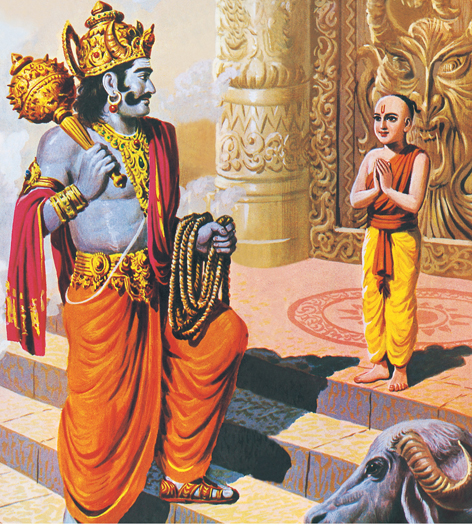
The main teaching of the Kaṭha Upaniṣad is Death’s response to the request by a young seeker, Naciketas, for Self-knowledge. Any serious student of advaita will want to know the answer as this is our own question too: using logic we may well be able to arrive at what we are not, but we still need to know clearly what we are. For this reason this book by Smt. Sarojini Varadarajan, based on Swami Paramarthananda’s traditional unfoldment of the Upaniṣad and Śaṅkara’s commentary theron, is a valuable addition to any seeker’s library.

One way of approaching this Upaniṣad is to note that Naciketas standing at Death’s door (literally) remained steady-minded enough to press his request for Self-knowledge – in spite of Death’s initial resistance to answer. And, by the end of the Upaniṣad, after Death finally gave in to the young man’s request, Naciketas ‘became pure and immortal’. Is it really possible that we can also reach the same point by closely following the teaching that Naciketas hears, especially as we are living lives grounded in fear? Continue reading