Q.400 – Consciousness and the person

A few questions or clarifications please…

  1. As you’ve said to me before, to focus on this world and everything within it, is really the wrong focus, because it’s mithyA. And what we really are, is that in which all of it occurs?
  2. Am I correct in saying that Vedanta is truly a specific system or process to know who you really are as well as understanding the functioning of everything?
  3. So the elements or energy is not who we are since they are dependent on Consciousness. As Nisargadatta said, “without Consciousness nothing is”.
  4. To gain self-knowledge however, there must be a body with a nervous system. So the body does matter in relation to self-knowledge? But, consciousness doesn’t care whether it’s manifested or not?
  5. Words cause confusion, so what is the difference between Consciousness and Awareness from your understanding?
  6. The mind is discussed a lot, and many say that to have ‘no mind’ is the key to peace and freedom. Is the mind a part of the brain or something entirely different?
  7. Upon gaining self-knowledge, does the mind continue or fade away if you will, leaving the brain to function in its normal and natural way without the mind blocking it?

A (Dennis):

  1. You are not the body-mind; you are Consciousness. There is only Consciousness in reality; the ‘rest’ is just appearance and mistaken interpretation.
  2. Advaita is a teaching methodology to bring you to this realization.
  3. Elements, energy etc are only name and form of Consciousness.
  4. In reality, there is only Consciousness. From the perspective of the person, there is a body-mind. The realization that there is only Consciousness has to take place in the mind of the person in order for the person to realize that ‘All there is is Consciousness’.
  5. You can define words how you like. As long as you do this, there need not be any confusion. The way I use these terms is that Consciousness (capital ‘C’) is the reality (better called ‘Brahman’ to avoid confusion); and ‘awareness’ (capital or not) and ‘consciousness’ (small ‘c’) refer to the person’s perceiving/conceiving ability.
  6. The ‘person’ requires a mind in order to function in the world. This applies whether the person has Self-knowledge or not.
  7. It is likely (though not necessary) that the mind of someone with Self-knowledge will be less prone to disturbance by desire/fear etc.

Tattvabodha – Part 23

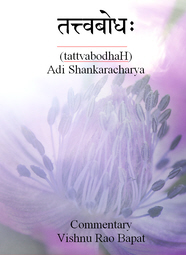
Part 23 of the commentary by Dr. VIshnu Bapat on Shankara’s Tattvabodha.This is a key work which introduces all of the key concepts of Advaita in a systematic manner.

The commentary is based upon those by several other authors, together with the audio lectures of Swami Paramarthananda. It includes word-by-word breakdown of the Sanskrit shloka-s so should be of interest to everyone, from complete beginners to advanced students.

Part 23 continues the enquiry into the statement ‘you are That’ (tat tvam asi) and looks at the meaning of ‘you’ and ‘That’.

There is a hyperlinked Contents List, which is updated as each new part is published.

Q.399 – Self-evident Atma

Q: I want to ask about the following quotation from your series on upadesha sAhasrI – part 19 (upadesha sAhasrI compiled by R. B. Athreya from the lectures of Swami Paramarthananda):

Atma, though a knower of everything, is not a known object, because, if Atma were to be a known object it will need another Atma to know, leading to what is known as infinite regress (anavasta dosham)Atma cannot be known by itself, because, to be known by itself, it has to become both the subject and the object, which is not possible as one and the same entity cannot function as subject and object simultaneously.

We cannot also say that one part of Atma can be known by another part, as Atma is by definition partless.  Thus, Atma is ever the knower but not known by others or by itself. 

As Atma is self-evident, its existence needs no proof.  That I am conscious is evident to me.  The very search for proof is possible because of my being conscious.  Thus, Atma is revealed as self-evident Witness Consciousness which illumines everything and which cannot be objectified by anything.  This Atma is my real nature.  All the known attributes belong to the known objects and cannot belong to the knower, Atma (consciousness).” Continue reading

Q.396 – Atman cannot be known

Q: Swami Paramarthananda makes the following comments in his talks on upadeSha sAhasrI:

Atma, though a knower of everything, is not a known object, because, if Atma were to be a known object it will need another Atma to know, leading to what is known as infinite regress (anavasta dosham).  Atma cannot be known by itself, because, to be known by itself, it has to become both the subject and the object, which is not possible as one and the same entity cannot function as subject and object simultaneously.

We cannot also say that one part of Atma can be known by another part, as Atma is by definition partless.  Thus, Atma is ever the knower but not known by others or by itself. 

No Proof Needed

As Atma is self-evident, its existence needs no proof.  That I am conscious is evident to me.  The very search for proof is possible because of my being conscious.  Thus, Atma is revealed as self-evident Witness Consciousness which illumines everything and which cannot be objectified by anything.  This Atma is my real nature.  All the known attributes belong to the known objects and cannot belong to the knower, Atma (consciousness). Continue reading

It was seen (by no one)

“One early morning in October upon awaking from slumber, there arose a sensation of the sense of self being gone. It was seen that there was literally no one there and that all movement was happening spontaneously without central control.”  Nancy Dolen, interviewed by Jerry Katz.


Why the Neo-Advaitin is not an Advaitin at all

Recently, I asked the question: “Who or what is it that acts?” And it led me to think that this is a question that many modern teachers need to ask themselves. The above quotation immediately triggered my antipathy (my apologies, Nancy, nothing personal!) In fact, one could pick up virtually any book by modern neo-advaita teachers and find a similar statement. Here are a few:

What sees through it? There is simply seeing – there is no-thing, no one that sees.” (Nathan Gill – already awake)

For this body-mind, when liberation was seen, any sense of localization ended for a while. Awareness was seen to be everywhere. The room in which standing was happening, the street in which there was walking, the bodies and lamp posts and benches and space that were appearing, were not differentiated in the belonging from this arm, this thinking process, this seeing, these feet walking the pavement.” (Richard Sylvester – I Hope You Die Soon) Continue reading

Q.395 – Person vs Consciousness

Just to keep alive the thoughts on eka Jiva vAda…

Q: If we are just a ‘Stream of Consciousness’, how is it possible to introspect and know Reality? It is akin to the dreamer knowing that he is dreaming while still being in the dream. Also, the SOC’s suffering is really Brahman’s sufferring as Brahman alone exists. So is the SOC doing Brahman a favour by realizing the “Reality”? That doesn’t sound right!

A (Dennis): What do you (think you) mean when you say ‘I am a Stream of Consciousness’? In reality, there is only brahman (or Consciousness if you prefer). So it is correct to say ‘who-I-really-am is Consciousness’. But, if you are saying such things as ‘I know’, ‘I introspect’, ‘I dream’ etc, then you are speaking of the person. This is the level of the seeming world – vyavahAra. In reality (paramArtha), there is no world, no persons. I, the person, may suffer but  brahman does not suffer.

Q: My terminology is wrong but I meant ‘the thread of consciousness within Brahman’ which seems to be creating this impression of a ‘Creation’. This thread is running within Brahman and there are feelings of suffering. Since nothing exists but Brahman, Brahman is the sufferer through this thread. Suffering need not be physical it could be just psychological or some other means of pain.

A: There is no separate thing inside or outside of brahman; there is only brahman. The concepts that you are using are only of value to the extent that they help you to realize that truth. If they are not helping, discard them!

Pantheism, agnosticism/atheism — and Advaita Vedanta

How would you define your sense of pantheism?   www.quora.com/How-would-you-define-your-sense-of-pantheism/answer/Brad-Neil

Brad Neil, proponent of nonduality

I have devised this classification for reference: Modes of pantheism

(Divine pantheism; Natural pantheism; Spiritual pantheism; scientific pantheism)

Modes of pantheism

Within the range of categories given, I find myself somewhat ambivalent:

  • I most closely align with natural I believe the physical universe is all that there is, and that there are eternal forces and energies at play. I do not believe in the supernatural.
  • Scientific pantheism is least applicable to me because I really don’t have a problem being labeled an atheist. In my opinion, atheism and pantheism are almost (but not quite) two sides of a coin.
  • But when I’m feeling in my best of moods, I think I fall under spiritual or divine When my mood is high, I sometimes experience an awe and a gratitude that gives me a deeper feeling of connection to existence.

More generally, self-labels that I do not find objectionable include pantheist, nondualist, agnostic, atheist, and skeptic. However, I have none of these words tattooed on my forehead, and I reserve the right to change my thinking at any time. Continue reading

The Simulation Hypothesis

digital-universe Wow! Wow!!

I have no words to describe.

A sheer Joy of 50 minutes. I was sitting glued to the seat. It’s almost like a Meditation where a ‘you’ dissolves untraceably and seamlessly into each pixel appearing on the screen.

All the super Stars of Physics, both of the past and current times, and their theories are discussed in simple understandable terms. The scientific evidence thus far available points to the inevitable inference that the perceived world is no more than a dream-like virtual reality, with no solidity or physicality to it. Nor do the space and time have true existence. Every object and every event in the universe is equidistant from the One Consciousness that is crafting the projection.   Continue reading

Continuing Reflections (on reflections)

reflections

Back in April I wrote an article which looked into the concept of chidAbhAsahttps://www.advaita-vision.org/chidabhasa/. This is the idea that the ‘notion of I’ is a reflection, in the mind, of the non-dual consciousness. The theory is called pratibimba vAda in advaita. It says that there is only one ‘real’, pAramArthika or witnessing Consciousness, although there are many jIva-s; one ‘original’ (bimba) and many ‘reflections’ (pratibimba-s).

But of course, reality is non-dual, so it makes no sense to talk of a ‘Consciousness’ and a ‘reflected Consciousness’! So how do we explain this? In order for there to be a reflection, there have to be two things: an original thing, and some medium in which a reflection can take place. This is obvious in the case of the mirror. We cannot see our face in order to be able to shave or apply make up by looking into empty space. We cannot even do it by looking at a blank wall. There has to be a mirror or some reflecting medium which can serve as a mirror. Here, we seem to be saying that there is Consciousness and a reflecting medium – the mind. But of course if we have these two things, then we’re talking about dvaita not advaita.

Shankara’s Advaita introduces the concept of mAyA to provide a sort-of explanation for the world-appearance but the dvaitin may argue that, pedantically, brahman and mAyA are still two things. Only if we can explain everything in terms of paramArtha alone, he might say, can we establish non-duality. Of course, we can be pedantic too – you cannot explain anything in paramArtha, only in vyavahAra! But we acknowledge that mAyA is mithyA. In reality, there are no jIva-s, no world, no reflections. So, the bottom line is that reality is non-dual, so that we do not really have to justify the theory at all! Continue reading

Q. 393 – Idealism or Realism?

Q:       Advaita often uses certain language and metaphors, and these can often come across as sort of a “subjective idealism plus”. Where subjective idealism argues that the “outside world” is a completely nonexistent illusion produced in a mind, Advaita sometimes seems to say yes, that’s true – only, behind that mind that imagines the world is consciousness witnessing the mind, which is “projected” onto consciousness by the mysterious maya. In other words, Berkeley was right, only he didn’t go far enough. This leaves Advaita sounding like total solipsism, blended with hardline idealism. Consciousness, some sort of unimaginable void incapable of anything, is having a mind and a world “imagined” onto it by maya, which despite the incapability of consciousness to do anything is still a “power” of that consciousness. (Of course, this is very much a conceptualization, taking these metaphors too literally and looking at these terms and concepts through a very Westernized lens. But this is often the way some teachings sound!)

      But in addition to the talk of all things being total illusion, I will also hear that Advaita is realist – that the universe is not a hallucination; that it is, in one sense, “actually there”; and that it is in comparison to the changeless paramarthika viewpoint that vyavahara is “unreal”. This position makes much more sense to me than imagining the universe to be some sort of magic trick.

      Now, I recognize that these explanations – both of them – are attempts to “point” at truth, and not a tidy description of truth itself. Ultimately, there is only brahman; there are no “illusory things” and no “real things”. But I’m far from truly grasping that yet, so I suppose my question is: which of these descriptions more accurately reflects the nature and relation of vyavahara and paramartha? Or are both illustrations only as useful as what they can communicate to a student? Or am I just getting way too caught up in concepts here? Continue reading