Mithya, Mythology, and Metaphysics – an exchange

(Under part 4 of my ‘Review of article on Shankara’ 9 ‘thoughts’ or
comments were made, the last one on May 8th, 2013. Following that,
Peter and I continued our dialogue, which took us in different
directions, resulting in a 12 page thread. We both thought that our discussion might merit publication in AV. Quite sadly, Peter passed away one week after he wrote his last reply within our exchange. This is the first part, to be followed sequentially).


Martin (M) – How interesting that myths (different from ‘mithya’) give rise to different interpretations, perhaps mostly due to one’s cultural background and held views on life, etc. When you say ‘literal’, in this context, I understand something like an interesting story, mostly for children; but if myths say something about man’s life, his struggles, aspirations, etc., how can they be just nice, imaginative stories? (‘literal’ x2 is for those who believe – in the recounting of The Garden of Paradise – that that is how it actually happened; I don’t count you among them, of course).

 About your points (Peter’s (P):

  1. Right, not unity, but union (Creator/creature, lover/beloved, etc.); therefore bhakti, with its bond of love and surrender on the part of the creature – which can lead to a state of unity (advaita) once Knowlege or realization has dawn. No?
  1. a) “with us” is not plural; it is first person singular when the subject is God, a king, or someone in authority speaking for the law or from a chair of authority, which is impersonal. If you have the KJ version of the Bible, it reads: “man is become as one of us, to know good and evil” Gen., 3, 22.

      b) P: “Before Adam was ‘one with’ God, (i.e. before he knew right from wrong), what was he?” My (M) answer: ‘one of us’ sounds rather sarcastic, No? Yes, man knew duality by his ‘individualistic’ act, but was not like God; this cannot be the meaning of the Hebrew Bible (Old Testament). With the New Testament, things are no longer oppressive, based on fear and ‘the law’: Jesus brings liberation through knowledge, love, and compassion, and man is seen as theomorphic (capable of assuming his divinity in Oneness). cf.  St. John’s Gospel and the Gnostic Gospel of Thomas.

  1. a) M: The serpent “presaging Jesus”? At one time Jesus said: “you must be wise as serpents”, meaning to discriminate between acts (and people), but, other than that, the serpent is ‘the Tempter’ and the representation of evil (egotism?), and henceforth there will be enmity between it and mankind (“it  shall bruise thy head, and thou shalt bruise his heel” (Gen., 3,15).

        b) P: “what’s wrong with having the knowledge of right and wrong?”.

M: ‘Seeing’ duality everywhere*, precisely – the pairs of opposites – and thus becoming judgmental and stuck in that limited, constricted vision, the consequence being the loss of Paradise in union with God. “You will be like gods” was the promise of the serpent. Duality (plurality) pertains to the dimension of God or Ishvara (‘I’ and ‘other’, heavens, hells, etc.). Right and wrong belong to thinking (vritti/s), as you well know, and it can be a problem unless you just observe it as such (i.e., an object for Consciousness). Did the couple know that they were immortal? I don’t know, and probably they did not know either. Continue reading

Q. 346 – brahman, Ishvara and mAyA

Q: I am not clear about the relationship between Brahman, Maya and Ishwara. Maya is said to be inherent in Brahman. Like Brahman, it is ever existent. Ishwara is said to be a product of Brahman and Maya. However, while the universe is governed by Maya, Maya does not govern Ishwara. Ishwara governs Maya although he is a product of Maya. This is confusing.

 Secondly, did Shankara deviate from the teachings of Upanishads? The invocatory verse in Ishopanishad, Purnam idam, Purnam adaha, Puranat, Purnam utpadyate seems  to indicate that this world is born out of that Brahaman. Shankara does not seem to agree with this view. According to him, the imperfect limited world cannot emerge from unlimited, perfect Brahman and the world is only an illusion created by Maya. What is the correct position? Continue reading

Eka jIva VAda – I Am Alone: Part VI

Part – V

Understanding Perception:

We don’t ever see or experience a ‘world.’

Our capacity to detect anything  is confined to a limited bandwidth of certain characteristics (in a so-called world) using our sensory organs:

                       Eyes      →   light, colors, shapes, distances, sizes

                       Ears         sounds, distance

                       Skin       →  heat, pressure, itch, softness, roughness

                       Nose      →  smells

                       Tongue   →  taste

                       Mind (?)   time, imagining (thinking)

[Note: 1. The normally held view about our senses as given above is valid only in a broad way.  Modern scientific research shows that quite a bit of collaborative overlap exists in their actual functioning.  For example, eyes and skin also have a role in hearing;  nose and ears (and even lungs) assist the tongue in tasting etc. Embodiment takes place from multi-sensory input.

2.  Notice that we are not endowed with any sensory organ to detect ‘time.’]

Continue reading

Invisible Energy In Empty Space

The Universe is overwhelmingly empty!

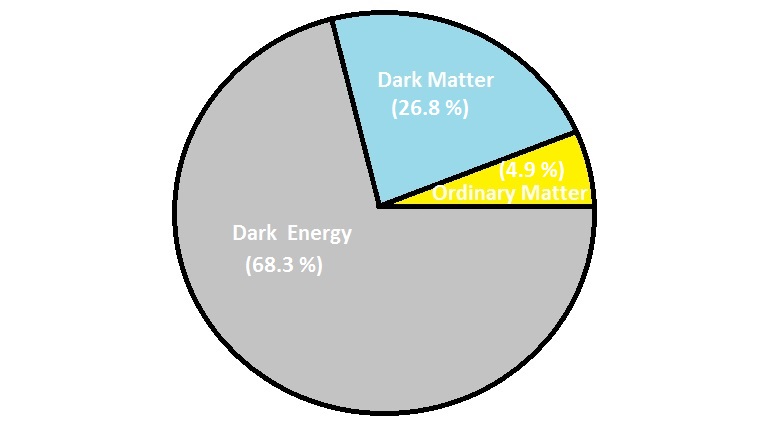
Up in the heavens, galaxies are interspersed by huge empty spaces. Matter constitutes less than one percent of the universe – about one atom in ten cubic meters of space.  structure of the universe (Planck 2013)Within an atom too, there is more empty space than substance.  If the atom is magnified to the size of a football stadium, matter (nucleus) in it will be no bigger than a golf ball, the remaining space being just emptiness.  However, many ancient Indian scriptures hold that there is energy aplenty in space.  Physicists unhesitatingly agree.  Evidence for energy in empty space comes both from Cosmology that deals with the astronomical objects of huge proportions and Quantum Physics which studies atomic- and subatomic-sized particles.

Continue reading

The Weird World Of Small Things

You are certain of your toothbrush being in the  bathroom when you walk in there after a good night’s sleep.  You have no doubt, the water comes to a boil in two minutes in the microwave for the delicious morning cuppa.  You are pretty sure how long it takes you to drive to the office.  That is all true. But the particles that constitute you or your toothbrush are not  predictable with that sort of certitude where they will be at any given time or when they appear at a given place!

Quantum Physics studies how the tiny particles like electrons, protons and atoms that constitute everything behave. Quantum Physics sobers us down quite a bit when it is a question of being sure of things.  It teaches us not to be so definite and deterministic.  It comes out with mind-bending mathematics and unbelievable concepts almost bordering Vedanta.  Dr. Niels Bohr, a giant among Quantum Physicists, famously said: “Anyone who is not shocked (by the concepts of Quantum Physics) has not understood it.”

For all that, Quantum Physics is not an esoteric theory. It comes with redoubtable experimental back up and unfailing proof.  Continue reading

We are all an entangled web

Quantum Physics is the science of small particles. The strange and counter-intuitive phenomena it predicts often leave us stunned. It says that if two particles were together once, they never lose their connectedness even after they get separated.  Each particle readjusts itself in response to any change in the state of its counterpart which might even  be several millions of miles away.  The readjustment is instantaneous and happens without any sort of messaging link between them.  So if you met Dr. Singh once, you can never escape from getting affected by what happens to him, even if you run away to another galaxy!

Unconvincing?  Do not blame yourself. Continue reading

Reality ‘Out There’ And Quantum Physics

 “Hello!”

Hello!”

“Is Dr. Singh there?”

Sure, he is.”

“Is he not in New York?”

Certainly not.”

Not in London either?”

No, he is definitely here in Delhi.”

“Is he sleeping?”

What?! …….  Sleeping? …….  No, he is in his office and very much awake.”

Dr. Singh’s Assistant, though a bit bewildered, sounded very confident in his replies. But I remained unconvinced.

If the probability of Dr. Singh being in New York is zero, and his being present in Delhi is one hundred percent, there must be some probability of his being in London in-between!  Further, his Assistant asserts that Dr. Singh is awake. How does he know Singh’s state so definitely without actually seeing him?  Don’t think that I lost my wits or I am an over the top Vedantin.

Continue reading

Tat Pada Vicāra – 1 – Sṛṣṭi – Creation

CreationIn the previous article, I had said that īśvara and jīva have to be understood in their entirety in order for us to understand the mahāvākya, tat tvaṁ asi. Over the next few articles, we will attempt to have a fuller understanding of who īśvara really is.

The most important understanding of īśvara is his dimension of being the abhinna nimmitta upādāna jagat kāraṇam. Its means the one who is the non-different intelligent and material cause of the jagat. Continue reading

Eka jIva VAda – I Am Alone: Part V

Part – IV

This Post responds to the Comments of 18th April made by Suka.

(Suka’s Comment in blue and my response in black).

S:  Mithya is defined as sadasadbhyām vilakṣaṇam – meaning it cannot be categorically classified as truth or false. Mithya is vyāvahārika, experientially efficient, substantially unreal. 

R:   vyAvahArika and prAtibhAsika fall under mithya.  Both vyAvahArika and prAtibhAsika are experienced in their respective spheres, and both derive their reality based on the Reality of the immutable substratum. Dr. Mani Dravid Shastri also suggests in his lectures on adhyAsabhAshya that, “mithya can be divided into two categories, namely vyAvahArika or empirical and prAtibhAsika or illusory.”

S:  The argument tat pot is an illusion does not hold water, because pot does hold water.

R:  “Holding water” too is as much an illusion as pot or water!!

Continue reading