Nisargadatta terminology

A frequent contributor to the site, Vijay Pargaonkar has provided the following valuable information rearding the terminology of Nisargadatta Maharaj:

When references to Nisargadatta Maharaj and his teachings come up at the AV forum during discussions, the arguments often seem to become tangential. I think this is mainly due to the differences in terminologies and definitions used by the followers of Nisragadatta and the ones used in traditional Advaita forums.

Last week I came across a rare Satsang tape in Marathi where Maharaj clearly lays out his version of the Creation Model and Prakriyas while explaining various Advaita terms according to his definitions. I have excerpts of this Satsang translation (as I heard and understood) below, where I have indicated the Sanskrit/Marathi terms along with the English terms used by the translator – the translator has actually chopped the live recording and inserted his English translation in between.

Creation Model

Prior to your waking is Nirguna, the substratum of Waking. The Nirguna is not at all bothered by this samara (samara = ‘war (of life)’). In Nirguna appeared knowledge (Bodha).  This is pure Consciousness or Beingness or the Sense “I am” that has no shape or form. In this pure Consciousness there appeared a slight perturbation or movement and the pure Consciousness then grabbed a body-form (deharupa). After wearing this body form it started calling itself a man or woman while bound by different concepts (I am this; I am that; I am going; I am coming etc.). These concepts are all imaginary (Kalpana) and not real. Continue reading

Serialization of Yogavasishta 4

yogavasishta3

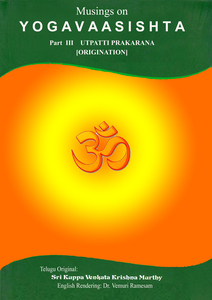
Professor Sri Kuppa Venkata Krishna Murthy, Chairman and Managing Trustee of I-SERVE, the Institute of Scientific Research on Vedas, has kindly given permission for Advaita Vision to serialize his 6-volume ‘Musings on Yogavasishta’. Written in Telugu, the work has been painstakingly translated by our Dr. Ramesam Vemuri and published by Avadhoota Datta Peetham.

Rather than reproducing successive extracts from the books each month, as has been done with our other two serializations, the books themselves will be made available for download in PDF format. Each part will be associated with a page at the main website, which will contain a Contents List for that volume. Links to all of the volumes will be provided on a general Contents Page.

The fourth part to be published is Part 3 (ORIGINATION). (We began with Part 7 of the Series as it provides an overall summary of the Non-dual teaching and is a better introduction than simply jumping in at Part 1.) As Ramesam puts it: “The main thrust of the teaching by Sage Vasishta is that the visible world has no real origination. He establishes that the space-time-causation of the phenomenal world is illusory and arises out of pure mentation.” A timely coincidence with Charles’ series on Kant, where he notes that “Kant’s position, therefore, translated to Advaita terms, is that space and time are only valid in the context of transactional (vyAvahArika) reality, and therefore not truly Real (pAramArthika).”

Please go to the Contents Page to read the Announcement and general introduction from Ramesam. The page for this Third Volume, Part 3 (ORIGINATION) also contains the download link for the PDF file (0.9MB).

Creation According to Reason

small_A-U-MAlthough not scheduled for publication until the 25th of this month, both Amazon UK and Amazon US claim to have only a few copies left! So, to remind you of the sort of content you can expect, here is another extract from the book on the topic of ‘Creation according to Reason’.

Having spent some time showing how key passages from the scriptures claim that there is no creation (and explaining how there can be apparently contradictory passages elesewhere), Gaudapada turns to reason – his principal tool in this work.

Read the extract here.

Q. 374 – Ramesh

Here is a question and answer from several years ago, which addresses a topic that I avoided getting involved with publically at the time.

Q: I recently bought a book called “Final Truth” by Ramesh Balsekar. I read the book and now see it as one of the most “deep” and “philosophical” books on Advaita. But then I read Balsekar had some sex scandals and preached “do whatever you want you are not responsible” philosophy and I`m shocked. Anyway…

I saw an idea in the book and it resonated with me so much. In my opinion, It even explains (for some level) why there is Maya or why the appearances exists or why there is “creation” in the first place. (or Why there seems to be creation) The idea is this: The formless Consciousness can be experienced only through the multitude of sentient bodies with names and forms, just as light can be seen only through refracting agents. It is thus not that the multitude of names and forms exist independently of Consciousness but that Consciousness can express itself only through these forms.
 
So the other way of saying is the God or the Brahman or the Consciousness experiences himself through us. We and the universe are God looking into himself.
 
 Brihadarnyaka 2.5.19 has this verse
 
“He transformed Himself in accordance with each form; that form of His was for the sake of making Him known. The Lord on account of Maya (notions superimposed by ignorance) is perceived as manifold, for to Him are yoked ten organs, nay, hundreds of them. He is the organs; He is ten and thousands – many and infinite. That Brahman is without prior or posterior, without interior or exterior. This self, the perceiver of everything, is Brahman. This is the teaching.”
 
What do you think?  I  wanted to know if traditional Advaita accepts that idea or not.

A: As it seems with most questions I get these days, this one also revolves around the reality-appearance, paramArtha-vyavahAra question.

Who-you-really-are does not act, so cannot be ‘responsible’ in the sense that you mean here. The person, on the other hand, does act and is responsible, and gets puNya-papa as a result of those actions. It is especially the responsibility of the realized person to act in accordance with dharma – the awareness of right and wrong – since he is setting an example to others. However it is also possible that, because of insufficient prior mental preparation, an enlightened person is still attached to desires and fears. Even knowing that he is perfect and unlimited, he could still act in accordance with these feelings, which are called pratibandha-s (obstacles or impediments). These will go in time, with further nididhyAsana.

It has to be assumed that this was the position regarding Ramesh, as far as the ‘scandals’ are concerned. However, if it was the case that he was actually preaching “do whatever you want you are not responsible”, as you say, then this is not a clear presentation of the truth of the situation and should be condemned.

Regarding your second point about the ‘purpose’ for the seeming creation, this does not hold water either. There can be no meaningful attribution of purpose at all. Purpose implies some sort of deficiency in brahman, which is a contradiction. Experience of any sort is a limitation, so cannot be applied to brahman. Best just to think of everything as name and form, including the ignorance and the experience; the experienced and the experiencer. But, as an imaginative way of thinking about it, God looking into himself is fine, as long as you don’t take it literally.

Creation means manifestation

The words, ’cause’ and ‘effect’ are only from a point of view. You say that this is the effect and that is the cause. In fact, the effect itself is the cause, being non-separate from the cause. Then again, which is cause and which is effect? When the pot is broken, it becomes clay. That means clay came from pot! This concept of cause and effect is purely a point of view. Our understanding that the cause came first and the effect came later is only a point of view. From the standpoint of Brahman, there is nothing that comes later, because Brahman itself is the effect. If at all the concept of ’cause’ and ‘effect’ is talked about, it is from the standpoint of the unmanifest and manifest conditions.

The unmanifest becomes manifest – that is called creation. Creation itself is not a proper word for us, because the word ‘creation’ is relevant only when something did not exist before, and later came into being. But it is not like that. That which is in an unmanifest, undifferentiated form, comes to be differentiated. One is in a subtle form, the other in a gross form. In a differentiated form it is called creation. In an undifferentiated form it is called dissolution. This creation is cyclic. The creation becomes unmanifest because it was manifest before. Unless it was manifest before, it cannot become unmanifest. We cannot talk about any sequence here.

 Mundakopanishad (Two Volumes), Swami Dayananda, Arsha Vidya Center Research.
ISBN: 8190363638.
Review Link

Creation according to Vasishtha

P1000932asa~NkalpajAlakalanaiva jagatsamagraM

sa~Nkalpameva nanu viddhi vilAsacetyaM
sankalpamAtramalam utsRRijya nirvikalpa

mAshritya nishcayam avApnuhi rArna shAntiM (39)


VASISTHA continued:

To illustrate this there is an interesting legend. Kindly listen to it,

A young boy asked his nanny to tell him a story, and the nanny told him the
following story to which the boy listened with great attention:

Once upon a time in a city which did not exist, there were three princes who
were brave and happy. Of them two were unborn and the third had not been conceived. Unfortunately all their relatives died. The princes left their native city to
go elsewhere. Very soon, unable to bear the heat of the sun, they fell into a swoon.
Their feet were burnt by hot sand. The tips of grass pierced them. They reached
the shade of three trees, of which two did not exist and the third had not even been
planted. After resting there for some time and eating the fruits of those trees, they
proceeded further. Continue reading

Topic of the Month – Creation

P1020897_tripled-1

Creation

The ‘original’ topic for discussion! Lots of potential material here. I have a number of interesting extracts to post, as soon as I can get around to scanning them in.

Meanwhile here are a couple of my favorite quotes, which I used in ‘Book of One’:

In the beginning the Universe was created. This has made a lot of people very angry and is widely regarded as a bad move. Douglas Adams

In the beginning there was nothing and God said ‘Let there be light’, and there was still nothing but everybody could see it. Dave Thomas (This one especially for budding Buddhists)

Review of article on Shankara by Ramakrisnan Balasubramanian

(This is a slightly modified article published here one year ago, which was improperly and incompletely posted. Ramesam had asked me to review the following article, with which I complied after much hesitation. The article is over 40 p. long and quite dense and complicated in parts – in other words, ‘academic’: for specialists only; one could add: cutting the slices so thin, that the substance is practically lost, or forgotten).

Review of ‘A New Approach to Understanding Advaita as Taught by ´Sa ˙ nkara Bhagavadp¯ada’ – by Ramakrishnan Balasubrahmanian. Continue reading

Some Thoughts And Questions On ‘mokSha for all’

Our last ‘Thoughts and Questions’ proved so popular that we are offering a new topic for your consideration:

I received an interesting Question that touches on several aspects of creation and liberation for ‘everyone’. I posted the question at Advaitin discussion group because of my doubt about its value in gaining Self-Knowledge which is after all the one that matters for us here. The question is this:

“Is there any teaching anywhere in the scriptures regarding the enlightenment and ‘freeing’ of all jIva-s? What the questioner is getting at is: will the cycle of sRRiShTi – sthiti – laya ever come to an end, namely when there are no more jIva-s left to be enlightened? Or even: if this does occur at some point, will the process start all over again with a new set of jIva-s? If not, what happens then?”

My initial apprehension was that any ‘answer’ is clearly going to be in the same category as the various creation myths that we can find scattered about in the scriptures. However, a lively discussion ensued that eventually led to eka jIva vAda, a powerful but contentious theory that describes liberation of the jIva and the simultaneous end of creation.

I give below some of the salient points that have come up in those discussions: Continue reading

Mithya, Mythology, and Metaphysics – an exchange, ll

13.5.2013

“All that now exists will die” (The goddess Erda, in Wagner’s opera Das Rheingold, 4th scene)

M: P, I have to commend you for the exacting work and research you have done on The Terrestrial Garden in such a short time. I am in substantial agreement, as you will see, with much of what you are saying, but take some exception with respect of part of the methodology (parallelisms mostly, rather than contrasts) you use, which has consequences to me either excessive or unwarranted. Also, agree that it is  “pointless to look for the single Truth in this story”. I start with some observations in the way of contrasts (rather than parallelisms or analogies): ‘unlike’, rather than ‘like’, realizing that I am not actually discovering anything new to you.
1. Mythology vs. Mithya

2. Monotheist exoterism (Moses, Old Testament) vs. Esoterism (Jesus,
New Testament)

3. Right and wrong (ethics & morality; or ‘moralism’) vs. sat-asat
(metaphysics or spiritual science)

4. (Christian) God vs. (Hindu) Ishvara

5.  a) Knowledge, empirical, religious, philosophical (‘categorial’) vs.
KNOWLEDGE (reality, realization)

5b) doctrine (theory) vs. method (practice)

1. We could consider, I think, The Garden of Eden, or Terrestrial
Garden, as a myth, like that of Prometheus, or the deeds of heroes –
as much in the East as in the West (puranas, sastras, sagas). They are
illustrative, imaginative stories applicable to man and society (or
collectivities). Not so mithya, which belongs to the spiritual or
metaphysical science of the Indian tradition exclusively, as you know
(that is, esoteric or sapiential: jñana). They (myth and mithya) are
quite different; though there is an overlap in the way we can make use
of them in order to bring out a deeper understanding of something
which may only be implicit in them. I think this is what phenomenological
analysis consists of (briefly, ‘the contents of consciousness’ – to be
elicited). Also, myth and mithya are in the same relationship as pratibhasika and vyavaharika – the first of each pair being merely illusory, subjective, imaginary. Continue reading