Logical enquiry into ‘Who I am’ (3/4)

Who I am 3When we analysed the world of objects in the waking state we came to the understanding that our experience of the variety of objects is due to the variety of corresponding mental impressions (covered in Part 2 of this series). If there isn’t a mental impression ‘this is a pot’ then, despite fully-functioning senses, the pot will be as good as non-existent. The perception of ‘is-ness’ is the single, unchanging common thread in all our worldly experiences. This perception is given the name, ‘consciousness’.

When we analysed our dream state experience we realised that the same observation holds true for the dream universe as for the universe we encounter when awake. This experience gives an added dimension to our understanding of consciousness: not only is it the one, unchanging basis of the varied, changing objects (gross and subtle), but now we see that it is also continuous through the changing states of experience. The ‘I’ that is awake is the same ‘I’ that dreamt: ‘I am awake, I had a dream’. Continue reading

Logical enquiry into ‘Who I am’ (2/4)

who am I 2In the first part of this enquiry we saw how, by discriminating between the seer and what’s seen, we arrive at the understanding that ‘I’, the seer, am not the body, not the sense powers, not the thinking faculty, not even a combination of all of them. They are all objects of my perception and I am the perceiving subject. And I, the subject, cannot be what I can perceive as an object. In this logical way we arrived, step-by-step, at a final ‘knower’, which is given the name ‘pure consciousness’. This pure consciousness is what remains after thoughts, (which are the subtlest objects of perception), have been dismissed as the ultimate ‘I’. We know there’s something there but it is still a bit hazy. We now need to test the robustness of our new working conclusion that this ‘pure consciousness’ is the ‘I’ we are searching for and sharpen the understanding.

For this we need to understand the nature of consciousness and its relationship, if any, with ‘I’. A question might arise at this point: If ‘I’ is the pure consciousness that remains in the absence of vtti-s (thoughts), and no cognition is possible without vtti-s, then how can I ever know what I am? How do we go further with this enquiry if there are no thoughts? Continue reading

Experiencing Non-Duality

the striped blouse Edouard Vuillard 1895

Edouard Vuillard, The striped blouse 1895

Spiritual seekers who aim to go beyond duality often fancy that, at the end of the journey, they are going to experience reality altogether differently. That’s right and wrong at the same time.

Even before, there are many situations that allow us to experience non-duality, which is in and through everything. Reality being non-dual, it would be quite surprising if non-duality was untraceable up to the time of enlightenment. So even unenlightened mortals experience non-duality plenty of times throughout their day. Indeed we interpret the experience wrongly. What happens with enlightenment or awakening, is that this wrong interpretation, based on ignorance, is dropped. This means that all those possible non-dual experiences are recognised for what they essentially are: non-duality itself. Continue reading

Traditional Teaching and Deep Sleep – III. mAyA & Creation

Part – I              Part – II              Part – III

[The latter part of the article requires a bit of mathematical (or at least arithmetic) orientation in the reader. If you know the addition, 1 + 1, that is enough. Otherwise, it could prove slightly boring!]

We shall tackle now the question of how we wake up to be what (we think) we were before we went to bed.

I said in my previous argument that our waking up to a new morning and into an awake state is comparable to another cycle of creation.  So I suggest we examine how creation itself takes place.

From a scientific perspective, creation seems to be happening from ‘nothingness’ and dissolving back into nothing.  Vedantins prefer to call nothingness as ‘Beingness’ simply because even ‘nothingness’ has to ‘Be.’

If we go by what Quantum Physics tells us, what we may refer to as ‘nothingness’ is not just emptiness.  There is an enormous amount of energy in ‘Emptiness.’ Physicists have been able to measure this energy of empty space.

The energy within the empty space of the nucleus of an atom is the main reason for the weight of the nucleus (and hence of the matter we are all).  The energy of the emptiness within the intergalactic space is the reason for the expanding universe causing the colossal and mighty galaxies to recede from one another at speeds exceeding the speed of light. This vast energy is the result of constant creation and annihilation of virtual particles smaller than sub-atomic particles. Thus creation-dissolution is an ongoing unstoppable roiling and boiling process from emptiness to emptiness within emptiness!

Continue reading

Traditional Teaching and Deep Sleep – II. Dreams

[The topic of Dreams is something I have not originally planned to include here in this series which was primarily designed to address the issue of Upanishadic support for considering deep sleep itself as Liberation (moksha).]

Part I      Part – II            Part – III

Please allow me here to take a short digression to discuss dreams because of a few questions raised by our esteemed readers.

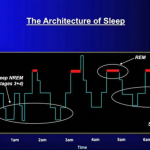
Secrets of Sleeping Brain - Architecture of Sleep - Prof. M Walker, 2009

Fig. 1. Sleep Hypnogram (After M. Walker, 2009) – Click on the figure for enlarged view.

First of all, I would like to correct the misconception that some of us have that the moment we hit the pillow and get lost in sleep, we just flow through one continuous phase of dreaming, then deep sleep and, lo  behold, we get up refreshed in the morning. So, to this extent, the sequence of Awake state (A), Dream state (U), and  Deep sleep (M) corresponding to AUM as presented by Mandukya  Upanishad is awfully way out. ***  The Upanishad says that these three states arise in an everlasting turIya which is compared to the ‘silence’ at the end of AUM. ***  Several experimental studies carried out over a period of more than half a century demonstrate that the architecture of our sleep pattern is vastly different as experienced by us every night. A typical hypnogram (the nightly sleep cycle) we go through each night is shown in Fig. 1. (Please click on the figure for an enlarged view).

Continue reading

Traditional Teaching and Deep Sleep – I

Part – I        Part – II          Part – III 

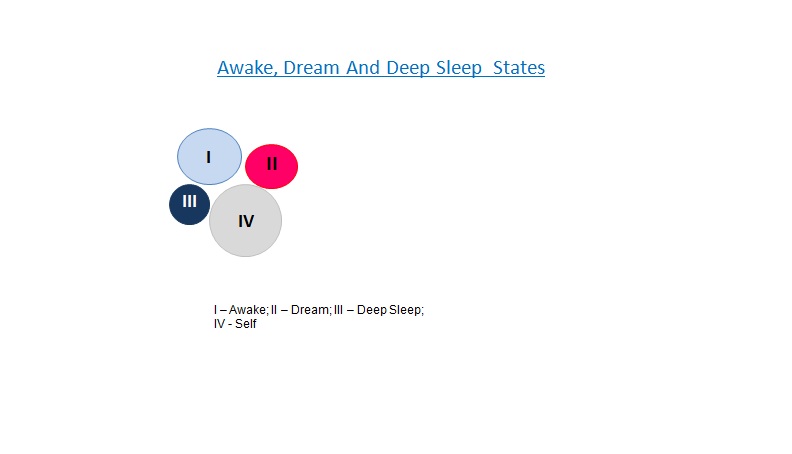
In my Talk on “Inquiry in Science and Vedanta “, the slides numbered 50 and 51 are about  the three states of  consciousness — Awake, Dream and Deep Sleep. (The full PowerPoint Presentation can be viewed at : http://beyond-advaita.blogspot.in/ ). The three worlds are represented by the three distinct circles I, II and III and a ‘Me’ is shown by the circle IV in the Slide 50 (Fig. 1 below). In our normal understanding, we think that “I am a separate ‘self’ (individual) and I pass through three distinct worlds viz. the Wakeful world, the Dream world and the Deep Sleep world.” We also take that the worlds to be external to ‘me.’

Fig 1: The Normal Worldview – an individual “I” (IV) passes through three distinct worlds (I, II, III) that are external to ‘me’ during a day of 24 hrs.

Continue reading

Non-dual Reality – Q. 328

Q: Can one ever KNOW that reality is non-dual?

A (Ramesam):

(i)   YES, The moment you can grasp tight your reflection in the mirror!!! 
(ii)  No, you cannot know it like you know the salary you get.

(iii) Yes, you cannot ever NOT know it; what all IS, is your perception alone.
(iv)  No, if you place yourself aloof trying to know it as a distant object.

(v)  Yes, you know It in your deep sleep.
(vi)  No, if you want to measure and compare to duality. Continue reading

brahman and AkAsha – Q. 326

Q: My mind has this tendency of creating doubts every once in a while and I was able to find answers for every doubt I’ve had through contemplation, logic and reasoning. But not this one.

Before I begin, please understand that my mind simply will not accept anything that cannot be proven to it through logic and reasoning, which is why ‘Sruti says so’ has not satisfied my mind.

So, my question is, how can we say that Brahman is the cause of Akasha (I’m referring to the Vedic element which is the substratum of everything that exists) and not Akasha itself? How do we know that consciousness itself is simply not the Akasha our bodies are made of which happens to be a conscious entity?

I understand that reality is non-dual, but Akasha being omnipresent (basis of all things), omnipotent (since it is Akasha that takes all forms, it can be said to be the cause of everything), omniscient (if we cannot deduce that Akasha is an unconscious entity, it would become omniscient), infinite, eternal and able to take forms without changing its own nature makes it no different from what is described as Brahman. Continue reading

Enjoying Being Brahman – Q. 324

Q1: When I was in the constant of awareness that I was Brahman I used to enjoy the Thoughts that all indeed was Brahman. Since I progressed to the simply I AM I am not enjoying the earlier feelings of thinking everything as Brahman. Is it that the state of being in simply I AM is absolute absence of any thought whatsoever? 

 Q2: How to overcome the sleep state to be in constant awareness of Who am I? Please some practical hints!

 Regarding my second point I intended to know more about the Fourth State in which the Saints wait to consume all their Prarabdha. How is this state practised and what are the skills of it?

Please shed some light on how do the realised but unpractised people live in their day to life while all the time immersed in their truest identity. My readings tell me just to let things happen without least botheration how they happen. Is it this way?

A (Peter): These questions make a strong case for why seeking proper guidance in this work is vital. Vedānta isn’t something that anyone can just pick up from a book, any more than anyone can dive straight into advanced mathematics from a book. If one doesn’t have a basic concept of numbers and the ways they combine through addition, multiplication, subtraction and division then how could one cope with the more esoteric realms of the subject? And compared to the science of self-knowledge, which is subtler than the subtlest, higher maths is crude. Self-knowledge needs appropriate prep work before the books make sense. Continue reading