Meaning of anubhava

The Sanskrit term that is interpreted by many modern teachers as ‘experience’ is anubhava. And indeed ‘experience’ is one of the translations given by Monier-Williams, along with the expansion “knowledge gained from personal observation or experiment”. (Ref. 179) But words such as ‘understanding’ and ‘apprehension’ are also given and these are much closer to the intended meaning.

Continue reading

Q.537 Need for a Guru

A: It is highly desirable to have a qualified, traditional guru. There do not seem to be many of these around today and it is unlikely that you happen to have one conveniently close by! Consequently, the best you can do is to read books that reliably present material in the traditional manner (unfolding scriptural texts and Shankara commentaries) and listen to recorded talks from similarly reliable sources.

Continue reading

What is Truth or Reality?

Neti, neti.

Reality is ‘everything there is, all in a bundle’ (a tentative definition) – inner, outer, manifest and unmanifested, known and unknown, thought of and imagined. Reality is not a bundle of separate truths, though, since ‘everything’ is interconnected in mutual dependency. Reality is indefinable; ungraspable by the mind (it requires a silent mind and a ‘leap of faith’ – a constancy of purpose). ‘Those who think they know know not’ (Upanishads and common knowledge). Reality is subjective and objective at the same time (nay, there is no such dichotomy in it). Reality is Knowing and Being, beyond the seeming individual, the latter as partaking of it. Reality, truth, cannot be transmitted or expounded – it is at the same time ‘personal’ and impersonal, or neither of them. Only metaphysics (non-duality) and contemplation, love of truth, not mere philosophizing, can take one to it.

Q.533 Value of practice

Q: Do you know of any effective (tried and true) praxis methods for Advaita? Meditations, contemplations, visualizations, prayers, mantras, hymns, and so on. Particularly methods that nurture the understanding of the mahavakyas. I’ve been meditating daily and I’m open to different approaches.

I suppose I might do okay with reading, rereading, fathoming, and contemplating the mahavakyas, one by one. But if there are already good praxis methods out there, I’d love to give them a try.

A: The ‘problem’ is Self-ignorance and the ONLY remedy for this is Self-knowledge, which comes from scriptures, ideally interpreted/explained by a qualified teacher.

Having said that, the only value of any practice is to enable the above or enhance the ability of the mind/intellect to do the above. sādhana catuṣṭaya sampatti tells you what practices are of value. But practicing to the extent that you are able to still the mind at will and give all your attention to what is front of you, dropping desires etc., is of no value (as far as Advaita is concerned) unless you give that attention to scriptures/teacher.

You do that in the form of shravaṇa-manana and then go away and regurgitate-reassimilate that until it is fully accepted. ‘Doing’ of any sort, such as learning shruti by heart, singing mantras, trekking to the Himalyas etc. is not going to achieve anything.

Supreme Consummation of Self-knowledge (in Summary)

[This Article, “The Supreme Consummation of Self-knowledge (in Summary)” is about the aspect of “How To” attain the unbroken abidance in/as the Self by a mature and ready seeker. It is (mainly) based on Shankara’s explanation at 18.50, BGB.]

Q: Of what nature is the Self-knowledge?

A: Of the same nature as the Self.
(In other words, Self and Self-knowledge are one and the same).

Q: Of what nature is the Self ?

A: Of the (same) nature as described by Lord Krishna (in the Bhagavad-Gita) and (also) as mentioned in the Upanishads.

Q: But the Upanishads say that the Supreme Self is formless and featureless. For example, 

अरूपम् (formless)  — 1.3.15, kaTha Upanishad. 

Further, it is also said that the Self is not an ‘object’ that is available for perception:

न सन्दृशे तिष्ठति रूपमस्य न चक्षुषा पश्यति कश्चनैनम् (His form does not exist within the range of vision; nobody sees Him with the eye)  – 4.20, Shwetaswatara; 2.3.9, kaTha.

In addition, the Self is,

अशब्दमस्पर्शम् (soundless, not touchable)  –  1.3.15, kaTha.

The Self and the cognition (*) there of being formless and intangible, how can there be constant consummation on the Self? Continue reading

The reification of ignorance

The reification of ignorance or the One-percent Brigade

There has recently been a brief spate of posts relevant to this topic on the Advaitin List. I rarely post there these days for fear of getting involved in long arguments with members committed to opposing views. But, after someone claimed that 99% of Advaitins accepted that ‘ignorance’ was a really existent entity, I posted to assert my membership of the ‘1% Brigade’, explaining that “I mainly wanted to reassure those readers who were dismayed to think that they were in the 1% and apparently did not understand Advaita!”

What I said was:
“(In volume 2 of ‘Confusions’), one of the aspects that I specifically address is the notion of avidyā as a really existent entity and I am afraid that I have to conclude, using reason and common sense, as well as the quotations, that what is meant by ‘ignorance’ is simply ‘lack of knowledge’. Essentially, it is a language problem. So, yes, there is certainly ignorance in the deep-sleep state, simply because the mind is resolved and incapable of having knowledge about anything. But there is no mūlāvidyā, I’m afraid. And I hope that many will be convinced if they read all of the arguments.”

Continue reading

World, The Only Hospital

Swedish Health | P2S Inc.The entire world is like a huge Hospital!

We get admitted into it when we are afflicted by the “Disease” called “ajnAna” (i.e. ignorance of Knowing what we are in truth – disembodied brahman). This disease manifests with many symptoms – unique to each patient. There is no other place in the whole Universe where one can work to rid oneself from his/her disease. 

There are many specialists, doctors, nurses, ward boys and so on to help the patients to administer a medicinal antidote suitable for each so that they may get rid of their disease. But each patient has to take his/her medicine. Just looking at others or listening to the talks of their caregivers and wishes of their well-wishers will not work, however beautiful may be the doctors or however enthralling their words and blessings may be. Howsoever superhuman a patient may imagine the caregivers to be, they are still a part of the Hospital only.

After all, none has really lost his/her health! Everyone is eternally Healthy (swasthata). But that health got “infected.” None need to acquire “Health.” Each patient just has to lose ‘the infection.’ His/her normal health will automatically be back and s/he gets discharged (liberated) from the Hospital. One cannot cleverly manipulate a discharge, for, one surely comes back to the Hospital with a more severe relapse of the disease!

Be Healthy Ever. 

[guru pUrNima day – 07/03/2023]

Intuition

‘In truth, Anubhava [Intuition, Intuitive experience] alone is the fountainhead or substrate for all Pramana Vyavahara – transactions involving valid means of knowledge… pursuit of the Absolute Reality, Self-knowledge… culminates in Anubhava, Intuitive experience… the substratum for everything’. (It is the same as saying that Pure Consciousness is behind the apparent individual mind). – From ‘The Basic Tenets of Shankara Vedanta’, transl. from Kannada’s SSSS by D.B. Gangolli, pp. 51,55.

Plato and Opinions

Is everything said just an opinion? 

Mostly yes, except for mathematics, which is not theory-dependent. If you are appalled at reading this, wait a second. 1) All scientific statements are theory-dependent and subject to further developments in the empirical sciences. 2) In ordinary life what is considered true, objective, common-sense statements (e.g. London is the capital of England) are true within the parameters of empirical life.

From the metaphysical perspective, however – for instance, that of Plato – things are quite different, e.g. what is a physical object, whether natural or man-made? What is ‘true opinion’? What do the senses tell us and how to relate them to the Intellect (nous)? In this higher, metaphysical, order there is, following Plato, only one (ultimate) truth: that arrived at through contemplation of ‘Ideas’ or archetypes, themselves reducible to the one supreme Idea, ‘the Good’. This is the only thing that merits the name of real knowledge according to Plato and is not transferable from person to person.

All interactions between people can be considered at most ‘true opinion’ (except, as said, consensual, empirical truths for the most part). Plato found ‘true opinion’ to be lacking in epistemic support; in the end, he even made a joke about it, rather than ending with the usual ‘aporia’ (indeterminable). A similar account of truth v. belief or opinion can be found in Eastern metaphysics.

 Enlightenment, for Plato, can only be effected through the contemplation of the highest Idea, the Idea of the ‘Good’, which involves having led a life in accord with that supreme end.

If one has in view Advaita Vedanta in that respect – opinion (or ’true opinion’) – the ready answer lies in vyavahara/vyavaharika, which refers to the empirical life as a whole, where everything is relative. In this realm can we not say that everything in human interactions is just an opinion, except, say, for the words of a real jñani?

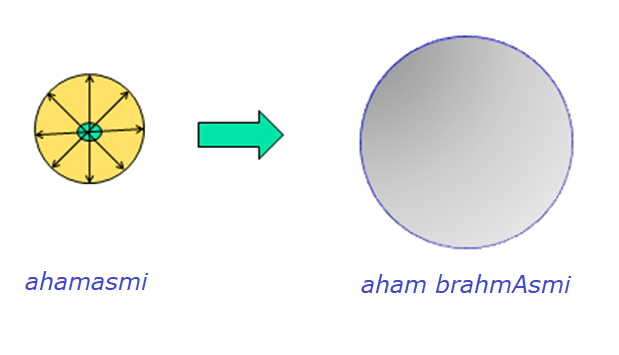
The Final Paradox – ahaṃ brahmāsmi

Shankara’s explanation in Bhagavad Gita bhāṣya 2.21

[Note that this is a ‘stand-alone’ article which nevertheless supplements the material asking ‘Who am I?’ in the pratibandha posts beginning https://www.advaita-vision.org/pratibandha-s-part-5-of-7/. It provides a response to Venkat’s challenge at https://www.advaita-vision.org/verse1-of-drg-drsya-vivek-an-analysis-of/#comment-9797]

Reality is non-dual. All Advaitins know that this is the teaching, even if they have not yet succeeded in reconciling this with the appearance of the world and their own apparent individuality.

The Self does not act. The jñānī knows this. The well-known statement in Bhagavad Gita 5.8-9 tells us that: The balanced person who knows the truth thinks: ‘I do nothing at all; it is only the senses relating to their sense objects,’ even whilst seeing, hearing, touching, smelling, eating, going, sleeping, breathing, speaking, excreting or grasping; even just opening or closing the eyes. It is all simply the ‘play of the guṇa-s’, name and changing form, like the movement of waves on the surface of the ocean – all is always only water.

Continue reading