The Mystery – Part 1

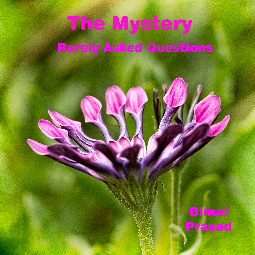
bimal_coverA new, short series presenting the booklet by Bimal Prasad, in which he answers some ‘Rarely Asked Questions’ on Life. Primarily from the perspective of Advaita, questions addressed include the nature of happiness, consciousness, mind and ego. There is also practical guidance on meditation in the final chapter. Answers are relevant and succinct, so that many of the issues of interest to the seeker are covered.

See the Contents List or go straight to Part 1 of the series.

The complete (electronic form) booklet may also be purchased from Amazon.

Reflections on Body-Mind and Liberation

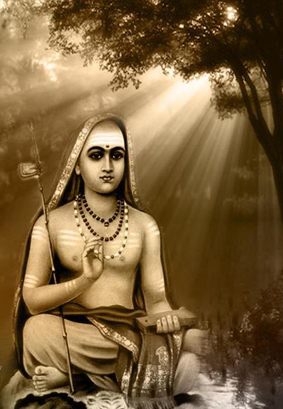
shankaraThere has been much healthy debate recently on the Advaita Vision Blog about Liberation, who or what is a jnani or jivanmukta, and what it means to follow traditional Advaita. The theme of this post is that we cannot resolve such questions without first gaining a clear understanding of the body-mind and its role in the context of Liberation. What follows are some reflections inspired by a spirited discussion with Ramesam, with due credit to him for stimulating many of the thoughts below. Any errors or possible misunderstandings are entirely my fault. Or perhaps not, since “Words fall back from it.” Continue reading

‘ego’, self, and metaphysics – Part lV

In the Buddhist perspective, the ego or self as ordinarily considered in Western traditions (i.e., as soul or person), is a non-self, actually a non-entity (anatta). Hence the suffering, which stems from an experience -ultimately illusory- of separation and vulnerability.

Here we have to consider two things. First, according to Mahayana Buddhism, Adi-Buddha, equivalent to Dharmakaya – the highest metaphysical, or divine, level – represents that unique Being or Divine ‘State’, pervading all manifestation as Buddha-nature; and second, the notion of the Self (Atman, derived from the Hindu Vedanta) is not only compatible with that view, but also with that of the Spirit in Christianity and in Islam.

As to the soul (metaphysics and theology), though intrinsically perfect or whole in itself (one could add: in ‘primordial man’ –the purusha or Hiranyagarbha of Hinduism)- it experiences imperfection, self-limitation, anxiety and doubt in its state of (aparent) separation -the ‘fallen state’. Being, not just potentially, a ‘focal point of the Universe’, yet it becomes, through ignorance and self-will, the subject of illusions, attachments, and passions which lead to that predicament. Its condition is thus ambivalent; it can orient itself upwards (or towards the centre) – to ‘holiness’ and integration – or downwards, pulled by its ‘lower nature’ (nafs in its lower stages, according to Sufism). The end result will be either self-denial, or self-assertion; self-giving, or ego-centeredness. Inevitably, this latter tendency, based on ignorance, can only lead to an unwanted result: dispersal, disintegration, and suffering. Alas!, on the whole, if not in principle, psychiatry is not interested in this distinction or dichotomy; but let not anything else be said about this at this point.

From the viewpoint of advaita vedanta, all of what is described in this paragraph – and what follows – pertains to the empirical, relative (ontological and epistemological) level: mithya (or vyavahara), in other words. Continue reading

Q.379 – Practice, Enlightenment and Reincarnation

Q: My understanding is that the purpose of spiritual practice is to purify the intellect so that it ‘reflects’ Consciousness without distortion. This enables the mind to recognize the delusion caused by ahaMkAra. This would mean that ‘enlightenment’ is a function of the mind. Is this correct?

If this is so, it would seem to mean that any ‘benefits’ gained from enlightenment would only apply to this body-mind, in this life. Is this so?

Scriptures indicate that one may have to undergo many lives before gaining mokSha, and suggest that fruits of previous lives accumulate to enable this. But, if enlightenment is an event in this mind, how can previous lives be of any benefit? Is there something in the mind that is ‘carried over’ into future births?

A (Ramesam): The most fundamental aspect of Advaita teaching is that an individual (jIva) is non-different from the Supreme Self (brahman). It follows, therefore, from this that a seeker is already of the nature of ever pure, all-knowing and liberated entity. As Gaudapada explains in his kArikA on mANDUkya Upanishad, by Its own freedom, brahman takes the form of an individual (and the world) and there is neither a creation nor liberation, neither a seeker nor something to be sought. Continue reading

Vedanta the Solution – Part 23

venugopal_vedanta
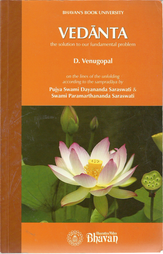
VEDĀNTA the solution to our fundamental problem by D. Venugopal

Part 23 begins the chapter on ‘Analysis of the subject in its three states of experience’. This first part looks at the three aspects of the body-mind-sense complex – the causal, subtle and gross bodies.

There is a complete Contents List, to which links are added as each new part appears.

The ontological status of concepts in Plato and Shankara

Concerning the theory of Forms or Ideas in Plato – and by extension that of perception – we can find an interesting parallel in the account given by Shankara’s Advaita Vedanta. The Idea of ‘the Good’ (the supreme Idea in Platonic metaphysics) would correspond to the highest ontological principle in advaita: Atman-Brahma; in fact, there is only one ontological principle, one primary, or ultimate, reality, in both philosophers.* Objects of external perception are illusory in both accounts. In Plato they are only images (ikones) of Ideas, which alone are real, whereas in Shankara these objects are also just representations in the mind, phenomena, and described as ‘names and forms’. For example, ‘pot’ is just a name, its underlying ‘substance’ being only clay (this is only an analogy or illustration, since there is no talk of substance in Shankara’s philosophy). There are no objects, and no world, having a separate (objective!) existence, the only reality being Atman-Brahman.

* This makes of Plato a non-dualist, which is contrary to the commonly-held idea that he was a dualist, due to the emphasis given throughout the ages to his doctrine of the two Worlds, Intelligible and Phenomenal (or ‘World of Appearances’).

Tom McFarlane (writing in Quora): ‘What concepts really are is a philosophical question about their ontological status. The answer will depend upon the philosophy you adopt. A materialist would regard concepts as ultimately reducible to the functioning of the material brain, while an idealist would regard concepts (and matter) as ultimately reducible to mind or consciousness.

The most famous idealist account of concepts was given by Plato in his theory of forms. According to Plato, a concept (or form) is a general abstract pattern that has various sensory objects as specific instantiations. The concept of a tree, for example, is an abstract idea that makes it possible for us to experience trees, as such. Without the concept of a tree, we may have experiences of images but they are not recognized as being an experience of a tree without the concept of a tree. In Plato’s view, the concept of the tree is more fundamental than any particular tree because the concept is a necessary precondition for trees to exist as objects of experience. Plato called the experiences of trees as instantiations of the concept of a tree. For more discussion, see What is a form in Plato’s metaphysical theory?’

Vedanta the Solution – Part 22

venugopal_vedanta

VEDĀNTA the solution to our fundamental problem by D. Venugopal

Part 22 concludes the chapter on ‘Enquiry into the Self as subject’, equating Consciousness and Existence and looking at the relationship between the body-mind-sense complex and Consciousness.

There is a complete Contents List, to which links are added as each new part appears.

Swami Dayananda

dayanandaIn case anyone has not yet heard, Swami Dayananda passed away yesterday, the 23rd September, at 22.18 IST in Rishikesh. Unquestionably the greatest teacher of Advaita in our lifetimes, he must certainly rank as one of the most important ever. Fortunately the legacy of his own writings and transcriptions, and that of the institutions he founded and the teachers he taught, will live on to the benefit of future seekers.

As a topical example of his teaching, I would like to reproduce the following pieces on the subject of manonAsha. These are extracted from the excellent book already recommended in these pages: ‘Pujya Swami Dayananda Saraswati – his uniqueness in the vedanta sampradaya’ by D. Venugopal.

manonaSha or Thought-free-mind Confusion

There is also a widespread contention among the adherents of aShTANga-yoga that the truth of the self is covered by vRRittis (thought-forms) and it has to be uncovered by stoppage of thoughts (citta-vRRitti-nirodha). Pujya Swamiji clarifies that thought is not the problem. He says:

“The confusion comes from the statement that AtmA is undivided (nirvikalpa). The vision of the ShAstra is that while the knower, known, and knowledge are not separate from AtmA, AtmA is independent of all of them. In MANDukya UpaniShad and in the kArikA, the dreamer is cited as proof that there is no real division (vikalpa) such as dreamer, dream and dreamt, even though during the dream, the division was taken to be real. Continue reading

Tattvabodha – Part 4

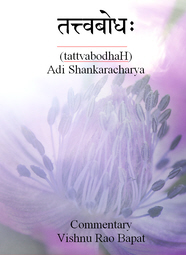
OLYMPUS DIGITAL CAMERAPart 4 of the commentary by Dr. VIshnu Bapat on Shankara’s Tattvabodha.This is a key work which introduces all of the key concepts of Advaita in a systematic manner.

The commentary is based upon those by several other authors, together with the audio lectures of Swami Paramarthananda. It includes word-by-word breakdown of the Sanskrit shloka-s so should be of interest to everyone, from complete beginners to advanced students.

Part 4 begins to look at the six sAdhanA-s (shamAdhi shakti sampatti), and in this part addresses shama (control of mind) and dama (control of senses). There is also a hyperlinked Contents List, which will be updated as each new part is published.

Q. 370 – nirvikalpa samAdhi

Q: Should a person have compulsorily experienced nirvikalpa-samādhi in order to know that he has a mind which is prepared for jñāna? In other words, is experience of nirvikalpa-samādhi a must as a sādhana?

Responses from VenkatMartinTed, Shuka and Dennis

A (Venkat): Nirvikalpa-samAdhi is an experience of the absence of objects, for a finite period of time, which the experiencer eventually exits to re-perceive the world.  As it is not permanent, it is not real.  Any temporary experience that is witnessed cannot be a pre-requisite for j~nAna – since j~nAna is the permanent dissolution of the illusory I-thought.

“Abiding permanently in any of these samadhis, either savikalpa or nirvikalpa, is sahaja. What is body consciousness? It is the insentient body plus consciousness. Both of these must lie in another consciousness which is absolute and unaffected and which remains as it always is, with or without the body consciousness. What does it matter whether the body consciousness is lost or retained, provided one is holding on to that pure consciousness? Total absence of body consciousness has the advantage of making the samadhi more intense, although it makes no difference to the knowledge of the supreme.” – Sri Ramana Maharshi Continue reading