dhyAna and samAdhi

Meditation

dhyAna and samAdhi are quite fascinating, pretty alluring and romantically inspiring terms for an aspirant on the spiritual path. They are almost always spoken in a tone that creates an awe. They sound mysterious, other worldly and ethereal. Many stories are told in the Purana-s about highly revered Sages lost in deep meditation or samAdhi to the extent that they were unaware of their own body being buried in heaps of sand or eaten away by critters and crawlers. Hair-rising narratives too are often reeled out about the powers that dhyAna and samAdhi lead one to – clairvoyance, multiple accomplishments (aNimAdi siddhi-s), infinite longevity (ciranjIvatva), visitations to subtler worlds inaccessible to normal human beings and so on. There is hardly a spiritual Guru who does not harangue about the glories a seeker will be bestowed through practicing dhyAna and samAdhi. Some teachers would even make these as a pre-requisite before any true ‘knowledge’ is imparted. As a result, the words dhyAna and samAdhi acquired varying meaning. Teachers too historically used or interpreted them in different ways. We shall attempt to take a synoptic view particularly from a Non-dual perspective what these terms connote and their role and relevance for a seeker who has adopted the jnAna mArga (The Knowledge Path) in his/her pursuit of liberation.

The write up is structured as a Power Point Presentation downloadable as a pdf file at: http://www.advaita.org.uk/discourses/downloads/dhyAna_samAdhi.pdf. Continue reading

Serialization of Yogavasishta 6

Professor Sri Kuppa Venkata Krishna Murthy, Chairman and Managing Trustee of I-SERVE, the Institute of Scientific Research on Vedas, has kindly given permission for Advaita Vision to serialize his 6-volume ‘Musings on Yogavasishta’. Written in Telugu, the work has been painstakingly translated by our Dr. Ramesam Vemuri and published by Avadhoota Datta Peetham.

Rather than reproducing successive extracts from the books each month, as has been done with our other two serializations, the books themselves will be made available for download in PDF format. Each part will be associated with a page at the main website, which will contain a Contents List for that volume. Links to all of the volumes will be provided on a general Contents Page.

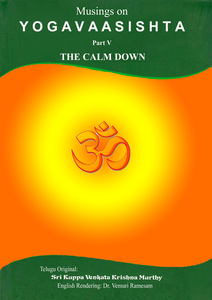
The present volume, “Musings on Yogavaasishta” – Part V The Calm Down, is a presentation by Brahmasri Kuppa Venkata Krishna Murthy, the Vidyadhikari of Avadhoota Datta Peetham, Mysore and forms a part of his lectures on “Yogavaasishta” telecast by GEMINI T.V. in Telugu. This volume is a rendering of the same into English by Dr. Vemuri Ramesam. In it: The 5000 stanzas of the fifth chapter on The Calm Down (Upasama)   have been ably condensed and lucidly explained in simple words. Possible methods of alleviation from the state of Bondage and annulment of mind are described through the stories of Janaka, Bali, Prahlada, Uddalaka, Gadhi, Sraghu, Parigha and others.

Please go to the Contents Page to read the Announcement and general introduction from Ramesam. The page for this Fifth Volume, Part 5 (THE CALM DOWN) also contains the download link for the PDF file (0.9MB).

chidAbhAsa

The ‘Real I’ verses the ‘Presumed I’ – An Examination of chidAbhAsa

Ramana Maharshi’s instruction to seekers to ask themselves ‘Who am I?’ is lauded by many modern Western teachers as sufficient, on its own, to lead to enlightenment.  I suggest that this is not strictly true; that what it can do is rather to give us insight into what we are not and thereby point us in the direction of traditional teachings to learn about our real nature. It is inciting us to conduct Self-inquiry in the proven manner, i.e. by listening to a qualified teacher interpret the scriptures, rather than merely providing a mantra or formula to provide an answer directly.
An explanation of how traditional teaching can lead us to an understanding of who I am might begin with an analysis of our three states of consciousness – this is the so-called avasthA traya prakriyA of traditional advaita.
We almost certainly begin with the belief that who-I-really-am is only fully present in the waking state. In the dream state, I am not in command of my mental faculties so that the mind free-wheels outside of my control even though I am not actually unconscious. And we no doubt accept the deep sleep state as one in which mind and body rest and recuperate in order to be ready for the trials that the next day may bring. According to this interpretation, consciousness in deep sleep is in a resting state, as indicated by the lowered activity shown by EEG displays. (This view, also supported by many Western philosophers, claims that consciousness is a by-product or ‘epiphenomenon’ of the brain; an evolutionary advantageous development to enable an animal to find food and mate more efficiently than before. This is also the view of the chArvAka-s or materialists of thousands of years ago – it is certainly not new!) Continue reading

Serialization of Yogavasishta 5

Professor Sri Kuppa Venkata Krishna Murthy, Chairman and Managing Trustee of I-SERVE, the Institute of Scientific Research on Vedas, has kindly given permission for Advaita Vision to serialize his 6-volume ‘Musings on Yogavasishta’. Written in Telugu, the work has been painstakingly translated by our Dr. Ramesam Vemuri and published by Avadhoota Datta Peetham.

Rather than reproducing successive extracts from the books each month, as has been done with our other two serializations, the books themselves will be made available for download in PDF format. Each part will be associated with a page at the main website, which will contain a Contents List for that volume. Links to all of the volumes will be provided on a general Contents Page.

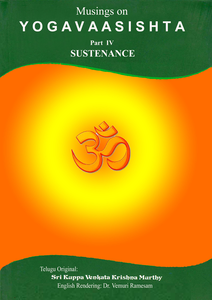
The present volume, “Musings on Yogavaasishta” – Part IV Sustenance, is a presentation by Brahmasri Kuppa Venkata Krishna Murthy, the Vidyadhikari of Avadhoota Datta Peetham, Mysore and Chairman, Institute of Scientific Research on Vedas (I-SERVE) and forms a part of his lectures on “Yogavaasishta” telecast by GEMINI T.V. in Telugu. This volume is a rendering of the same into English by Dr. Vemuri Ramesam. In it: The 3000 stanzas of the fourth chapter on Sustenance (Stithi) have been ably condensed and lucidly explained in simple words. Possible methods of alleviation from the state of Bondage and annulment of mind are described through the stories of Bhargava, Daama, Vyaala, Kata, Daasura, and others.

Please go to the Contents Page to read the Announcement and general introduction from Ramesam. The page for this Fourth Volume, Part 4 (SUSTENANCE) also contains the download link for the PDF file (0.6MB).

Q.384 – Dark night of the soul

Q: Please help me.I had a temporary glimpse of reality around 15 months ago by following 8 fold path. I tried to penetrate the question of suffering and learned that everything wants to come into Equilibrium (a known chemistry fact) due to which my thought trains stopped and I got an instant realization of something called reality. After that, I experienced I am a silent witness and not mind, body, ego, etc.

This faded away after some time and now I am in mental anguish and turmoil. I don’t know what is happening in my mind but it is disturbed or in what people call the “Dark night of soul”. Every joy is lost now; I get angry easily and have feelings of despair from something. Maybe it is because I didn’t discipline my mind with ethics before starting this practice for enlightenment. Please save me now. Whatever is going on in my head, save me from it. I don’t know how to complete surrender unto reality and may be this is due to the hold of ego. Please help!

A (Dennis): The teaching tradition of Advaita is all about Self-knowledge. You listen to the teaching from a qualified teacher (ideally) or read about it and discuss it (less good). You ask questions about it to resolve your doubts. Eventually, you realize that what is being said is true and that is that. In theory!

The problem is that you need a clear, self-controlled mind and some trust in the teacher, the ability to discriminate and so on. These ‘skills’ are not really a part of Advaita – they are mostly lifted from Patanjali’s Yoga system. If you have no mental discipline along these lines, you are never going to be able to assimilate the teaching. You need at least a medium level of attainment. With that you can take on board the knowledge and then continue your practices until you reap all the other benefits (peace of mind, fearlessness and so on).

From what you say, I would advise that you forget about Self-knowledge for a while and concentrate on acquiring the mental skills. Meditation is invaluable. And, if you have no religious-type outlook (praying to a god and so on), then the practices of karma yoga are the other main route – doing what is in front of you because it needs doing, ignoring desires and not expecting any results. And so on!

I do not know anything about Buddhist methods so cannot really comment. I would forget about ‘dark nights’. The main thing to remember, even if you don’t yet believe it, is that the world is not absolutely real. Your body, mind and everything else have empirical reality only, depending ultimately on Consciousness, which is the only reality. And you are That.

Free Will versus Fatalism


Below is another essay from Atman Nityananda whose earlier essay on sAdhana triggered so much interest. This is preceded by an essay on the same topic from Swami Sivananda.


Free Will versus Fatalism
by Swami Sivananda

The controversy between free will and fatalism is still going on in the West and no one has come to any definite conclusion. It is a great pity that the doctrine of Karma is mistaken for fatalism. Fatalism is the doctrine that all events are subject to fate and happen by unavoidable necessity.

Fate is otherwise known as luck or fortune. That indefinable mysterious something which brings trials, successes and failures to man, which shapes and moulds him by teaching lessons of various sort, which takes care of him like a mother, which brings various sort of experiences, which brings cloudy days and days of bright sunshine, which raises a beggar to the level of a landlord and hurls down a mighty potentate to the level of a street-beggar, which gives different kinds of fruits and experiences to two people of equal talents and capacities, which made Napoleon at one time a terror in the eyes of the people and at another time a prisoner, and which makes a certain portion of the life of a man quite stormy and another portion quite smooth, is called fate. Fate educates and instructs man. However whimsical the fate may appear to operate, it works in harmony with the law of causation. Continue reading

Vedanta the Solution – Part 27

venugopal_vedanta

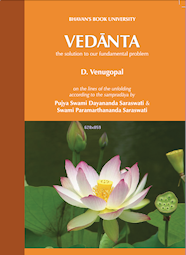
VEDĀNTA the solution to our fundamental problem by D. Venugopal

Part 27 begins the enquiry into the nature of the jIva. It looks at the various explanations for how Consciousness manifests in the body-mind and the special role of the buddhi.

There is a complete Contents List, to which links are added as each new part appears.

Tattvabodha – Part 12

OLYMPUS DIGITAL CAMERA

Part 12 of the commentary by Dr. VIshnu Bapat on Shankara’s Tattvabodha.This is a key work which introduces all of the key concepts of Advaita in a systematic manner.

The commentary is based upon those by several other authors, together with the audio lectures of Swami Paramarthananda. It includes word-by-word breakdown of the Sanskrit shloka-s so should be of interest to everyone, from complete beginners to advanced students.

Part 12 examines the waking and dream states of experience.

There is a hyperlinked Contents List, which is updated as each new part is published.

The Mystery – Part 2

bimal_cover

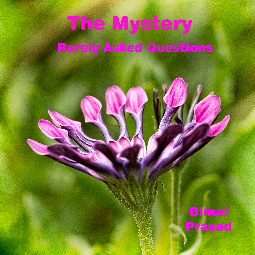
Continuing this new, short series presenting the booklet by Bimal Prasad, in which he answers some ‘Rarely Asked Questions’ on Life. Primarily from the perspective of Advaita, questions addressed include the nature of happiness, consciousness, mind and ego. There is also practical guidance on meditation in the final chapter. Answers are relevant and succinct, so that many of the issues of interest to the seeker are covered.

This second part looks at the distinction between ‘I’ and the body-mind and identifes ‘Consciousness’ as being who we really are. See the Contents List or go straight to Part 2 of the series.

The complete (electronic form) booklet may also be purchased from Amazon.

Vedanta the Solution – Part 26

venugopal_vedanta

VEDĀNTA the solution to our fundamental problem by D. Venugopal

Part 26 examines the nature of AtmA, utilising the ‘descriptions’ from the Brihadaranyaka, Kena and Mandukya Upanishads. How can we ‘know’ the Self, when it is not an object?

There is a complete Contents List, to which links are added as each new part appears.