Inception: Dream or Not?

Here are two (related) book reviews which may be of particular interest to readers of our new serialization of ‘The Dream Problem’.

Nearly 2 years ago, the film of the moment was ‘Inception’, directed by Christopher Nolan. And this justifiably went on to win four Academy Awards. Friends told me how good this film was but, as is quite normal regarding films, I did not actually get to see it until some time after it came out on DVD. Since I have been a fan of science fiction ever since my childhood, I realized fairly quickly what this film was about in a general sense. Nevertheless, it was obvious that the story was quite complex and that all of the nuances could never be fully appreciated with one viewing. Accordingly, even at the time, I wondered whether anyone would write a book about it. (Of course, I realized that there would be a deluge of blogs on the subject but there is the slight problem of not having sufficient time to look, as well as not knowing which ones would be worth reading.) Continue reading →
Gunas and History (Q. 318)

Q: 1. If the triple gunas are the matrix of the “reality”, aren’t they immutable and therefore truly real? (I have asked this question a while ago in our personal correspondence but I can’t access my old email and it still bothers me…).

2. What is the ontological status of the course of human history? Is it objective, or just a sort of shared mass illusion that somewhat gets transferred from generation to generation? I am aware of the imprecision of my language but hopefully you will understand my meaning.

A to Q1 (Peter):  Guṇas are the subtlest form of manifest matter and, being matter, are thus subject to change. So they are not immutable.

 Guṇas in their unmanifest and undifferentiated form are the triple śakti of māyā: jñạna, krīyā and dravya shakti, the undifferentiated and unmanifest powers of knowledge, action and materialisation. When these move into manifestation they get the names sattva, rajas and tamas. Continue reading →

Vision Of Truth (sad darshanam) – 1

Ramana Maharshi was one of the greatest philosophers India has seen. One does not need an introduction as much has already been written about him.

He used to direct people to the nature of I, not as the body mind individuality but the very aware-full being. He would relentlessly ask his followers to enquire into the individuality by probing into the innermost recesses with a ‘Who am I’ thought.

This ‘who am I’ should not be taken as a mental, mechanical repetition. Knowledge will not dawn on a person, by forcefully exterminating thoughts and contemplating on ‘Who am I’. Man has become habituated to identifying with the body mind and ‘who am I’ enquiry by an unprepared mind will lead one nowhere.

It can provide a temporary tranquility which can be got even through listening to good music or visiting a hill station. This ‘who am I’ is nothing but claiming the content of our very being as the only truth by negating all that one is not. Once the non self is negated, there is nothing to do. The truth is apprehended as one’s own self. His advice hence was not to get lost in unnecessary thoughts and questionnaires but know oneself, as the truth behind the very ego, the individuality which he thinks he is. One is not the ego, but the very truth behind it.

Continue reading →

ANESTHESIA, DEEP SLEEP, DEATH AND CONSCIOUSNESS – Part 3/3

[Part 1/3         Part 2/3]

To eff the ineffable:

We travelled the depths of Non-duality in Part 2/3.

As Jeff would put it, “I am realized, you are not” is a silly game. There’s no one – none – that’s not Brahman. You are already realized! So relax.

And let’s know what the brainy brain-scientists say consciousness is.

What consciousness is and how the brain produces it (if it does), is still one of the great challenges to science. Until a few decades ago, science was averse to dabble into this subject for lack of adequate investigative tools (both conceptual and instrumental). “Today consciousness research has become a passion for many scientists.”

But what is consciousness? It’s like asking what life is or what energy is. You know it when you see it. We say that “a brain that is fully awake and constructing experiences is fully conscious.” The thalamus, a sort of hub located deep in the brain for information flows from the senses to the upper reaches of the brain is crucial for consciousness. A person turns into a vegetative state if the thalamus is damaged or the information flows are inhibited. This does not mean that thalamus produces consciousness; it may just show that one is conscious – much like a thermometer which doesn’t actually make the heat, but tells you how hot it is.

Dr.Giulio Tononi of the University of Wisconsin–Madison and his colleagues are studying

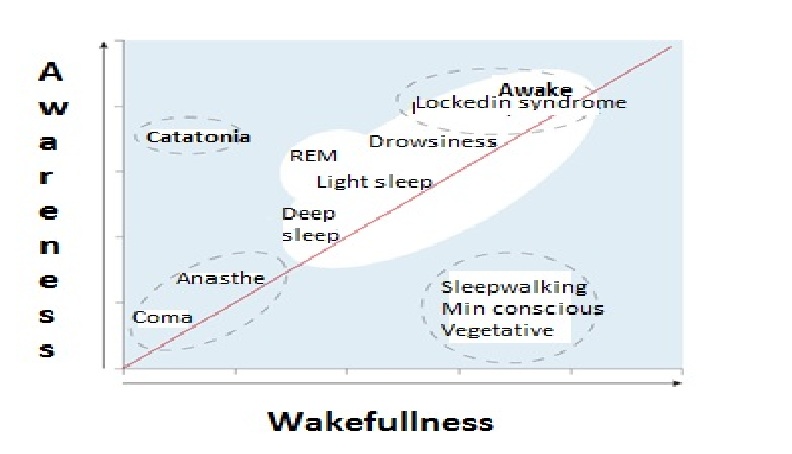
States of consciousness (After L. Saunders, 2012)

brains that are deeply asleep, under anesthesia or in comas to understand consciousness. As shown in the figure at the right, “awareness typically tracks with wakefulness — especially in normal states of consciousness. People in coma or under general anesthesia score low on both measures, appearing asleep with no signs of awareness. Sometimes, wakefulness and awareness become uncoupled, Continue reading →

ANESTHESIA, DEEP SLEEP, DEATH AND CONSCIOUSNESS – Part 2/3

[Part 1/3      Part 3/3]

Before going into a consideration of Deep Sleep, once again a small detour.

Dennis raised in an e-mail the question of Sleepwalking. Where would it fit in the Model?

Some people amble around in sleep and even hurt themselves.  A few persons could commit heinous crimes in the state of somnambulism.  A well-known case is that of Kenneth Park in 1987 when he strangulated his father-in-law and killed his mother-in-law. However, he was let out by the court on the ground that he was sleepwalking when he harmed and killed people.  A similar case of acquittal also occurred in 1846. Apparently the body of the sleepwalkers is active but the mind seems to be asleep.

Neuroscientifically speaking, in the case of sleepwalking, the motor cortex of the brain is functional whereas the frontal lobe vested with executive functions is at rest. This means that a part of the mind (that propels the body to act) is active while the part responsible for reasoning and self-control is asleep. Continue reading →

Discrimination

Spiritual seekers should be able to distinguish the essential from inessential in order not to waste time and energy with inessentials on their journey. Hence, the ability to discriminate is basic.

What exactly is it that helps us discriminate? Our senses inform us about the fact that a zebra is something other than a fish. The fact that the feeling of joy is something other than the thought that triggers that joy, is already a more subtle difference. However, both differentiations, indeed any differentiation, is made by using the function in our mind responsible for it, the buddhi. Continue reading →

How did ‘I’ come to deceive itself? (Q. 304)

Q: How did ‘I’, the all knowing, all loving, all powerful, the absolute & infinite blissful ONE, without a second, come to deceive itself, and place itself in this illusion of illusions? How or why did the Ultimate Reality have this come to pass? (Sept 2010)

A: The spirit of your question is unanswerable – it is effectively asking why there is Self-ignorance and this is said to be anirvachanIya – inexplicable. From the standpoint of absolute reality, of course, there is no deception because there is no creation; and there is no illusion because there are no persons to be deluded. There is only brahman – satyam j~nAnam anantam as the taittirIya upaniShad says, limitless consciousness. It is only from the perspective of this apparently limited entity, the mind of the person, that there seems to be a problem. Once the truth is realized, it is also seen that there is no problem because everything is brahman – sarvaM khalvidam brahma.