Image by valemngilda
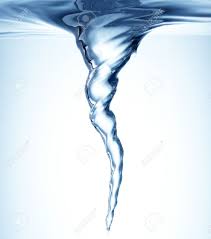
Think of a whirlpool. There seems to be a definable shape that we can point to and know as a whirlpool, and yet there is nothing separate or fixed about its whirlpool-ness. All the water that constructs the thing we have labelled “whirlpool” is in flow, never the same water in any moment, and yet it appears to hold its shape/from so convincingly that we believe we can point to the moment our whirlpool began, measure it’s lifetime, and record the moment it ceases to be.
But what is it that convinces us that the whirlpool is separate and of its own causal relatedness to “other” forms we have labelled in the single field of All That Is?
For as much as we focus on the ways to practice into a consciousness immune to mithyA, we have the experiences we have as All That Is in constant flow, unfixed and inseparable, no matter how we might label that experience.
It seems prudent to mention at this point that we are prone to use the word experience to separate so-called “personal identity” from “other-ness”, so the concept of experience encompassing all that we have labelled inner, outer, before, present, and so on, is an unnatural leap… until one comprehends the arbitrary lines we have drawn (even in language being the means of defining ideas that can be fixed in objective transfer of meaning), and recognise these too as whirlpools in the ocean of All That Is.
Image by Andrey Alyukhin
Of course, the analogy can only go so far. According to the assumptions of our current cosmology, to know-observe a whirlpool is to be separate from it, and to literally form a whirlpool the ocean must exist within an atmosphere. But in our present physics of a causal universe, we have no means of explaining an alternative conceptual reality with words. Even the term “reality” inspires our perceptual bias dividing existence as dimensional from that which cannot be known/named/defined.
Which also means that while it seems that we can be taught the Vedantic mokSha; that there are those who trust innately, and perceive (for want of a better word) the whirlpool in its ocean state. Those who seek to trust, and devote themselves to practices which might reveal an ocean in all things. And those who examine trust through chemical, experimental, and philosophical means in order to demystify that which defies explanation (which will ultimately allow us to speak of that which language is yet to adequately express)… we do not experience (learn/live/know) from within a body because the “body”, the “self”, and experience as a point of separation, are all whirlpools within an ocean of All That Is.
“There is no dissolution, no origination, none in bondage, none possessed of the means of liberation, none desirous of liberation, and none liberated.” Gaudapada (K2.32)
 Everyone wants to be happy. This is the motivational force for everyone. The Vedas acknowledge this. The first part of the Vedas – karmakANDa – is effectively aimed at those who look for their happiness in external, limited, objects and pursuits; the latter part of the Vedas – j~nAnakANDa – is aimed at those who are looking to find the happiness within, through gaining knowledge of their true nature.