
Q: I am reading your book ” Confusions in Advaita Vedanta”.
I am from India, born in the Smarta Brahmin tradition of The revered Adi Shankara.
The purport of Adi Shankara as repeatedly explained by you is that no pramana or meditation except shabda pramana, teaching of scripture expounded by qualified teacher can give jnana. And this understanding happens in the process of listening once. Repetitions don’t help.
This caused both enthusiasm and later negativity in me. I have heard scriptures being expounded by Swami Dayananda, Swami Paramarthananda, Swami Brahmananda, Swami Parthasarathy, Sri Gangolli (translator of Swami Satchidananendra) etc. But no understanding or Jnana has resulted.
Am I doomed? Or Does it mean I was not qualified enough? More yoga sadhana required for purifying my mind? Of course there can be no doubt that the teachers were qualified. So fault is mine.
Tag Archives: shankara
mANDUkya upaniShad Part 5
Mantra 4
*** Read Part 4 ***
स्वप्नस्थानोऽन्तःप्रज्ञः सप्ताङ्ग एकोन्विंश्तिमुखः प्र्विविक्तभुक् तैजसो द्वितीयः पादः॥ ४॥
svapnasthAno.antaHpraj~naH saptA~Nga ekonaviMshatimukhaH praviviktabhuk taijaso dvitIyaH pAdaH || 4 ||
dvitIyaH pAdaH – The second aspect (of the Self)
taijasa – is called taijasa.
svapna sthAna – (Its field of action is) the dream state.
antaHpraj~naH – (Consciousness is) turned inwards (as opposed to the waking state in the previous mantra, where it was turned outwards).
sapta a~Nga – (As with the waking state) (it has) seven divisions.
viMshati mukhaH – (and) nineteen interfaces.
praviviktabhuk taijaso – taijasa is the enjoyer (bhug = bhuk = bhoktA; experiencer, enjoyer) of the private, internal world (pravivikta).
The second aspect of the Self is taijasa. This is the dream state in which one’s awareness is turned inwards. taijasa has seven parts and experiences the dream world via 19 interfaces.
Continue readingQ.526 MithyA
Q: In your comment on the article by Arun Kumar, I was confused but intrigued that you define Mithya as something that simply explains the fundamental nature of the Brahman in life and its objects. I have not so far found any dictionary that defines mithya as anything other than false or illusory nor discovered any major scholar-philosopher who thought that Shankara viewed this world as a reality – as real as the ornament in your metaphor. You say that Shankara himself by discriminating between the waking and dream states suggests that novel meaning of Mithya. Is this your own interpretation or does Shankara himself link the ability to differentiate between those states to explain mithya?
You raise the example of how jumping into the middle of traffic would help one realize why this world is NOT an illusion… but it is not convincing enough. Potentially, both a person jumping in front of a truck and his consequent “death” could be perceived as illusory events too. The real question I have is whether Shankara himself viewed this world as illusion and used Mithya to convey that or not. And, if it was an illusion for him, what did he think the meaning of life was? If on the other hand life was Not an illusion to him, as you seem to suggest, what was its purpose in that case?
Continue readingmANDUkya upaniShad Part 4
Mantra 3
*** Read Part 3 ***
जाग्रितस्थानो भिष्प्रज्ञः सप्ताङ्ग एकोन्विंश्तिमुखः स्थूलभुग्वैश्वानरः प्रथमः पादः॥ ३॥
jAgaritasthAno bahiShpraj~naH saptA~Nga ekonaviMshatimukhaH sthUlabhugvaishvAnaraH prathamaH pAdaH || 3 ||
prathamaH pAdaH – The first aspect (of the Self)
vaishvAnara – is vaishvAnara (or vishva)
jAgaritasthAna – (This is) the waking state
praj~na – (and it is one in which one’s) knowing awareness
bahis – (is) turned outwards
sapta a~Nga (a~Nga literally means ‘limb’) – (This aspect has) seven divisions ekonaviMshatimukhaH – and nineteen interfaces (with the outside world) (viMshati is ‘twenty’ and ekona is ‘one less than’; mukha literally means ‘mouth’ or ‘opening’)
sthUlabhugvaishvAnaraH – vaishvAnara (is) the enjoyer (bhug = bhuj = bhoktA; experiencer, enjoyer) of the gross world.
The first aspect of the Self is vaishvAnara. This is the waking state in which one’s awareness is turned outwards to the external world. vaishvAnara has seven parts and experiences the universe via 19 interfaces.
Continue readingIn Praise of SSS
Of great men and their opponents.
Only great men (magn+animus), above all others, can be the butt of bitter attacks – be it personal or to their output or works – as was the case with Hujwiri, 6th Buddhist Patriarch, Jesus of Nazareth and, in other realms, Shakespeare in England, Cervantes and Lope de Vega in Spain – and so many others. Such was also the case with, to me the best Advaitist writer of the 20th Cent., Swami Satchidanandendra Saraswati. The attacks or resistance to accept their views is often motivated by envy. As it has been well-documented, there was initial resistance to accept or agree with the notion of mulavidya in the early work of Swamiji (SSS from now on) as he unfolded it.
Continue readingmANDUkya upaniShad Part 1
I have just started reading the massive commentary on the mANDUkya, Gaudapada kArikA-s and Shankara bhAShya (if it was Shankara) by Divyaj~nAna Sarojini VaradarAjan, so I thought it might be appropriate to post my own translation and commentary on the Upanishad itself from ‘A-U-M’.
The VaradarAjan book is in two volumes and, as far as I am aware, is only available from Exotic India at £65 to post to the UK. Only 500 copies were printed and these may sell out quickly as her Upanishad commentaries are unparalleled.
My own book ‘A-U-M: Awakening to Reality’ is a ‘by topic’ rather than verse by verse commentary, although it does cover all of the material. The specific translation and commentary on the 12 verses of the Upanishad itself are relegated to an Appendix, since the material is rather ‘dense’, and the tone less ‘conversational’ than the main body of the book. It is available from Amazon:
Book ($34.95): Buy from Amazon US; Kindle ($16.49): Buy from Amazon US
Book (£20.99): Buy from Amazon UK; Kindle (£6.99): Buy from Amazon UK
This series will post the whole of Appendix 1 of ‘A-U-M’ and, in general, each post will cover one verse of the Upanishad. This first post, however, covers the shAnti pATha – the traditional prayer at the beginning of an Upanishad – and Shankara’s introduction.
Continue readingBook Review: Heart of Sri Shankara
Sri Satchidanandendra Saraswati Swamiji
(5 January 1880 – 5 August 1975) was the founder of the Adhyatma Prakasha Karyalaya in Holenarasipura, Hassan district, Karnataka, India. Born as Sri Yellambalase Subbarao, he worked as a school teacher in the Indian state of Karnataka. He gave many lectures and wrote many articles on the Vedanta in English, Kannada and Sanskrit.
Satchidanandendra Saraswati was a philosopher who dedicated all his life for the Vedanta sAdhana and attained brahma-j~nAna. He was known as a jIvanmukta sage. He was the best example of a Sanskrit saying, “One should spend one’s life until sleep and until death only in Vedantic contemplation”. (Wikipedia)
Heart of Shri Shankara Swami Satchidanandendra, translated by A. J. Alston. A detailed consideration of what Shri Shankara said about the nature of ignorance, and other views. A translation of a work by Shri Swami Satchidanandendra first published in 1929 under the title Refutation of Root Ignorance or The Heart of Shri Shankara. It considers the philosophical view that there is a ‘root-ignorance’ that ‘creates’ the phenomenal world and which in some sense really exists. The Swami sets out to show that this view arose among Advaitins after Shri Shankara and is contrary to his true teaching.
978-0-85424-050-0 £12.00 from Shanti Sadan in the UK, http://www.shantisadan.org/bookstore/heartshankara.php (Still £12 over 10 years after this review was written!) or available as a PDF download from http://www.adhyatmaprakasha.org/Volumes/PDF/english/042/index.pdf.
Continue readingBook Review: Vivekachudamani – Swami Dayananda
Another review from 10+ years ago at Advaita Academy. I have amended this to bring it up to date.
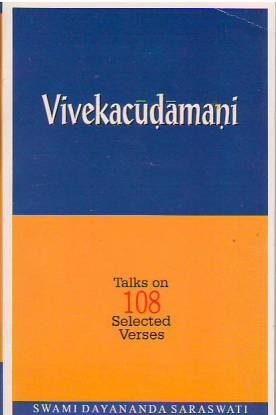
Vivekachudamani (vivekachUDAmaNi), Swami Dayananda Saraswati, Sri Gangadadharesvar Trust, 1997, No ISBN. (312 pages), $12 from Arsha Vidya Bookstore, Arsha Vidya Gurukulam, Institute of Vedanta & Sanskrit, P.O. Box 1059, Saylorsburg, Pennsylvania, 18353, USA Tel: 570.992.2339 (http://books.arshavidya.org/) The book is in English. Verses are given in Devanagari, followed by transliteration and then word by word translation. Direct Devanagari quotations from other sources are provided in footnotes.
Continue readingBook Review: dṛg dṛśya viveka, Clarissa
Over the next couple of months, I will be posting some book reviews that I made 10+ years ago, which are no longer available elsewhere on the Internet.

The first of these is:
dṛg dṛśya viveka, Clarissa, Lulu Press, 2010, ISBN 978-1-4452-0858-9. (171 pages), $19.62 from Amazon.com. Also available from Watkins Books, 21 Cecil Court, London WC2, £12.99.
A Primer on Advaita
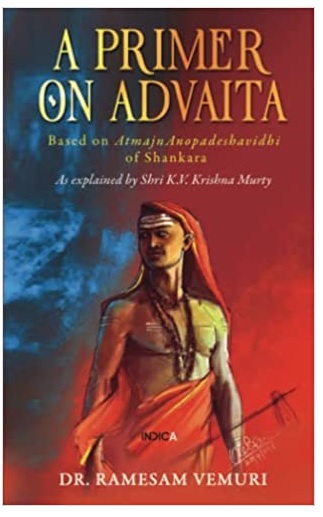 Publisher : Notion Press; 1st edition (27 April 2022), Paperback : 62 pages; ISBN-13 : 979-8886675023, Weight : 118 g; Dimensions : 12.7 x 0.41 x 20.32 cm
From the Back Cover:
This booklet is based on AtmajnAnopadeshavidhi, a short treatise (prakaraNa grantha) of Shankaracharya, much respected within the Advaita tradition. It leads the reader, literally holding his/her hand, from the simple way we observe the objects in the world to the inexpressible “Consciousness principle” (brahman) that is present in all of us and everywhere without any abstruse quotes or indecipherable terminologies.
Available from:
Amazon.com ; U.K. ; India