
Tattvabodha – Part 14

Part 14 of the commentary by Dr. VIshnu Bapat on Shankara’s Tattvabodha.This is a key work which introduces all of the key concepts of Advaita in a systematic manner.

The commentary is based upon those by several other authors, together with the audio lectures of Swami Paramarthananda. It includes word-by-word breakdown of the Sanskrit shloka-s so should be of interest to everyone, from complete beginners to advanced students.

Part 14 continues to look at the metaphor of the five sheaths, from the Taittiriya Upanishad. This part explains the vital, mental and intellectual sheaths.

There is a hyperlinked Contents List, which is updated as each new part is published.
Knowledge and Enlightenment

Over the past few months, we have had several posts following which there were discussions in which some participants attempted to argue that knowledge was not the direct cause of enlightenment. Alternative suggestions have been that enlightenment comes with nirvikalpa samAdhi or that one has to pursue some course of action, such as asking ‘Who am I?’.

I argued that neither of these were the case; that ONLY Self-knowledge could give enltightenment. This is primarily because ignorance is the cause of saMsAra and knowledge, not action, is opposed to ignorance. And I said that I would endeavor to find quotations from scripture or from Shankara to support this contention (since some participants were not prepared to accept arguments from such as Swami Dayananda).

Below, I have compiled a brief list of some of those quotations and hope these should be adequate to convice readers that the above is the stance of traditional Advaita and it is supported by clear, reasoned argument. Continue reading

Tattvabodha – Part 13

OLYMPUS DIGITAL CAMERA

Part 13 of the commentary by Dr. VIshnu Bapat on Shankara’s Tattvabodha.This is a key work which introduces all of the key concepts of Advaita in a systematic manner.

The commentary is based upon those by several other authors, together with the audio lectures of Swami Paramarthananda. It includes word-by-word breakdown of the Sanskrit shloka-s so should be of interest to everyone, from complete beginners to advanced students.

Part 13 concludes the exmaination of the states of experience with the deep-sleep state and begins to look at the metaphor of the five sheaths, from the Taittiriya Upanishad. This part explores the sheath made of food.

There is a hyperlinked Contents List, which is updated as each new part is published.

Tattvabodha – Part 12

OLYMPUS DIGITAL CAMERA

Part 12 of the commentary by Dr. VIshnu Bapat on Shankara’s Tattvabodha.This is a key work which introduces all of the key concepts of Advaita in a systematic manner.

The commentary is based upon those by several other authors, together with the audio lectures of Swami Paramarthananda. It includes word-by-word breakdown of the Sanskrit shloka-s so should be of interest to everyone, from complete beginners to advanced students.

Part 12 examines the waking and dream states of experience.

There is a hyperlinked Contents List, which is updated as each new part is published.

Tattvabodha – Part 11

OLYMPUS DIGITAL CAMERA

Part 11 of the commentary by Dr. VIshnu Bapat on Shankara’s Tattvabodha.This is a key work which introduces all of the key concepts of Advaita in a systematic manner.

The commentary is based upon those by several other authors, together with the audio lectures of Swami Paramarthananda. It includes word-by-word breakdown of the Sanskrit shloka-s so should be of interest to everyone, from complete beginners to advanced students.

Part 11 looks at the five organs of action and the nature of the causal body.

There is a hyperlinked Contents List, which is updated as each new part is published.

Adi Shankara

lamp and grassMost people (or at least those who visit this website!) will be aware that the dates for Shankara’s birth and death are a trifle hazy. It is generally assumed that he lived around the ninth century A.D. and had a fairly short life, dying at around the age of 32. Fewer people will know, however, that one of the principal Maths – namely that at Sringeri – actually has his date of birth as 44 BCE. And 509–477 BCE are the dates based on records from other Maths!
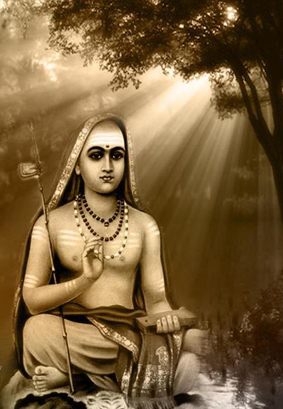
In fact, there are endless discussions in the academic world over details such as these. The sort of argument that is used takes a quotation from some writing attributed to Shankara, in which another person, place or quotation is used. If the date of that cited material is known, then it can be concluded that Shankara must have been living at a time later than this. (Such arguments enable the BCE dates to be discounted.) Unfortunately, in most cases, the dates of the cited person or place are not known either! Basically, Indians in the past have not been particularly good at recording their historical events. Plus, enlightened sages are not in the slightest bit interested in having their name associated with any recorded words or in having anyone record their biographies. Continue reading

Tattvabodha – Part 10

OLYMPUS DIGITAL CAMERA

Part 10 of the commentary by Dr. VIshnu Bapat on Shankara’s Tattvabodha.This is a key work which introduces all of the key concepts of Advaita in a systematic manner.

The commentary is based upon those by several other authors, together with the audio lectures of Swami Paramarthananda. It includes word-by-word breakdown of the Sanskrit shloka-s so should be of interest to everyone, from complete beginners to advanced students.

Part 10 looks at the five organs of perception and the six means of acquiring knowledge.

There is a hyperlinked Contents List, which is updated as each new part is published.

Tattvabodha – Part 9

OLYMPUS DIGITAL CAMERAPart 9 of the commentary by Dr. VIshnu Bapat on Shankara’s Tattvabodha.This is a key work which introduces all of the key concepts of Advaita in a systematic manner.

The commentary is based upon those by several other authors, together with the audio lectures of Swami Paramarthananda. It includes word-by-word breakdown of the Sanskrit shloka-s so should be of interest to everyone, from complete beginners to advanced students.

Part 9 looks at the makeup of the subtle body, its functions and purpose, from one birth to the next.

There is a hyperlinked Contents List, which is updated as each new part is published.

Reflections on Body-Mind and Liberation

shankaraThere has been much healthy debate recently on the Advaita Vision Blog about Liberation, who or what is a jnani or jivanmukta, and what it means to follow traditional Advaita. The theme of this post is that we cannot resolve such questions without first gaining a clear understanding of the body-mind and its role in the context of Liberation. What follows are some reflections inspired by a spirited discussion with Ramesam, with due credit to him for stimulating many of the thoughts below. Any errors or possible misunderstandings are entirely my fault. Or perhaps not, since “Words fall back from it.” Continue reading

Tattvabodha – Part 8

OLYMPUS DIGITAL CAMERAPart 8 of the commentary by Dr. VIshnu Bapat on Shankara’s Tattvabodha.This is a key work which introduces all of the key concepts of Advaita in a systematic manner.

The commentary is based upon those by several other authors, together with the audio lectures of Swami Paramarthananda. It includes word-by-word breakdown of the Sanskrit shloka-s so should be of interest to everyone, from complete beginners to advanced students.

Part 8 looks at the makeup of the gross body, its functions and purpose, and the modifications that it undergoes.

There is a hyperlinked Contents List, which is updated as each new part is published.