
 It might seem difficult to accept the Vedāntic assertion that knowledge is the one and only direct path to mokṣa. It might be difficult for some to accept that meditation isn’t a direct path to mokṣa, that yoga isn’t a direct path to mokṣa, that living a devotional lifestyle with prayer and hymns and attending temple / mosque / church isn’t a direct path to mokṣa. Too much has been invested in following these practices. So hearing that knowledge alone is what ultimately frees one from self-ignorance is something that raises resistance, because what’s meant by ‘knowledge’ is usually misunderstood. ‘The path of knowledge’ is seen as a dry undertaking that is suitable only for scholarly types, characterised by the need to understand Sanskrit, to follow convoluted arguments and study countless obscure texts. Continue reading
Tag Archives: shankara
Review of article on Shankara – Part 6, and final
 Maya
Maya
A tarka (reasoning, argumentation) is required for the analysis of anubhava, as both SSS and RB agree – consistent with Shankara’s position. That is, language and thought, needless to say, have a role to play, chiefly for exposition and analysis.
However, after two long, dense paragraphs RB contends: “If the tarka required to examine anubhava is itself completely dependent on ´sruti, then by no means is anubhava the ‘kingpin’ of pram¯an.as.”
Prior to this, SSS was quoted as maintaining that “for this unique tarka all universal anubhavas or experiences (intuitive experiences) themselves are the support.” The author states that this affirmation involves circular argumentation, and that to say that Shankara interprets the Vedas as being consistent with anubhava is wrong, the truth being the opposite: anubhava is consistent with the Vedas: “it should be clear that according to Sure´svar¯ac¯arya, the direct realization is directly from just ´sruti itself, thus satisfying the criteria for it to be a pram¯an.a…. The direct realization of the self is from ´sruti alone.” Continue reading
Review of Article on Shankara – part 4
THIS 4TH PART IS CURRENTLY UNDER REVISION AND WILL BE REPLACED BECAUSE BEING REPETITIVE IN PARTS WITH RESPECT OF PREVIOUS 3RD PART. FINAL PARTS ALSO TO BE REVISED Continue reading
upadesha sAhasrI part 10
Part 10 of the serialization of the presentation (compiled by R. B. Athreya from the lectures given by Swami Paramarthananda) of upadesha sAhasrI. This is the prakaraNa grantha which is agreed by most experts to have been written by Shankara himself and is an elaborate unfoldment of the essence of Advaita.
Subscribers to Advaita Vision are also offered special rates on the journal and on books published by Tattvaloka. See the full introduction and part 1 of the new series.
Review of article on Shankara – part 3
Ramakrishnan Balasubrahmanian (RB): “Now the error in calling avidy¯a as something epistemic should be obvious. The following extract, from [SSS], is clearly putting the philosophical cart before the horse:
‘Avidy¯a is subjective and has been explained by ´ Sa ˙ nkara as the natural tendency of the mind to superimpose the self and the not-self oneach other.’
When the conception of j¯ıva itself is due to avidy¯a, how can avidy¯a be the ‘natural tendency of the mind to superimpose the self and not-self’?” (*)
Our reply: To repeat, it is not just avidya as a general concept, that is, ignorance, but avidya-adhyasa, which is a technical (double) concept whose consequences are far-reaching in empirical life, being responsible for all divisions and superimpositions. No reason why this should be considered a circular argument. Continue reading
Q.343 – Meaning of Ishopanishad mantra
Q : The second line in the first Shloka of Ishopanishad begins with ” Tena tyaktena Bhunjeeta”. The literal meaning appears to be ” therefore, enjoy with a sense of tyaga or renunciation (as everything created in this world is permeated by Ishwara) but Adi Shankaracharya has interpreted these words to mean ” protect ourselves”. Is there a satisfactory explanation for this interpretation?
Also, the second word of first verse of Ishopanishad: is it vasam (is full) or vasyam (should be considered full). Shankara says vasyam. Vasam appears more logical to me.
A (Ramesam): In order to fully appreciate and admire the beauty and profundity hidden behind the simplicity of a cryptic statement, one ought to know the background and the context against which that expression gets developed. It is as much true when we talk of an equation such as E = mc^2 or a routine proverb like ‘Still waters run deep.’ Continue reading
Review of article titled ‘A New Approach to Understanding Advaita as Taught by Shankara Bhagavadpada’
(Ramesam asked me to review the following article, with which I complied after much hesitation. The article is over 40 p. long and quite dense and complicated in parts – in other words, ‘academic’: for specialists only; one could add: cutting the slices so thin, that the substance is practically lost, or forgotten).
Review of ‘A New Approach to Understanding Advaita as Taught by ´Sa ˙ nkara Bhagavadp¯ada’ – by Ramakrishnan Balasubrahmanian
The first impression, on a quick glance at the beginning of the article, is that the criticisms of the author contained in the article, and addressed to the writings of Swami Satchidanandendra Saraswati (SSS), a recognized sage and scholar, are extensive to the latter’s whole opus, as coming from an uncompromising position concerning the teachings and method of Shankaracharia. Some of the words and expressions used in the article are quasi-litigious (e.g., ‘intellectual arrogance’, ‘vociferously opposes’, ‘pointless’, ‘glaring inconsistency’, ‘making errors’, ‘misconstruing’, ‘twisting’, ‘has invented a new term’, etc.), reminiscent of the theological disputes and diatribes in the European Middle Ages. Evidently, SSS had his followers as well as his detractors, and the same can be said of the author of this article, who belongs to an opposite camp. Occasionally, he shows signs of (partial) approval of his adversary’s (if one can use this term) enunciates; for example: “No doubt SSS’s textual analysis skills are excellent, but the problem I see with SSS’s writings is his obsession with terminology, rather than philosophy. Indeed none of his works are about the philosophy of advaita [!], but are oriented almost exclusively towards contradicting previous commentators of ´Sa˙nkar¯ac¯arya”. And soon after that: “The difference between Padmapada and SSS is that the former is a philosopher, while the latter is a textual analyst”. Concerning these pervading criticisms of the work of SSS by the author, Ramakrishna Balasubramanian (RB), the reader may judge whether they are excessive, unwarranted, or justified.
The main criticism by the author, in respect of the interpretation of avidya by SSS, is that this is not due to a double superimposition of the self and the non-self, as the latter maintains, but only to a superimposition of a subject, non-self, on the self: “[T]he fundamental error is a superimposition of an observer on the real… and by a reverse process the inner self, which is the witness of everything, is superimposed on the inner-organ”. He calls this reverse act (or process, as he calls it) ‘natural’, since “a superimposition of observer on the self naturally leads to the imagination of objects ‘outside’ and ‘inside’ the observer, just as described by Gaud.ap¯ad¯ac¯arya”. He adds: “The usage of the continuative ‘adhyasya’ in the above passage also clearly indicates that the superimposition of an observer is avidy¯a and is prior to the reverse superimposition”.
Logically prior?, prior in time? Or simultaneous, by mutual implication? Continue reading
upadesha sAhasrI part 8

Part 8 of the serialization of the presentation (compiled by R. B. Athreya from the lectures given by Swami Paramarthananda) of upadesha sAhasrI. This is the prakaraNa grantha which is agreed by most experts to have been written by Shankara himself and is an elaborate unfoldment of the essence of Advaita.
Subscribers to Advaita Vision are also offered special rates on the journal and on books published by Tattvaloka. See the full introduction and part 1 of the new series.
upadesha sAhasrI part 7
Part 7 of the serialization of the presentation (compiled by R. B. Athreya from the lectures given by Swami Paramarthananda) of upadesha sAhasrI. This is the prakaraNa grantha which is agreed by most experts to have been written by Shankara himself and is an elaborate unfoldment of the essence of Advaita.
Subscribers to Advaita Vision are also offered special rates on the journal and on books published by Tattvaloka. See the full introduction and part 1 of the new series.
Book Extract – Bhagavadgita: The Celestial Song
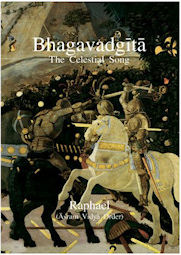
Extract: Action in Non-Action from the new book by Raphael.
Raphael interprets Shankara’s comments on the famous verse IV.18 from the Bhagavad Gita:
One who sees non-action (akarma) in action (karma) and action in non-action, is the wisest among men, he is one who has realized yoga, who has fulfilled everything.