The Darkness of Ignorance (Part 1)

Introduction

Any reader who has begun a study of Advaita will know that reality is non-dual, that who-they-really-are is Brahman or Consciousness. The seeker’s problem is that, although they acknowledge this as the ‘end point’, they do not yet really believe it. The purpose of the teaching of Advaita is to bring them to this realization – an ‘event’ in the mind which is called ‘enlightenment’.

It might seem self-evident that gaining this Self-knowledge is the same as ‘removing the ignorance’ which presently prevents that realization. But by changing the phrasing in this way, it is perhaps not surprising that some (both seekers and teachers) have then started to consider ‘ignorance’ to be an actually existent entity that ‘obscures’ the truth. It is seen to be analogous to the way in which darkness prevents us from seeing objects in a cave, for example. And there is a tendency for people to believe that darkness is a real entity also.

This way of looking at things is very common and has led post-Śaṅkara authors to pursue endless, esoteric arguments which are virtually incomprehensible to the non-academic mind (e.g. me!) and (as far as I can tell) have entirely failed to reach a consensus. I have addressed some of these issues in my book ‘Confusions in Advaita Vedanta: Ignorance and its Removal’ (it should be available from Amazon in 2025). Those discussions examine some of these aspects, although aiming to do so in a readable and understandable manner.

Continue reading

Advaita in the Vedas – Rig Veda 6.47.18

There is a verse in the Brihadaranyaka Upanishad which says, 

Indra, through Maya, appeared as many forms. [1]

It has been quoted by both Gaudapada and Shankara to illustrate how, through the illusion of Maya, Brahman appears as many. With knowledge of Advaita, this illusion is dispelled. 

The full verse says,

He shifted shape to match every shape, to manifest his shape. Indra, through Maya, appeared as many forms. his horses, hundreds and ten, are yoked.

Though quoted in Advaita literature, the verse is, itself, a quote — from the Rig Veda [2].

Continue reading

Q.547 – Māyā an attribute of Brahman?

A (Martin): Maya is not an attribute of Brahman. Maya is a diffuse, or polyvalent, concept which gives rise to much confusion, particularly by translating it as ‘illusion’ (see below). This concept can be viewed from the psychological, epistemological, and ontological perspectives.

Purely from the standpoint of Shankara’s  Advaita Vedanta, Maya is tied in with the concept of ‘ignorance’ (avidya), which is prior to it; that is, avidya is the necessary condition for Maya. Once ignorance has been annihilated by knowledge, Maya disappears. That means that from the higher (of two) points of view, Maya does not exist. This is contrary to most post-Shankara authors, with the exception of Sureshvara, who taught that Maya is a positive entity or force. If that were the case, how could a positive entity be removed by knowledge? Swami Satchidanandendra, practically alone in the 20th Cent. has defended the former, Shankarian position.

Continue reading

Advaita Gurus and Critics – part 6

by Prof. Phillip Charles Lucas

<Read Part 5>

Theme Three: Insufficient Grounding in Vedanta Traditions (concluded)

Tony Parsons articulates the NTMA counterargument on this matter quite clearly:

Traditional Advaita appears to make proper use of logic, reason, belief, and experience, rational explanation, truth, and traditional wisdom, all directed towards helping the seeker along the path to their enlightenment. The Open Secret’s apparent communication is illogical, unreasonable, unbelievable, paradoxical, non-prescriptive, non-spiritual and uncompromising. There is no agenda or intention to help or change the individual. Its resonance is shared energetically, not through the exchange of ideas. It is prior to all teachings and yet eternally new. [Tony Parsons, “Traditional Not Two-ness.”]

Waite counters that Advaita tradition, although holding a high degree of reverence for its scriptural corpus, does not regard the scriptures as a perfect articulation of absolute truth that cannot be questioned or clarified. Rather, they are a “reliable source of self-knowledge in which one can trust until such time as the truth is realized for oneself, at which time they are discarded along with the ignorance they helped to dispel.” [Waite, Enlightenment, 24, 37-39]

Continue reading

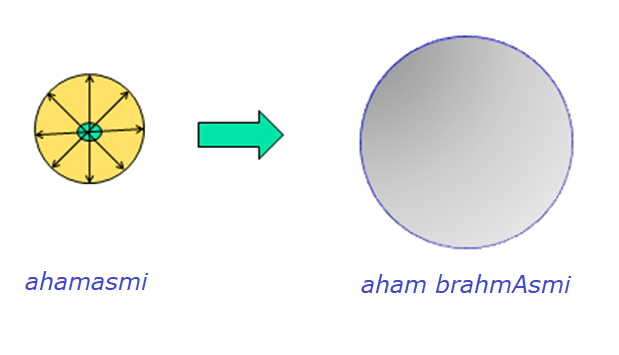
‘adhyAropa’ to ‘adhiSThAna’ – 4/4

Part – 3

What happens by the ascertainment of the implied meaning of the words in the sentence “You are That”?

Just as the idea of a snake is negated from a rope (in the snake-rope analogy), everything of the nature of non-Self is negated from the eternally existing Self implied by the word “I.” In other words, ‘ignorance’ vanishes (immediately on the attainment of right Knowledge) – 18.4-5, US.

In addition, the (false) conception of the pain with regard to the Self vanishes forever when the right Knowledge of the Self arises like all kinds of pain which is experienced in a dream comes to an end as soon as one wakes up.

What action should I take to augment my “understanding” and attain brahman?

Shankara tells us,

चतुर्विधमेव हि सर्वं कर्म कार्यम् — उत्पाद्यमाप्यं विकार्यं संस्कार्यं वा ।  – 1.2.12, muNDaka B.

Meaning: All the effects of actions are of four kinds: Production; Acquisition; Modification; and, Purification. Continue reading

‘adhyAropa’ to ‘adhiSThAna’ – 3/4

Part – 2

It is said that brahman Itself gets deluded by Its own magic. Does it not then imply that there is really creation and a (created) world out there?

Shankara is never tired of pointing out that there is actually no creation at all and the purpose of all the scriptures, when they talk of creation, is NOT to establish creation as a fact. For example:

1. न चेयं परमार्थविषया सृष्टिश्रुतिः ; अविद्याकल्पितनामरूपव्यवहारगोचरत्वात् , ब्रह्मात्मभावप्रतिपादनपरत्वाच्च — इत्येतदपि नैव विस्मर्तव्यम् — 2.1.33, BSB.

Meaning: “The Vedic statement of creation does not relate to any reality, for it must not be forgotten that such a text is valid within the range of activities concerned with name and form called up by ignorance, and it is meant for propounding the fact that everything has brahman as its Self.” Continue reading

‘adhyAropa’ to ‘adhiSThAna’ – 2/4

[Part – 1]

When and how does the process of ‘imagination’ (creation/projection) happen?

Shankara contends in his ‘adhyAsa bhAShya’ (Intro to his ‘Commentary on the brahma sUtra-s) that the formless, featureless and functionless, unbounded, immutable “Beingness” does not ‘cognize’ or ‘act’ unless Its Infinitude is somehow compromised. He writes, “The unrelated Self cannot become a ‘cognizer’ unless there are all these mutual superimpositions of the Self and the body and their attributes on each other, because perception and other activities (of a man) are not possible without accepting the senses etc. (as his own); the senses cannot function without (the body as) a basis; since nobody engages in any activity with a body that has not the idea of the Self superimposed on it.” [Slightly re-arranged the clauses for easy comprehension.] Continue reading

‘adhyAropa’ to ‘adhiSThAna’ – 1/4

    राजविद्या राजगुह्यं पवित्रमिदमुत्तमम् 
प्रत्यक्षावगमं धर्म्यं सुसुखं कर्तुमव्ययम्   — 9.2, BG.

[This is the Sovereign Knowledge, the Sovereign Profundity, the best sanctifier; directly realizable, righteous, very easy to practice and imperishable.]

What is this world that is available for our experience?

“The world is a ‘superimposition’ (adhyAropa). In other words, it merely appears to be present but does not really exist. It is like ‘casting forward’ a non-existing or unreal “form” (objects) onto the Eternal, Immutable and Real ‘Substratum’ (adhisThAna) or the Supreme Self,” avers the Advaita Vedanta. Because of our inherent inability to know what “exactly” is out there, our intellect ‘confabulates’ what could be present out there and ‘externalizes’ the internally imagined ‘form’ as a projection.

Shankara in his introduction to the Vedanta aphorisms (sUtra-s) explains to us that this ‘superimposition’ is natural (naisargika) to us – i.e., it exists from our birth itself. Left to itself uninvestigated, adhyAsa seems to have no locatable or known beginning-point (hence, anAdi); nor an end-point (hence, ananta).

No meaningful answer can be given to a question like “What is north of North Pole?” Similarly, a point of ‘beginning’ cannot be indicated for something which is outside of our familiar time-space dimensionality. “anAdi” also implies that it lies beyond our time-space framework. As a result, we find ourselves inexorably caught up in its snares and suffer the consequences as helpless victims trapped within the jaws of a mighty ‘diaphanous power.’

A superimposition or a projection is, however, an ‘action.’ There cannot be an ‘action’ without an ‘agent’ who does the act.

If I am just a ‘victim’ and not the doer of this projection, who is the ‘agent’ that does the ‘superimposition’? Continue reading

Q.539 Māyā and Brahman

A (Martin): 1) Māyā is not an attribute of Brahman which, as you say, is attributeless. Māyā is a diffuse, or polyvalent, concept which gives rise to much confusion, particularly by translating it as ‘illusion’ (see below). This concept can be viewed from the psychological, epistemological, and ontological perspectives.

Purely from the standpoint of Ṥaṅkara’s Advaita Vedanta, māyā is tied in with the concept of ‘ignorance’ (avidyā), which is prior to it; that is, avidyā is the necessary condition for māyā. Once ignorance has been annihilated by knowledge, māyā disappears. That means that from the higher (of two) point of view māyā does not exist. This is contrary to most post-Ṥaṅkara authors, with the exception of Sureśvara, who taught that māyā is a positive entity or force. If that were the case, how could a positive entity be removed by knowledge? Swami Satchidanandendra, practically alone in the 20th Cent. has defended the former Ṥaṅkarian position.

Continue reading

Q.537 Need for a Guru

A: It is highly desirable to have a qualified, traditional guru. There do not seem to be many of these around today and it is unlikely that you happen to have one conveniently close by! Consequently, the best you can do is to read books that reliably present material in the traditional manner (unfolding scriptural texts and Shankara commentaries) and listen to recorded talks from similarly reliable sources.

Continue reading