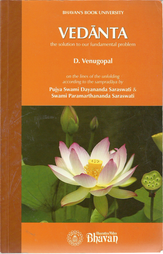
VEDĀNTA the solution to our fundamental problem by D. Venugopal
Part 33 explains the nature of mAyA and its relation to brahman and avidyA.
There is a complete Contents List, to which links are added as each new part appears.

VEDĀNTA the solution to our fundamental problem by D. Venugopal
Part 33 explains the nature of mAyA and its relation to brahman and avidyA.
There is a complete Contents List, to which links are added as each new part appears.
Part 18 of the commentary by Dr. VIshnu Bapat on Shankara’s Tattvabodha.This is a key work which introduces all of the key concepts of Advaita in a systematic manner.
The commentary is based upon those by several other authors, together with the audio lectures of Swami Paramarthananda. It includes word-by-word breakdown of the Sanskrit shloka-s so should be of interest to everyone, from complete beginners to advanced students.
Part 18 concludes the description of the ‘creation’ of the five basic elements and then moves on to the description of the evolution of the subtle sense organs of the jIva.
There is a hyperlinked Contents List, which is updated as each new part is published.

(Read Part 6 of the series.)
The Mind-Body Problem
Descartes’ separation of man into the two aspects of mind and matter also became the principal way in which Westerners subsequently viewed the world. Matter is extended in space, can be divided and so on, while mind is indivisible and seems to exist separate from the body, somehow outside of space. This is the theory known as Cartesian Dualism. Unfortunately, he was never able to explain how such completely different ‘substances’ were able to interact. The idea of an immaterial ‘little me’ somehow sitting in the brain (Descartes thought the soul resided in the pineal gland) and interpreting the information transmitted from the eyes and other material senses just did not make sense. How could this interface work? The so-called ‘mind-body problem’ has intrigued philosophers ever since and no universally accepted model of the nature of the self has yet emerged.
One of his disciples, a Dutchman called Arnold Geulincx, suggested that the mind and body were separately governed by God, who kept the two in synchronisation, like clocks. Thus, when we decide to do something and it happens, such as getting out of bed, there is no actual interaction between the two, no ‘willing’ as such, it is simply the consequence of the two being synchronised. A similar theory, called Occasionalism, was proposed by the French priest, Nicolas Malebranche. He said that neither mental nor physical events cause other events. Instead, what we call a cause is simply the occasion for God to exercise his will and instigate what we call the effect; there is no actual connection between the two events at all. All of this meant that life is strictly deterministic, with no place for free will and everything happening according to physical (or divine) law. Continue reading

An essay by Michael Damian
Self-realization is a matter of clarifying the relationship between experience and truth, which in our habitual, conventional view is entirely clouded. In this existence we can speak of three modes of perception or experience. Each of them has a different relationship to the ultimate truth. Let’s begin with the mode where most of humanity lives:

Understanding Reality
in the Vision of Advaita Vedānta
by Wolfgang P., wpl@gmx.net
Read Part 1 of this article
Let’s use this method of inquiry to investigate another ubiquitous entity: What is the reality of money? Ask someone on the street if money is real, you would hardly find anyone doubting it. But what actually ‘is’ money? We assume it is real, but what is the substratum of its reality? Is it independently real or does it depend on something for its existence? Is money just the amount of coins in your wallet? Certainly not, since money also appears as bills, cheques, and as digital data. Today the majority of the world’s money is stored as binary code on hard drives. Is the reality of money the binary code on the hard drive, which is storing the balance of the bank account?
Let’s imagine, an alien species visits our planet for the first time. In their foreign culture the concept of money is unknown. Would it be obvious for them to learn what money is, by simply investigating the data of the hard drive? All they could do is extract the data, but they would lack the contextual information about what to do with it. Therefore, money, which seems very ‘real’ to us practically, has no physical substratum. It is only by convention that coins, bills, or digital data act as a symbolic carrier for money. The reality of 10 USD does not originate from a 10-dollar bill. If the money were ‘in’ the bill, it would be impossible to replace an old bill for a new one. Physical carriers, like coins or bills, act as a medium for money, but they ‘are’ not money. Continue reading
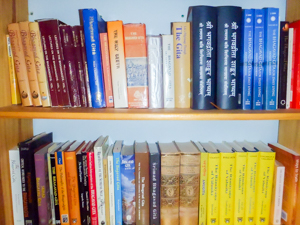 Many books (transcription of talks) by Swami Paramarthananda are available at www.arshaavinash.in. This includes a number of Upanishads (Mundaka, Mandukya, Brihadaranyaka, Kena and more), Bhagavad Gita, Brahmasutra with Shankara bhAshya and many other key scriptures such as upadesha sAhasrI, vivekachUDAmaNi, dRRig dRRiShya viveka etc. These cannot be recommended too highly.There are also books on Sanskrit grammar and a biography of Pujya Swami Dayananda.
There is an associated Google goup – https://groups.google.com/group/arshaavinash – and members are informed when new additions are made to the library.
Ignorance is a fundamental concept in Advaita and most people who call themselves Advaitins will believe that they understand what it is. After all, enlightenment is often equated to the gaining of Self-knowledge, which is equivalent to the removal of ignorance. Here is the definition of avidyA in John Grimes’ excellent ‘Concise Dictionary of Indian Philosophy’:
“It is the key concept in the Advaita Vedanta system. It serves as the cornerstone for Advaita Vedanta metaphysics, epistemology, and ethical disciplines; thus its role cannot be belittled. It is characterized by six marks: it is beginningless (anAdi); it is removed by right knowledge (j~nAna- nivartya); it is a positive entity of the nature of an existent (bhAva rUpa); it is indescribable (anirvachanIya); it has the two powers of concealment and projection which respectively represent the truth and suggest the false (AvaraNa and vikShepa); and its locus is either in the individual self (jIva) or in the Absolute (Brahman).”
And this is pretty much how most teachers and writers use the term. For example, in ‘Back to the Truth’, I said: “As long as the ignorance remains, there will be identification of one form or another and we will believe ourselves to be other than our true nature. The ignorance is said to be anAdi, without any beginning, and it will continue until it is removed by knowledge and enlightenment dawns.” This is backed up by shruti. The sarvopaniShad, for example, says (verse 1): “…this egoism is the bondage of the soul. The cessation of that egoism is mokSha, liberation. That which causes this egoism is avidyA, nescience.” Other, later scriptures echo this; e.g. the advaita bodha dIpaka: “Though the Self is Brahman, there is not the knowledge of the Self (being Brahman). That which obstructs the knowledge of the Self is Ignorance. Just as ignorance of the substratum, namely the rope, projects the illusion of the snake, so Ignorance of Brahman projects this world.” Continue reading
VEDĀNTA the solution to our fundamental problem by D. Venugopal
Part 32 concludes the ‘definition’ of brahman and then begins to look at brahman as the cause of the manifestation.
There is a complete Contents List, to which links are added as each new part appears.
Q: I am reading Dennis’ book ‘The Book of One’, and I am on the chapter about deep sleep.
From the age of around seven ( I am now 51), I have had a morbid terror of sleep. Not dreaming sleep which I enjoy (I am one of those rare people that has quite regular lucid dreams), but deep sleep, and equate it with “unconsciousness or non-consciousness” or death which leads to death anxiety. I understand that this fear is a result of constructs that I have devised, and am my own torturer. But the enquiry in this book and other books on Hinduism I have read seems to be returning me to the same cul-de-sac that is the dead end of my search.
Just reading the chapter now left me cold with fear and even worse complete dissappointment, as it doesn’t feel intuitive to me that this is our natural state? I really don’t want to return here at all, is this a normal reaction people feel when they are introduced to this concept?
I am not an intellectual. I have persevered with the book and it’s concepts, even though at times it is quite clearly beyond my comprehension. But is that it? Is that all there is? A kind of acceptance of annihilation of this ego-mind… forever?
I have some recollection of the Indra story where they ask the same question of Prajāpati and wasn’t quite satisfied?
Will this fear pass?
A (Dennis): You should take up meditation with the determination to practice fully. The nature of this would depend upon which method you chose. I took up mantra-based meditation similar to TM, which required 30 mins practice twice per day. This sounds impossible to begin with I know but, after a few months, it becomes part of your routine. And you benefit in so many ways, both mentally and physically. But the point is that, eventually (the time varies from one individual to another), you reach the point where you begin to experience periods of samAdhi. At these times, your mind becomes totally still. You are still aware of external and internal events but you remain entirely detached from both. You know that you are neither the body nor the mind but the observer of these. There is no ego at these times because you recognize this independence. Ego IS identification with one or other.
In deep sleep, you do not experience anything. But this is because there is nothing to experience, not because ‘you’ have disappeared. You see neither external world (because the senses are inactive) nor internal thoughts (because the mind is inactive). But the Self that is the witnessing Consciousness in deep meditation is still present in deep sleep. It never ‘sleeps’ (or dies) because it is the only thing that really exists. It is who you really are.
Hope this helps!
Part 17 of the commentary by Dr. VIshnu Bapat on Shankara’s Tattvabodha.This is a key work which introduces all of the key concepts of Advaita in a systematic manner.
The commentary is based upon those by several other authors, together with the audio lectures of Swami Paramarthananda. It includes word-by-word breakdown of the Sanskrit shloka-s so should be of interest to everyone, from complete beginners to advanced students.
Part 17 begins the analysis of creation. The nature of mAyA is explained and the description of the five basic elements is begun.
There is a hyperlinked Contents List, which is updated as each new part is published.