Serialization of Yogavasishta 5

Professor Sri Kuppa Venkata Krishna Murthy, Chairman and Managing Trustee of I-SERVE, the Institute of Scientific Research on Vedas, has kindly given permission for Advaita Vision to serialize his 6-volume ‘Musings on Yogavasishta’. Written in Telugu, the work has been painstakingly translated by our Dr. Ramesam Vemuri and published by Avadhoota Datta Peetham.

Rather than reproducing successive extracts from the books each month, as has been done with our other two serializations, the books themselves will be made available for download in PDF format. Each part will be associated with a page at the main website, which will contain a Contents List for that volume. Links to all of the volumes will be provided on a general Contents Page.

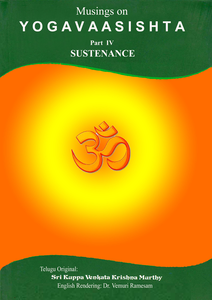
The present volume, “Musings on Yogavaasishta” – Part IV Sustenance, is a presentation by Brahmasri Kuppa Venkata Krishna Murthy, the Vidyadhikari of Avadhoota Datta Peetham, Mysore and Chairman, Institute of Scientific Research on Vedas (I-SERVE) and forms a part of his lectures on “Yogavaasishta” telecast by GEMINI T.V. in Telugu. This volume is a rendering of the same into English by Dr. Vemuri Ramesam. In it: The 3000 stanzas of the fourth chapter on Sustenance (Stithi) have been ably condensed and lucidly explained in simple words. Possible methods of alleviation from the state of Bondage and annulment of mind are described through the stories of Bhargava, Daama, Vyaala, Kata, Daasura, and others.

Please go to the Contents Page to read the Announcement and general introduction from Ramesam. The page for this Fourth Volume, Part 4 (SUSTENANCE) also contains the download link for the PDF file (0.6MB).
Webinars with Chinmaya International Foundation

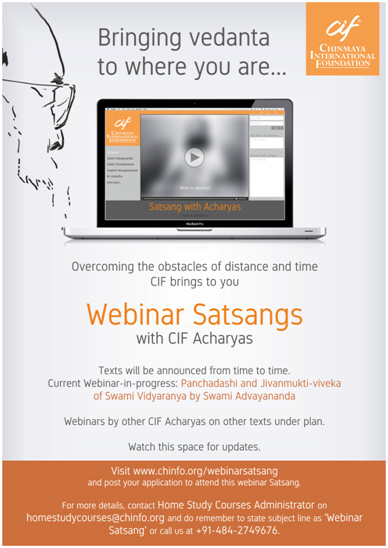
I have just received notification of the webinars which are being run by Chinmaya International Foundation. These are conducted on-line with audio and video content, covering both introductory and advanced texts – an opportunity to study with a traditional teacher when you do not have physical access to one! They are for serious students and feature Q & A sessions (in both directions!). Sounds excellent!

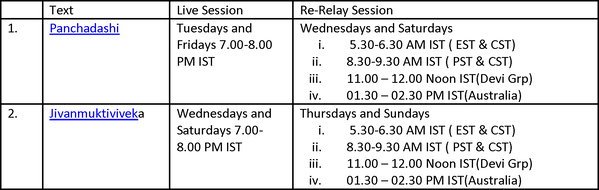
Here are brief details of current courses:

For more details about the courses and how to apply, look at their website.

If any visitor to this site takes up the offer, I would be interested in hearing back from them as to how they get on.

Knowledge and Enlightenment

Over the past few months, we have had several posts following which there were discussions in which some participants attempted to argue that knowledge was not the direct cause of enlightenment. Alternative suggestions have been that enlightenment comes with nirvikalpa samAdhi or that one has to pursue some course of action, such as asking ‘Who am I?’.

I argued that neither of these were the case; that ONLY Self-knowledge could give enltightenment. This is primarily because ignorance is the cause of saMsAra and knowledge, not action, is opposed to ignorance. And I said that I would endeavor to find quotations from scripture or from Shankara to support this contention (since some participants were not prepared to accept arguments from such as Swami Dayananda).

Below, I have compiled a brief list of some of those quotations and hope these should be adequate to convice readers that the above is the stance of traditional Advaita and it is supported by clear, reasoned argument. Continue reading

Tattvabodha – Part 13

OLYMPUS DIGITAL CAMERA

Part 13 of the commentary by Dr. VIshnu Bapat on Shankara’s Tattvabodha.This is a key work which introduces all of the key concepts of Advaita in a systematic manner.

The commentary is based upon those by several other authors, together with the audio lectures of Swami Paramarthananda. It includes word-by-word breakdown of the Sanskrit shloka-s so should be of interest to everyone, from complete beginners to advanced students.

Part 13 concludes the exmaination of the states of experience with the deep-sleep state and begins to look at the metaphor of the five sheaths, from the Taittiriya Upanishad. This part explores the sheath made of food.

There is a hyperlinked Contents List, which is updated as each new part is published.

Overview of Western Philosophy – Part 2

Topazwo-33832

(Read Part 1 of the series.)

Part 2 – Metaphysics

Metaphysics, as the study of the questions of ‘life, the universe and everything’ is known, fell out of vogue in the twentieth century, when the attitude arose that most of what had previously been thought to be intransigent problems were not really problems at all but arose through our inability to formulate the problem correctly. Once we used language properly, it was argued, the difficulties would disappear. Many recent philosophers have not even addressed the sort of fundamental questions that are being asked on this site. In this respect there is a similarity with science. There was a time when an enquiring mind could range over the entire domain of what is now thought of as ‘science’, becoming expert in many areas and making new discoveries. The amount of material that was written down and accepted as proven was minimal. Over the past few centuries, the rate of investigation and discovery has accelerated and it is now possible to conduct novel research in only a tiny area of specialisation. In the 3rd Century BC, Aristotle’s multi-disciplined enquiries have already been noted. By the 20th Century, most of the philosophy in England was devoted to analysing the meanings of sentences! Continue reading

The Mystery – Part 3

Continuing this new, short series presenting the booklet by Bimal Prasad, in which he answers some ‘Rarely Asked Questions’ on Life. Primarily from the perspective of Advaita, questions addressed include the nature of happiness, consciousness, mind and ego. There is also practical guidance on meditation in the final chapter. Answers are relevant and succinct, so that many of the issues of interest to the seeker are covered.

This third part is entitled ‘Pointers to Consciousness’ and answers questions about the nature of existence, reality, truth and consciousness. See the Contents List or go straight to Part 3 of the series.

The complete (electronic form) booklet may also be purchased from Amazon.

Q.384 – Dark night of the soul

Q: Please help me.I had a temporary glimpse of reality around 15 months ago by following 8 fold path. I tried to penetrate the question of suffering and learned that everything wants to come into Equilibrium (a known chemistry fact) due to which my thought trains stopped and I got an instant realization of something called reality. After that, I experienced I am a silent witness and not mind, body, ego, etc.

This faded away after some time and now I am in mental anguish and turmoil. I don’t know what is happening in my mind but it is disturbed or in what people call the “Dark night of soul”. Every joy is lost now; I get angry easily and have feelings of despair from something. Maybe it is because I didn’t discipline my mind with ethics before starting this practice for enlightenment. Please save me now. Whatever is going on in my head, save me from it. I don’t know how to complete surrender unto reality and may be this is due to the hold of ego. Please help!

A (Dennis): The teaching tradition of Advaita is all about Self-knowledge. You listen to the teaching from a qualified teacher (ideally) or read about it and discuss it (less good). You ask questions about it to resolve your doubts. Eventually, you realize that what is being said is true and that is that. In theory!

The problem is that you need a clear, self-controlled mind and some trust in the teacher, the ability to discriminate and so on. These ‘skills’ are not really a part of Advaita – they are mostly lifted from Patanjali’s Yoga system. If you have no mental discipline along these lines, you are never going to be able to assimilate the teaching. You need at least a medium level of attainment. With that you can take on board the knowledge and then continue your practices until you reap all the other benefits (peace of mind, fearlessness and so on).

From what you say, I would advise that you forget about Self-knowledge for a while and concentrate on acquiring the mental skills. Meditation is invaluable. And, if you have no religious-type outlook (praying to a god and so on), then the practices of karma yoga are the other main route – doing what is in front of you because it needs doing, ignoring desires and not expecting any results. And so on!

I do not know anything about Buddhist methods so cannot really comment. I would forget about ‘dark nights’. The main thing to remember, even if you don’t yet believe it, is that the world is not absolutely real. Your body, mind and everything else have empirical reality only, depending ultimately on Consciousness, which is the only reality. And you are That.

Free Will versus Fatalism


Below is another essay from Atman Nityananda whose earlier essay on sAdhana triggered so much interest. This is preceded by an essay on the same topic from Swami Sivananda.


Free Will versus Fatalism
by Swami Sivananda

The controversy between free will and fatalism is still going on in the West and no one has come to any definite conclusion. It is a great pity that the doctrine of Karma is mistaken for fatalism. Fatalism is the doctrine that all events are subject to fate and happen by unavoidable necessity.

Fate is otherwise known as luck or fortune. That indefinable mysterious something which brings trials, successes and failures to man, which shapes and moulds him by teaching lessons of various sort, which takes care of him like a mother, which brings various sort of experiences, which brings cloudy days and days of bright sunshine, which raises a beggar to the level of a landlord and hurls down a mighty potentate to the level of a street-beggar, which gives different kinds of fruits and experiences to two people of equal talents and capacities, which made Napoleon at one time a terror in the eyes of the people and at another time a prisoner, and which makes a certain portion of the life of a man quite stormy and another portion quite smooth, is called fate. Fate educates and instructs man. However whimsical the fate may appear to operate, it works in harmony with the law of causation. Continue reading

Nisargadatta terminology

A frequent contributor to the site, Vijay Pargaonkar has provided the following valuable information rearding the terminology of Nisargadatta Maharaj:

When references to Nisargadatta Maharaj and his teachings come up at the AV forum during discussions, the arguments often seem to become tangential. I think this is mainly due to the differences in terminologies and definitions used by the followers of Nisragadatta and the ones used in traditional Advaita forums.

Last week I came across a rare Satsang tape in Marathi where Maharaj clearly lays out his version of the Creation Model and Prakriyas while explaining various Advaita terms according to his definitions. I have excerpts of this Satsang translation (as I heard and understood) below, where I have indicated the Sanskrit/Marathi terms along with the English terms used by the translator – the translator has actually chopped the live recording and inserted his English translation in between.

Creation Model

Prior to your waking is Nirguna, the substratum of Waking. The Nirguna is not at all bothered by this samara (samara = ‘war (of life)’). In Nirguna appeared knowledge (Bodha).  This is pure Consciousness or Beingness or the Sense “I am” that has no shape or form. In this pure Consciousness there appeared a slight perturbation or movement and the pure Consciousness then grabbed a body-form (deharupa). After wearing this body form it started calling itself a man or woman while bound by different concepts (I am this; I am that; I am going; I am coming etc.). These concepts are all imaginary (Kalpana) and not real. Continue reading