VEDĀNTA the solution to our fundamental problem by D. Venugopal
Part 13 discusses the qualifications of uparati, titikShA and shraddhA.
There is a complete Contents List, to which links are added as each new part appears.

VEDĀNTA the solution to our fundamental problem by D. Venugopal
Part 13 discusses the qualifications of uparati, titikShA and shraddhA.
There is a complete Contents List, to which links are added as each new part appears.
All visitors are cordially invited to ask questions, which may be answered by any or all of the bloggers. The existing list of questions have already been answered and it is very likely that you will find something of relevance. However, as yet, they have not been sorted into categories so that you may have difficulty locating something! Accordingly, if you want to ask a question, and do not object to its being included in this section, please email me. (Note that all Q & As are posted anonymously, but you will receive a personal notification when this is done.)
 I am the light that is above them all, I am the all,
and the all came from me and the all attained to me.
Cleave a piece of wood and I am there;
lift up the stone and you will find me there.
You can find thousands of sayings like this in the Upanishads, in the Gita, in Buddha, but you cannot find a single parallel in the Old Testament. So which scriptures has Jesus come to fulfill? He has come to fulfill some other scriptures, some other traditions. This saying is absolutely Vedanta, so try to understand first the standpoint of Vedanta, then you will be able to understand this saying.
Jesus was born as a Jew, lived as a Jew, died as a Jew – but this is only as far as the body is concerned; otherwise Jesus was a pure Hindu. And you cannot find a purer Hindu than Jesus, because the base of Upanishadic religion is his base. He created the whole structure on that base, so try to understand what that base is. Continue reading
 Q: I’ve read something in Advaita about making meaning out of meaningless events. Are there any events to which meaning can be given?
A: You need to be a bit more specific here. But you are in any case talking about the empirical level of experience, not absolute reality. Time (and hence ‘events’) is within the former; it is not absolutely real. Similarly, there are no separate ‘objects’ (or ‘people’) in reality. Whether or not an event is ‘meaningful’ is going to be a subjective opinion! If you want my subjective view, there are probably only two meaningful events: when you commit to Self-inquiry and when you realize the truth! Continue reading
 sa~NkalpajAlakalanaiva jagatsamagraM
sa~Nkalpameva nanu viddhi vilAsacetyaM
sankalpamAtramalam utsRRijya nirvikalpa
mAshritya nishcayam avApnuhi rArna shAntiM (39)
VASISTHA continued:
To illustrate this there is an interesting legend. Kindly listen to it,
A young boy asked his nanny to tell him a story, and the nanny told him the
following story to which the boy listened with great attention:
Once upon a time in a city which did not exist, there were three princes who
were brave and happy. Of them two were unborn and the third had not been conceived. Unfortunately all their relatives died. The princes left their native city to
go elsewhere. Very soon, unable to bear the heat of the sun, they fell into a swoon.
Their feet were burnt by hot sand. The tips of grass pierced them. They reached
the shade of three trees, of which two did not exist and the third had not even been
planted. After resting there for some time and eating the fruits of those trees, they
proceeded further. Continue reading
 Part 1 of a 3-part essay by Dr. K. Sadananda, AchArya at Chinmaya Mission, Washington.
Science is Objective
The word science is derived from the root ‘scire’, meaning to know. Hence science really means knowledge which reveals a fact or truth. In Sanskrit, ‘vid’ means to know, and ‘veda’ means knowledge. Combining these two statements we can say that Veda means science. Vedanta means that which reveals the ultimate knowledge or absolute truth. From this, it follows that Vedanta is the ultimate science. This is not a fanatical statement but a statement of fact, as in ‘Light travels at 299,792,458 m / s’. This is not an opinion or belief but just plain fact, whether one believes it or not. We will examine here why Vedanta is the science of absolute.
Epistemologically, the word ‘knowledge’ without a qualifier, cannot be defined. The qualifier objectifies the knowledge as in ‘knowledge of Chemistry’ or ‘knowledge of Physics’, etc. It is always knowledge of something. It can be knowledge of the physical or phenomenal world, or knowledge of some subtle entities such as emotions, thoughts, intellectual concepts, etc. The former can be considered as the knowledge of gross entities that can be known via sense input, while the latter can be called the knowledge of subtle entities and can be known without the need of any sense input, or can be inferred indirectly from the sense input. Continue reading
Creation
The ‘original’ topic for discussion! Lots of potential material here. I have a number of interesting extracts to post, as soon as I can get around to scanning them in.
Meanwhile here are a couple of my favorite quotes, which I used in ‘Book of One’:
In the beginning the Universe was created. This has made a lot of people very angry and is widely regarded as a bad move. Douglas Adams
In the beginning there was nothing and God said ‘Let there be light’, and there was still nothing but everybody could see it. Dave Thomas (This one especially for budding Buddhists)
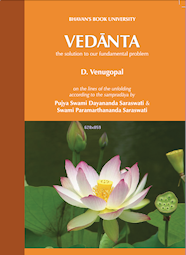
VEDĀNTA the solution to our fundamental problem by D. Venugopal
Part 12 discusses the qualifications of vairAgya, shama and dama.
There is a complete Contents List, to which links are added as each new part appears.
Q: I think I understand “Dispassion” and it’s importance, I’ve read “even loathing for worldly objects”. But I do have some passions or so it feels like it. For instance, I enjoy fabric and sewing “alot” is this just Brahman? At times it feels like an addiction. I don’t think there are judgements againt whatever passion one may have?? I guess I am just a bit confused. I am I guess in the beginning of my journey.
A (Ted): The Sanskrit word for “dispassion” is vairagya. Vairagya is defined as “indifference to the results of one’s actions.” Thus, dispassion is not so much a matter of the absence of desire as it is a matter of not depending on the satisfaction of any desires one does harbor for one’s sense of wholeness, completeness, and wellbeing.
As long as one is ignorant of one’s true nature as whole, complete, limitless awareness, one’s desires spring from a sense of incompleteness and inadequacy. In other words, discomfited by the mental, emotional, and physical limitations with which one seems afflicted as an apparent person, one feels that if one obtains certain desired objects, attains a certain desired status, achieves certain desired goals, accomplishes certain desired feats, or becomes established in a certain desired state of mind, then one will transcend the limited, inadequate, incomplete person one takes oneself to be and consequently become better or whole or even enlightened. Continue reading
 As you know, it is difficult to assess what another person ‘experiences’. It is also difficult to equate various words that might or might not mean the same thing to one person or everyone. Not sure if this is possible. Probably not. So, the following is not the gospel. I could be mad, mistaken, and a fool. Being foolish is not the worst thing. Feel free to call me names like Martin does.
For me, the word awareness has to constitute both subject and object. Someone or thing is aware. It is a function of the human being. We all have it and it is functioning right now. For me, all awareness functions within the context of self and consciousness, self and consciousness being virtually the same thing. I am talking about what constitutes self, not about self’s true nature. Self’s true nature has to be devoid of self completely and therefore out of the realm of all consciousness. Thus, it is also devoid of awareness as this is a function of our human nature, not our true nature. Normal death erases all experience and awareness but not our true nature.
Our human efforts can only concern itself with our human nature and that lasts maybe 70-90 years. To know thyself is a human endeavor that involves using observation. How else can we understand anything? Mind is involved to be sure. Everything we know is reflected in the mind. But this doesn’t seem to be the case with our true nature. Our true nature is not a reflection of our human life. No human faculty can know its true nature, only the human nature can be known. The only way we can ‘know’ our true nature is through the ending of this separate self that we call ‘me’, ‘I’, etc. And, it is not possible for our human nature to bring an end to itself. From what I have read of the sages, conversations I have had with sages (of course, the ones I think are sages!), it happens in a blink of an eye. You are simply swept away. It is a revelation, not an attainment. It is not a result. There are no levels of attainment, only levels of self. No true self. The body may remain, but no person inhabits it. True nature and human nature are not compatible. You can’t have your cake and eat it, too, as the saying goes. To know the self is to forget the self. But forgetting the self is not erasing it from memory. It’s erased from your whole being.
As others have said our own existence is common to us all. By observing this sense of existence, me, self, being it, breathing it, living it, you by-pass all the mental analysis and duality that most are involved with. The sense of problem is relieved and a kind of centeredness that focuses this observation can be felt and deepened. This centeredness is a gateway that our true nature reveals itself through and brings an end to all forms of self.
Posted by ‘Anonymous’