
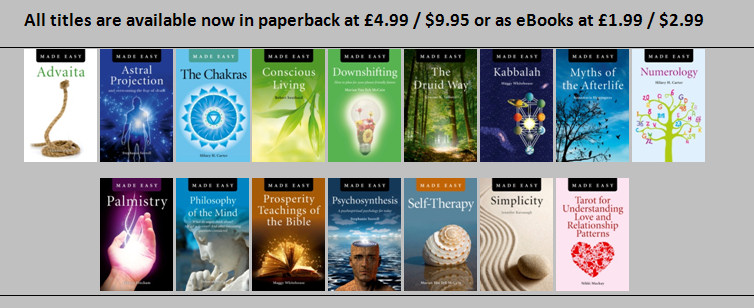
 John Hunt Publishing’s various imprints have built a series of Made Easy titles. They cover a whole multitude of spiritual ideas and disciplines. It is a collection of brief introductions which reveal alternative spiritual insights, paths and truths to new and experienced seekers whatever their current faith, practice or creed.
Author Archives: Dennis
Depression – Q.330
Depression – Q. 330
Q: For years now I’ve been severely depressed and it doesn’t seem to be changing. What led me to Advaita, I think, was the intense desire to know what I guess I can only meaningly refer to as God.
I read a lot about how we are not our bodies and how if we can be aware of something, then that ‘something’ cannot be us. I understand all this. There is a formless awareness that appears to be prior to everything, prior to my body, my mind and the suffering of depression, I can see that.
One book I’ve read, not specifically about depression, advises that we remain with that awareness, as that awareness that is prior to both body and mind. However, I find this difficult. The body and mind come out of the Self and thus must be the Self. Beyond this the reasoning and experience of it gets quite subtle, but I’ll give it my best shot. Yes, there is an awareness that is before the mind and body, something that you might call the Ultimate subject, but It is only apparent because of the body and mind – without the body and mind, the Self wouldn’t know itself. Continue reading
Subscription Deletions

We have recently been receiving large numbers of what appear to be spurious subscriptions to the site, presumably for the purpose of spamming.
Accordingly, new subscriptions have temporarily been suspended and a number of existing subscribers have been deleted. The criteria for deleting these were as follows:
. Username unnecessarily long, with random alpha characters or numbers.
. No Name field entered.
. Email address suspect in a similar way, or closely resembling those of other subscribers.
. No posting activity since subscribing.
(If there had been posts or if a name had been entered, then the subscriber was not deleted.)
My sincere apologies if any valid subscriber has been deleted but I am sure you will understand and accept the error. Please re-subscribe and ensure that you enter your name and preferably use a Username that does not look as though generated by a computer!
If I have inadvertently deleted anyone who was not guilty of the above misdemeanours, then I doubly apologize!
I will reinstate the subscription facility in a few days.
upadesha sAhasrI part 6

Part 6 of the serialization of the presentation (compiled by R. B. Athreya from the lectures given by Swami Paramarthananda) of upadesha sAhasrI. This is the prakaraNa grantha which is agreed by most experts to have been written by Shankara himself and is an elaborate unfoldment of the essence of Advaita.
Subscribers to Advaita Vision are also offered special rates on the journal and on books published by Tattvaloka. See the full introduction and part 1 of the new series.
Bhagavad-Gita and Advaita – Q. 329
Q: How would it be possible to deal with our common Bhagavad Gita in terms of Advaita Vedanta?
A (Ramesam): Please appreciate that Bhagavad-Gita is not the primary or basic text for Advaita. Though many of the verses in it are almost exact mantras from various Upanishads, prior to Sankara (8th Century A.D), Bhagavad-Gita was not perhaps as popular a scriptural text for teaching Vedanta as it is today. It was a part of the mythological story, Mahabharata. Some people hold that the Bhagavad-Gita of Mahabhrata contained 745 verses. Some others opine that the original Gita was much smaller and it was Sankara who compiled the present Gita putting together diverse verses from different sources. None of these opinions, however, have any credible supporting evidence. The first extant gloss on the Gita is by Sankara and it contains 700 verses (one or two verses are still disputed and said to have been later insertions). Continue reading
The Dream Problem part 8
 Part 8 of the New Book Serialization!
The sage Vasishta explains the working of the power of suggestion in creating both the dream world and the waking, the need for desireless ness and describes a metaphor for conceiving the nature of ultimate reality.
Non-dual Reality – Q. 328
Q: Can one ever KNOW that reality is non-dual?
A (Ramesam):
(i) YES, The moment you can grasp tight your reflection in the mirror!!!
(ii) No, you cannot know it like you know the salary you get.
(iii) Yes, you cannot ever NOT know it; what all IS, is your perception alone.
(iv) No, if you place yourself aloof trying to know it as a distant object.
(v) Yes, you know It in your deep sleep.
(vi) No, if you want to measure and compare to duality. Continue reading
Vegetarianism – Q. 327
Q: I need clarity on some questions.
01. The understanding is everything is life/consciousness/totality, it is the totality that functions through animals including human beings ( so-called separate entity/Body Mind Organism) and life/god/consciousness’ true nature though indescribable in words has been described as Sata Chit Ananda in other words peace love etc. So my question is if that is true why animals attack and kill, when they too have Life? Though humans too do that but, Master has good explanation for that under Advaita teaching as to why humans possibly do wrong or kill. One answer some what suffices when it comes to humans in particular as to why they kill or do wrong, i.e. when this impersonal consciousness identifies with the body and mind suit, there is every chance that actions that will happen will be imbued by the understanding that I am a body and so are others and actions with ignorance can take place, but the question is what about in the case of animals, why they do kill/attack if they have Life or rather they are Life? Continue reading
Mandukya Upanishad – part 1
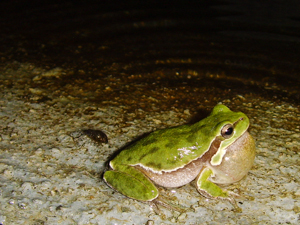 Here is Part 1 of a new, short series (5 or 6 parts) on the Mandukya Upanishad, from James Swartz.
This first part talks about the means for obtaining knowledge and the meaning of the word ‘limitlessness’, using the snake and rope metaphor.
(In case you are wondering about the photo, the title of the Upanishad is sometimes claimed to be derived from the Sanskrit ‘maNDa’, meaning ‘a frog’.)
Panchadashi series
Some of you may remember that I was posting a series of posts, presenting a new translation and commentary by James Swartz on the Panchadasi. Apologies for the long delay since the last post.
James and I had begun this collaboration on turning his lecture notes into a new written commentary on the text. But we have realized that this would require long-term commitment and we are both too busy at present. Accordingly, this is being postponed indefinitely. Meanwhile, he has given his permission for us to serialize some of his other writing, beginning with his essay on the Mandukya Upanishad. So see the next post!