Why do people talk so much about themselves?

“The ability to communicate—with almost anyone, about almost anything—has played a central role in our species’ ability to not just survive, but flourish. If you’re like most people, your own thoughts and experiences may be your favorite topic of conversation.  On average, people spend 60 percent of conversations talking about themselves.


Why, in a world full of ideas to discover, develop, and discuss, do people spend the majority of their time talking about themselves? Recent research suggests a simple explanation: because it feels good.

In an initial fMRI experiment, researchers compared neural activation during self-disclosure to activation during other-focused communication. Three neural regions stood out. (See the figure at top left showing the brain  cut vertically in the middle – the forehead is to the left and the back of the head to the right in the picture).  Continue reading
Expert on Truth vs. Knower of Truth

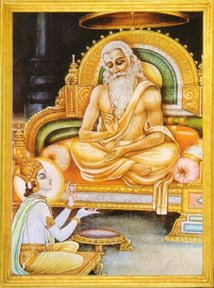
Sage Vasishta

Sage Vasishta

[Sage Vasishta points out to Rama the subtle difference between actually Knowing the Truth having obtained a clear understanding after a study of Non-dual Teaching and merely acquiring scholarly proficiency as an expert  and advises further on how a sincere seeker should proceed in the matter.  This discourse takes place in the 21st Canto of the Book II (Second Part) of the Chapter Nirvana in Yogavaasishta.  A slightly edited excerpt from “Yogavaasishta, Part VI” (by Shri K.V. Krishna Murthy, English rendering by Dr. Vemuri Ramesam, Avadhoota Datta Peetham, Mysore 570025, India, 2013, pp: 356) is presented below – ramesam.]


Sage Vasishta:  A man should not become an Expert on Truth but should be a Knower of Truth.  In my opinion, it is better to be an ignorant person rather than be an Expert on Truth.

Rama:  Sir!  Who is a Knower of Truth and who is an Expert on Truth?

Continue reading

Q.345 – The Purpose of Life, part 1

Here is a very basic question about purpose and faith. Five of our bloggers have provided answers and these are being posted in 5 parts.

Part 1 – Ramesam’s answer to this question

Q345: What is the purpose of life?

 If, as stated in Advaita, we are actually in a state of sat-chit-Ananda and we are actually this ‘Self’ already, why have these ‘illusions’ and this ‘ignorance’?

 How can we believe in lila? What could be its purpose? There is no convincing answer – I am sure you will concur. This then raises my more fundamental query. This ‘Self’ on which reams have been written – what is the proof that such a ’Self’ exists?

 The root problem is that in the end, even Advaitic teachings finally rely on ‘blind faith’ to put their point across. There’s nothing wrong in having faith. All religions ask for blind belief in the almighty to get you your promised ‘Kingdom of God’. It’s only in Advaita that folks try to push their case by saying: “No, it’s not pure faith, it’s by reason and discourse that we reach the truth etc”.

 To quote Gaudapada in his Mandukya Upanishad kArikA, “That which is stated in the scriptures ‘and is supported by reason’ is true  and nothing else”. The ‘reason/discourse’ argument for following Advaita is pure bunkum, in my opinion. It relies on blind faith not on a deity, but in an obscure ‘Self’.

 And even if reality is non-dual, why this seeming duality? Why does this mithyA of life exist? Continue reading

Eka jIva VAda – I Am Alone: Part VI

Part – V

Understanding Perception:

We don’t ever see or experience a ‘world.’

Our capacity to detect anything  is confined to a limited bandwidth of certain characteristics (in a so-called world) using our sensory organs:

                       Eyes      →   light, colors, shapes, distances, sizes

                       Ears         sounds, distance

                       Skin       →  heat, pressure, itch, softness, roughness

                       Nose      →  smells

                       Tongue   →  taste

                       Mind (?)   time, imagining (thinking)

[Note: 1. The normally held view about our senses as given above is valid only in a broad way.  Modern scientific research shows that quite a bit of collaborative overlap exists in their actual functioning.  For example, eyes and skin also have a role in hearing;  nose and ears (and even lungs) assist the tongue in tasting etc. Embodiment takes place from multi-sensory input.

2.  Notice that we are not endowed with any sensory organ to detect ‘time.’]

Continue reading

Invisible Energy In Empty Space

The Universe is overwhelmingly empty!

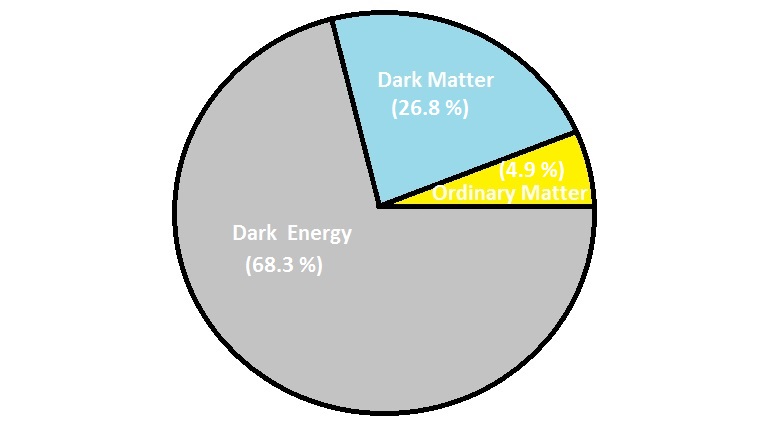
Up in the heavens, galaxies are interspersed by huge empty spaces. Matter constitutes less than one percent of the universe – about one atom in ten cubic meters of space.  structure of the universe (Planck 2013)Within an atom too, there is more empty space than substance.  If the atom is magnified to the size of a football stadium, matter (nucleus) in it will be no bigger than a golf ball, the remaining space being just emptiness.  However, many ancient Indian scriptures hold that there is energy aplenty in space.  Physicists unhesitatingly agree.  Evidence for energy in empty space comes both from Cosmology that deals with the astronomical objects of huge proportions and Quantum Physics which studies atomic- and subatomic-sized particles.

Continue reading

The Weird World Of Small Things

You are certain of your toothbrush being in the  bathroom when you walk in there after a good night’s sleep.  You have no doubt, the water comes to a boil in two minutes in the microwave for the delicious morning cuppa.  You are pretty sure how long it takes you to drive to the office.  That is all true. But the particles that constitute you or your toothbrush are not  predictable with that sort of certitude where they will be at any given time or when they appear at a given place!

Quantum Physics studies how the tiny particles like electrons, protons and atoms that constitute everything behave. Quantum Physics sobers us down quite a bit when it is a question of being sure of things.  It teaches us not to be so definite and deterministic.  It comes out with mind-bending mathematics and unbelievable concepts almost bordering Vedanta.  Dr. Niels Bohr, a giant among Quantum Physicists, famously said: “Anyone who is not shocked (by the concepts of Quantum Physics) has not understood it.”

For all that, Quantum Physics is not an esoteric theory. It comes with redoubtable experimental back up and unfailing proof.  Continue reading

We are all an entangled web

Quantum Physics is the science of small particles. The strange and counter-intuitive phenomena it predicts often leave us stunned. It says that if two particles were together once, they never lose their connectedness even after they get separated.  Each particle readjusts itself in response to any change in the state of its counterpart which might even  be several millions of miles away.  The readjustment is instantaneous and happens without any sort of messaging link between them.  So if you met Dr. Singh once, you can never escape from getting affected by what happens to him, even if you run away to another galaxy!

Unconvincing?  Do not blame yourself. Continue reading

Reality ‘Out There’ And Quantum Physics

 “Hello!”

Hello!”

“Is Dr. Singh there?”

Sure, he is.”

“Is he not in New York?”

Certainly not.”

Not in London either?”

No, he is definitely here in Delhi.”

“Is he sleeping?”

What?! …….  Sleeping? …….  No, he is in his office and very much awake.”

Dr. Singh’s Assistant, though a bit bewildered, sounded very confident in his replies. But I remained unconvinced.

If the probability of Dr. Singh being in New York is zero, and his being present in Delhi is one hundred percent, there must be some probability of his being in London in-between!  Further, his Assistant asserts that Dr. Singh is awake. How does he know Singh’s state so definitely without actually seeing him?  Don’t think that I lost my wits or I am an over the top Vedantin.

Continue reading

Eka jIva VAda – I Am Alone: Part V

Part – IV

This Post responds to the Comments of 18th April made by Suka.

(Suka’s Comment in blue and my response in black).

S:  Mithya is defined as sadasadbhyām vilakṣaṇam – meaning it cannot be categorically classified as truth or false. Mithya is vyāvahārika, experientially efficient, substantially unreal. 

R:   vyAvahArika and prAtibhAsika fall under mithya.  Both vyAvahArika and prAtibhAsika are experienced in their respective spheres, and both derive their reality based on the Reality of the immutable substratum. Dr. Mani Dravid Shastri also suggests in his lectures on adhyAsabhAshya that, “mithya can be divided into two categories, namely vyAvahArika or empirical and prAtibhAsika or illusory.”

S:  The argument tat pot is an illusion does not hold water, because pot does hold water.

R:  “Holding water” too is as much an illusion as pot or water!!

Continue reading

Eka jIva VAda – I Am Alone: Part IV

Part – III

This Post is once again in continuation to the discussions on my earlier Posts.

I shall try to answer the questions and clarify on some of the conceptual issues raised by our esteemed Colleague Suka in his Comments of the 15th of April.

That we have to necessarily use words to express ourselves is pretty obvious. But the words come with their own baggage especially when we use them in contexts that are non-quotidian and are hence liable to be understood or misunderstood in unintended terms. Therefore, it looks to me that I should begin with clarifying the meaning of some of the words, and many a time, this by itself, will have the potential to resolve some of the pending confusion.

Suka observed, inter alia, in his comments of the 15th April:

I)   “Traditionalists (do not) consider neither māṇḍūkya bhāṣya nor vivekacūḍāmaṇi as authentic works of śaṅkara for this very reason.” [I guess “do not” is a typo.] Continue reading