 Part 12 of the New Book Serialization!
The Dreamer asks Vasishtha about the usefulness of mind control and samAdhi and the value of yoga siddhi-s.

Part 12 of the New Book Serialization!
The Dreamer asks Vasishtha about the usefulness of mind control and samAdhi and the value of yoga siddhi-s.
So far, we have seen that ‘I’ thought = ahankAra= ego = sentient mind = mind with reflected consciousness. The ‘I’ thought (ahankAra) knows itself (ahankAra). It is always present in all experiences as ‘I’. ‘I thought’ remains the same. It is experienced as ‘I am’ ‘I am’, for e.g. “‘I’ know the book”, “‘I’ know the laptop”, “’I am fat” etc.
The ‘This-thoughts’ are thoughts corresponding to objects. ‘This-thought’ is variable, based on the object perceived.
Since these three are unreal, they are not eternal. They have a rising time and a disappearing time.
In the previous verse we saw that the world is dependent on the mind. This verse further elaborates it by stating the exact mechanism of the mind.
The world rises and disappears along with the ego; meaning the ‘This-thought’ depends on the ‘I-thought’. In other words, only when there is the ‘I-thought’ can then there be the ‘this-thought’. When the ‘I-thought’ is resolved, the ‘This-thought’ also resolves.
Hence, the appearance and disappearance of the world depends on the ‘I’ thought (ego). This is explained in the first two lines of the verse. This can be understood by considering the daily experience of sleep. In deep sleep, the mind (ego) is resolved. The ahankAra is temporarily not here. As soon as one gets ip, the mind is activated, the ego is ignited in the form of ‘I’. the ‘This-thoughts’ follow after this. The ‘This-thought’ does not directly come. The ‘I-thought’ is invoked first. The activities in the world are begun after this. Again, as soon as one goes to sleep, the mind is resolved and the the ego is not there temporarily. The ego gone, the world also does not exist. Hence, the world (this-thought) depends on the ego (‘I-thought’).
What then is the real ‘I’? We know that ‘I-Thought’ is not real, since it depends on consciousness. The mind has the ‘I-thought’ by the blessing of the consciousness otherwise it is inert matter. The origin of the ‘I-thought’ is in the mind , which is unreal. Hence, ‘I-thought’ is unreal, its origin being unreal and it being the kind which rises and sets.
The third line of the verse says that the real thing (self) is the substratum for the birth and death of the world (‘This-thought’) and the ego (‘I-thought’). The mind rises and resolves int eh basis, the self. Hence the world and ego finally depend on the Atma. everything rises, in the self, is sustained in the self and resolves in the self. The ego, the ‘I’ thought, the ‘this’ thought and the objects are all unreal. They are mere words with no substance, since, the basis is the self and they have no existence apart from the self. The clay pot, the clay saucer, the clay plate, the clay spoon are nothing but clay. The forms are incidental. There is nothing but clay. So also, the mind and world are mere appearances. The truth is the self. The consciousness in which all these shine alone is the truth.
The self is further explained as one, whole which has not birth and decay. The real thing has to be one since otherwise it would be finite. It has to be infinite and hence the whole. Being so, it has to be birth-less and decay-less meaning changeless. If it changes, it cannot be eternal.
The substratum on which the world, mind and its functions rise and set is the self. All except the substratum are unreal. The only truth is the basis behind the play.
The important lesson learnt in this verse is that not only should the world be negated as unreal but even the ego has to be included in the same category.
 At some time or other in every person’s life the question of identity arises in some form or other. For most people, the answer seems pretty obvious: I am a unique human being, a man/woman, in this body, with these parents, these siblings, and these ideas. I am defined by my wealth, my social class, my education, my tastes, my network of contacts, my race. I am shaped by my biology, my physiology, my psychology. Anything beyond this is ‘philosophy’, and one thing I am not is a philosopher!
If, however, people knew the life-changing value in finding the true answer to the question, ‘Who am I?’ they might be prepared to dig a bit deeper for that truth. Vedānta gives us a very good reason to pursue the question. It says that because we do not know the truth of who we are, we take ourselves to be an amalgam of the body and mind (thus pretty much confirming the majority view). The inevitable consequence of identifying with something that is as changeable, limited and vulnerable as the body and mind, is that ‘I’ is also taken to be changeable, limited and vulnerable. And it consumes a whole life of sweat and slog in trying to build up adequate self-protection. Continue reading
Our esteemed colleagues Suka and Martin made certain important observations on the earlier Posts of mine on this subject. So I felt it may be better to respond to the points raised by them without any further delay before resuming my presentation with regard to Eka jIva vAda.
A: About the similarity between Wakeful and Dream Worlds:
Suka pointed out to the three distinct orders of reality distinguishable from the way we experience them and opined that dream and awake world cannot be treated at par. He said that a dream world was a ‘bhrama‘ whereas the awake world was ‘mithya.’
Q: Is there a difference in the teachings of Ramana Maharshi and Nisargadatta Maharaj?
A (Dennis): This is too general a question, really. The short answer is that the bottom-line message of any teacher of Advaita must be the same, obviously. But the methodology depends upon the teacher lineage. Nisargadatta did have a lineage, although his own style developed somewhat! And Ramana did not have a lineage at all. The absence of a lineage means that what is said lacks rigor and is subject to differing interpretations etc. This is why the recommendation is always to try to find a qualified, traditional teacher.
Q: I do realize that my question was too general and could not be dealt with in a short answer. What I had in my mind was with regard to their approaches to meditation/ self enquiry or the “path” recommended by them. In self enquiry Ramana stated that while enquiring into “who am I?” the I that is enquired into is the individual or the ego and not the Self. According to him, focusing on the ego or I would make one realize that it is a phantom and thus lead one to the Self. Nisargadatta, on the other hand, seems to suggest that one should focus directly on I am, which is the same as the Self. In this sense, I thought there was some difference in their teaching. Continue reading

To be free from the other, from all others, is true freedom.
To be one with the other, with all others, is true love.
Both together is true happiness.
Photo credits: berggeist007@pixelio.de
This book has arisen from Direct Pointing sessions that I’ve had with clients around the world. These deceptively simple inquiries and dialogues work. Men and women who have studied Nonduality for decades, both in and out of structured traditions, without experiencing even the first authentic glimpse of themselves have come to recognize their true nature during these talks. Some of them have been glimpses, and others remain ongoing. Still others, who were confounded by oscillation when we began to talk, have moved from there into stable Nondual awareness. And of course there are a few people who’ve reported no change at all; such is the way of it. Continue reading
The quintessential teaching of Advaita is well encapsulated in the famous half-verse long apopthegm comprising eight words:
Brahma satyam
Jagat mithya
jIvah brahmaiva na aparah
(Brahman alone is Real; the world is unreal; and the individual (jIva) is in actual fact non-different from Brahman).
Thus the jIva-brahmaikya vAda (the Doctrine of the Identity of the individual and Brahman) effectively sums up the message of Advaita.
All of us are jIvas. Obviously then, without doubt, we are Brahman.
However, we outdo Brahman, if I may say so, with two additional qualities. These are (i) a delimited size, shape etc. (finitude in dimensions) and (ii) an ID (individual name, lineage etc.). Continue reading
Review of ‘A New Approach to Understanding Advaita asTaught by ´Sa ˙ nkara Bhagavadp¯ada’ – Ramakrishnan Balasubrahmanian — 2
We saw in the 1st part of this Review the primary or prior, not to say exclusive, importance that the author, RB, gives to the superimposition of a subject, individual mind or jiva, on the Self: “the superimposition of an observer is avidy¯a and is prior to the reverse superimposition”, not mentioning that Shankara does not talk of a ‘reverse process’, as if it was something happening through time, but of mutual superimposition of Self and non-Self in a primary sense. He continues: “It is not completely incorrect to say that avidy¯a is the mutual superimposition of the real and unreal. ´ San˙ kar¯ac¯arya and Sure´svar¯ac¯arya do mention this … the superimposition of an observer on the inner-self naturally leads to the reverse process of superimposing the inner-self on the inner organ”. RB’s objective in maintaining this priority of the subject in this ‘act’ seems to be to show that SSS is guilty of circularity (petitio principi, in logic). Even so, and rather surprisingly, he claims that avidya is not something subjective (neither is it ontic nor epistemic – see below). Continue reading
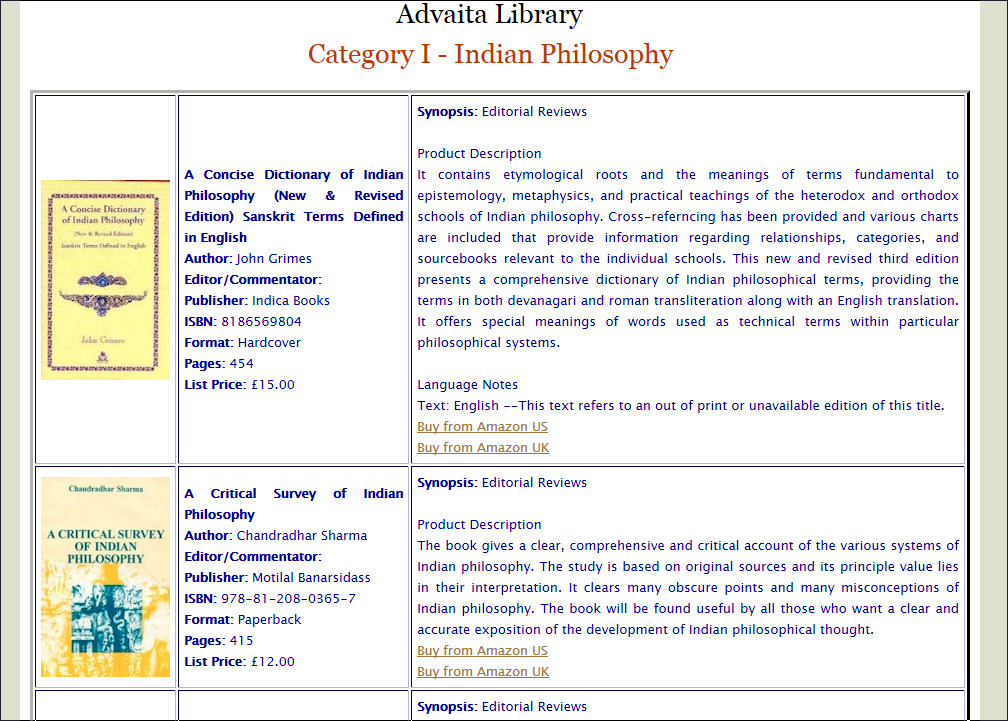 The Advaita Library has been completely updated, with the number of separate categories (one page per category) now expanded to 35. There are nearly 1400 books, DVDs and audio tapes catalogued, including Amazon synopses where available, links to purchase from Amazon and elsewhere and links to reviews and extracts on the site, if we have them. If you want any advaita-related book, this is the place to look. (And if you link through to buy from Amazon, the site gains a small royalty towards future purchases.)