Spiritual practice- earlier the better

Mahabharata is a famous epic describing diverse aspects of human life, like family and its intrigues, kingship, loyalty, friendship, dharma, war, Vedantic teaching, etc. Bhagavat Gita is in the 12th Book named Bhisma Parva because Bhisma is the commander of the Kauravas army during this part. 18 chapters of BG are chapters 23 to 40 of Bhisma Parva.  BG is a moksha shastra and a student of Vedanta should have read and understood Bhagavat Gita fairly well.  Surprisingly, there are other portions of Mahabharata that too have Vedantic teaching.  Mokshadharma Parva as the title suggests has Vedantic messages. It is a conversation between Yudhishthira and Bhisma.

After the Mahabharata war is over, Bhisma is lying on the bed of arrows awaiting his death to come at a time chosen by him. Yudhishthira is the new king but is depressed due to the destruction caused by the war. At the behest of Sri Krishna, he visits Bhisma to get instructions on various topics. Bhisma, though lying on the bed of arrows, is willing to answer Yudhishthira’s questions. He does so mainly through stories. One such story in Mokshadharma parva relates to the teaching given by a son to his father. Continue reading
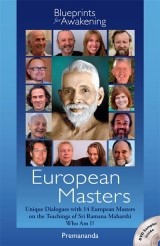
Book Review: European Masters – John David

Blueprints for Awakening: European Masters: Unique Dialogues with 14 European Masters on the Teachings of Sri Ramana Maharshi Who am I?

Premananda, Open Sky Press Ltd, Nov 2010, ISBN 978-0956607003. (350 pages).

Buy from Amazon US
Buy from Amazon UK

Note that, when I originally reviewed this book, it also included a free DVD of extracts from the interviews. This is no longer the case.

Premananda is the author of a number of books, including ‘Indian Masters: Blueprints for Awakening’, which I have reviewed at http://www.advaita.org.uk/reading/read_general.htm#blueprints. He spent 15 years with Osho, followed by another 5 with H. W. L. Poonja (Papaji) and much of his teaching now is influenced by Ramana Maharshi. He runs the Open Sky Satsang Community in Germany (between Cologne and Düsseldorf) and periodic meetings are organized throughout Europe.

(Extended biographical details may be found at his website – http://www.premanandasatsang.org/.)  

Note that, sometime during the elapsed time since I wrote this review (around 2011), he has reverted to his (presumed) birth name of John David. All reference to the name ‘Premananda’ appears to have been removed from his website and books (although the URL remains the same). I have left the words of the review itself, and the images, as they were in the original review.

Continue reading

Q.519 How can one experience the bliss?

Q: In ‘The Book of One’, you say: “If our true nature were allowed the freedom to experience to the full, what then? The Brihadaranyaka Upanishad tells us that “All the joys of the entire cosmos put together would be only a small drop of the bliss of this Supreme Being. Whatever little satisfaction we have, whatever pleasures we have, whatever joys we are experiencing, whatever be the happiness of life – all this is but a reflection, a fractional distorted form, a drop, as it were, from this ocean of the Absolute.” (Ref. 7)

Is there a way to get a taste such an ocean of joy while not ‘realized’?

A: This is a good question and highlights the dangers of attempting to relate the more ‘rapturous’ statements of the scriptures to the mundane experiences of life! When the Upanishad talks about the ‘bliss of this Supreme Being’, it cannot mean this literally. Brahman is non-dual, part-less, changeless, does not ‘experience’ or ‘know’ etc. In fact, whenever the word ‘bliss’ (Ananda) is encountered, it is a good idea to substitute ‘eternal’ (ananta) so as not to risk such a thought process. (See discussions at the AV site on ‘satyaM j~nAnamanantaM brahma’.)

Continue reading

Language and Color

Those people who regularly read my articles will know that, although my educational background is that of a scientist, I frequently criticize science in respect of its inability to say anything useful about the nature of reality. Because science can only operate by virtue of a subject making observations on an object, it only has validity in the empirical realm (vyavahAra). Nevertheless, I do acknowledge that science can sometimes throw light upon the thorny topics that we frequently encounter in advaita.  An obvious example of this is the findings of Benjamin Libet and Daniel Wegner regarding free will, about which I have written several times. Accordingly, I was very interested to hear recently (on a BBC Horizon program about how we perceive color) that scientists have carried out experiments which demonstrate that language affects the way in which we see the world.

I did not expect to see anything relating to advaita in the program but, when they described an experiment concerning the Himba tribe of northern Namibia, it quickly became clear that this was relevant to the vAchArambhaNa sutras from the Chandogya Upanishad.  

Continue reading

Plato and a Platypus Walk into a Bar…

I am still trawling through old blogs and articles which I wrote around 2011, and that are no longer available on the Internet. Here is a short one which may amuse…

This is the unlikely title of a book which is ostensibly an introduction to Western Philosophy, but is perhaps better viewed as a book of themed jokes. It is not even remotely anything to do with Advaita, so I wouldn’t be happy writing a formal book review.

If you are at all interested in philosophy in general; like reading about it, without necessarily learning very much; and enjoy a good joke, then this is definitely the book for you! It has chapters on many of the key Western names and schools and each has a few paragraphs telling you very cursorily where it fits into the history and what, essentially, it deals with. But this is interspersed with witty remarks and lots of full-fledged jokes which purport to illustrate the particular branch being discussed.

Continue reading

Book Review: dṛg dṛśya viveka, Clarissa

Over the next couple of months, I will be posting some book reviews that I made 10+ years ago, which are no longer available elsewhere on the Internet.

The first of these is:
dṛg dṛśya viveka, Clarissa, Lulu Press, 2010, ISBN 978-1-4452-0858-9. (171 pages), $19.62 from Amazon.com. Also available from Watkins Books, 21 Cecil Court, London WC2, £12.99.

Continue reading

New Book Announcement

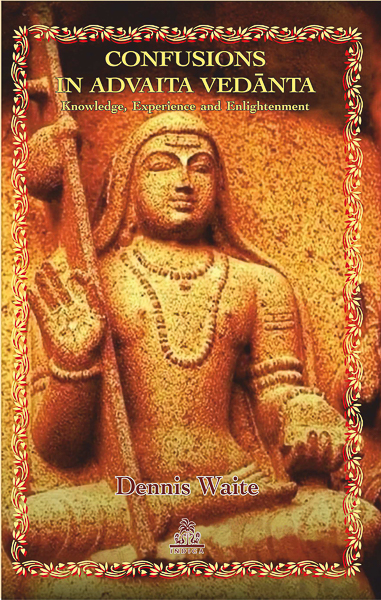
Confusions in Advaita Vedānta: Knowledge, Experience and Enlightenment

This is being published by Indica Books at Varanasi and may be purchased directly from them (PayPal accepted) at indicabooksindia@gmail.com.

It will also be available to buy from Amazon and I will post the links as soon as this is possible. (Note that it may still be cheaper to buy from Indica, even with postage costs, but it will obviously take longer to arrive in the West.)

Continue reading

Q.518 Reincarnation and Enlightenment

Q: I have been trying to wrap my mind around the question posed here: https://www.advaita-vision.org/q-489-creation-and-reincarnation.

Specifically: if reincarnation is not actually true and is just a part of adhyaropa-apavada — then why study Advaita at all when the probability of enlightenment is so low! Seems like life efforts would be better spent then trying to maximize ephemeral happiness.

The only way I can rationalize the practical utility of advaita is to accept that reincarnation is true in vyavaharika — that its a natural law, like gravity. Is that a fair understanding or is reincarnation truly just a teaching tool?

A: Where did you get the view that the probability of enlightenment is low? I know that this is implied in a few places in the scriptures but I rather think the point there is to ensure that only those who genuinely have mumukShutva pursue these ideas. If you are merely ‘interested’, you are going to lose that interest sooner or later and return to seeking the usual gratifications of empirical life. One of the seekers in the Upanishads is ecstatic when he is told that he ‘only’ has to live another few thousand lives before gaining enlightenment!

I believe that one of the main reasons that people today think that it is extremely ‘rare’ is their notion that there is ‘intellectual’ understanding that comes relatively easily and then there is experiential understanding that is extremely difficult to acquire. This is wrong! It is the erroneous understanding in the mind that keeps us in saMsAra and the correct understanding in the mind that frees us. It is perfectly possible to gain Self-knowledge in a single lifetime if you have the determination to do so. Obviously the best way is to find a qualified teacher. Then maybe years would be enough. If you have to read books and discuss with other seekers, it could take decades – especially if you read the wrong books!

As regards reincarnation, I wouldn’t worry about that too much. Whilst you really believe that the empirical world is real, then karma and reincarnation make sense. Without them, the ‘lawful’ nature of the universe appears to break down. The ‘good’ apparently suffer while the ‘evil’ triumph. Just look upon it as a mechanism that science is unable to explain or even believe. As I said in that other question, read the book by Muni Narayana Prasad if you want to understand more.

Consciousness and the world

What is the scriptural basis for Advaita consciousness being an awareness preceding the universe?

That’s an ‘easy’ one. 1)  Consciousness and awareness are the same for Advaita Vedanta. 2) Atman-brahman, or Consciousness, is the sole reality – the universe is, in essence, not other than Atman (Consciousness or ‘Spirit’). 3) Consequently, there is no creation – no causation, including space and time, which, like everything else, are phenomena, appearances.

Mundaka Upanishad 2.1.10: ‘the world is brahman alone’. 

K 3.18. In this karika Gaudapada demonstrates that creation is only apparent because reality is unchangeable (and it is taught that the effect is not other than the cause).

Katha Up. 2.1.10: ‘Whoever sees difference between what is here (individual Atman/’soul’) and what is there (brahman) goes from death to death’.

Brihadaranyaka Up. 2.5.19: ‘The supreme being is perceived as manifold on account of Maya’ (magic).

Taittiriya Up. 2.6: ‘Brahman, which is the absolute reality, became reality (satya) and unreality/appearance (asatya)’. That is, the cause itself appears as various effects due to superimposition, which is itself the core, or definition, of ignorance (avidya). Cf. Tai. 2.6, Chandogya Up. 2.8.4, and Bhavagad Gita 4.13 and 13.2.