Jagat Mithya – World is an Illusion

Article and Book Extracts by Arun Kumar

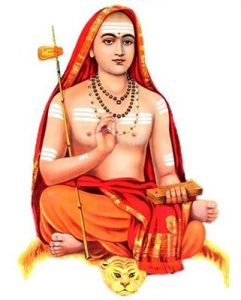
Sri Adi Shankaracharya, the great master of Advaita who lived in the early part of the 8th Century said, “Brahma satya jagat mithya, jivo brahmaiva naparah”. It means Brahman (name of the Ultimate Reality) is the only truth, the world is illusory, and there is ultimately no difference between the individual Self and the Brahman.

Mithya means neither true nor false. The world cannot be false because we all clearly see and perceive it. Shankaracharya says that the world is not true either, because it is constantly changing and everything that the world has to offer is temporary, transient and impermanent.

A fine dining experience gives us joy. Try doing it continuously for a few days and one would start nauseating. A trip to a nice resort is highly relaxing. After just a few days the charm of the place wears out. Eagerly awaited vacation trip to someplace, after hectic running around and visiting various tourist sites for days, finally the heart cries “Home! Sweet Home!!” and longs for the comfort of the home.

That’s why Shankara calls this world as Mithya which means anything in this world can only give temporary happiness and not permanent happiness. Continue reading


Advaita Vedanta & Neuroscience

https://www.quora.com/Do-people-s-consciousness-s-work-the-same-or-are-everyone-s-minds-completely-different/answer/Alberto-Mart%C3%ADn-2

Contrary to consciousness being an emerging property of the mind, as someone has answered, thus reifying the latter, I would hold the inverse: mind is a property or, better, a projection of consciousness. Consciousness is universal, mind particular, individual – standing in the relationship essence-accident (or substance-form). The first is without a beginning, the second temporal, The first, necessary as principle, the second contingent. First unmoving, second changeable.

All this is clearly spelled out in the philosophy and metaphysics of Advaita Vedanta and also, even if with different analysis and import, in Aristotelian metaphysics. Continue reading

The devil’s teaching part 2

Eka jIva vAda – the devil’s teaching (part 2 of 2)

Read Part 1

Here is how I described this teaching some years ago:

First of all, however, I will say a little about sRRiShTi dRRiShTi etc, since I have mentioned these above. I once thought that these were the principal creation theories of advaita. sRRiShTi is the Sanskrit word for creation. The mythical stories of God creating a world, for example over six days as in the Bible, are called krama sRRiShTi, meaning ‘gradual creation’ (krama means ‘ progressing step-by-step’). dRRiShTi is the Sanskrit word for ‘seeing’ or the faculty of sight. Thus, sRRiShTi dRRiShTi vAda means that a world is created and then we perceive it. dRRiShTi sRRiShTi vAda, on the other hand, supposes that perception precedes creation. This effectively boils down to a form of subjective idealism; i.e. the world only exists in our mind. This, in turn, implies that there are no other individuals than ourselves; i.e. solipsism. (The theory that there is only one person is called eka jIva vAda in Sanskrit.)  Continue reading

The Pull and Push Factors – Part 2/2

[Part 1]

 Let us take a simple case of “I see a tree.”

Whenever we have an “experience,” like I see, I walk, I do and so on, we should remember that the entity “I” has first separated out from the “Whole” that-IS and positioned itself as the “subject” (agent) of the action. Thus, at the moment of experience, it is not anymore a single entity, Oneness.  There are two —  the experiencer, “I,” and the experience. But the “experience” in turn consists of the object experienced and the act of having the experience (experiencing). So whether we are aware or not, a multiplicity got introduced. Continue reading

The devil’s teaching part 1

Eka jIva vAda – the devil’s teaching (part 1 of 2)

The ‘bottom line’ of Advaita is that there is only Brahman. The world with all its objects, bodies and minds, is mithyA – it is not real in itself but ‘borrows’ its existence from Brahman. Who-I-really-am is Brahman.

But all of this is already saying too much. We cannot actually say anything at all about Brahman. We ‘know’ it by ‘being’ it; that is all.

This, then, is the ‘final’ message of Advaita. Advaita is a teaching methodology that functions by removing all of the misunderstandings about the world and our ‘real Self’. It progressively removes Self-ignorance (neti, neti) until the time comes when the intellect can make the intuitive leap to a realization of that final truth which is beyond words and concepts.

The teaching utilizes various devices to enable us to remove misconceptions. These might be stories (e.g. ‘tenth man’), metaphors (e.g. gold and ring, wave and water) or more elaborate ‘prakriyA-s’ such as pa~ncha kosha or avasthA traya. The purpose of all of them is to draw attention to a particular aspect of the way in which we presently think about the world, and then to show by examination (comparison etc.) that we might be mistaken. In each case, by making us look at the situation in a different way, we advance our ‘non-dualistic outlook’.

But these new ways of thinking about the world are themselves only temporary, to help us to readjust our mental boundaries. They, too have to be discarded eventually because, as pointed out above, we can never truly ‘understand’ any of it. Once they have served their purpose, we drop them – adhyAropa-apavAda. Continue reading

Q.460 Is reality really real?

Q: In your answer to Q. 228 you wrote:

Reality is that which never changes; that which is the only existent, conscious ‘thing’, which lacks nothing and is limitless. Every, seeming ‘thing’ in creation is, on the other hand, transient and limited.

But this view of (pointer to) reality is not the only viable view, right? I mean viable in general, not within the Advaita worldview.

Couldn’t we say, instead, that reality is whatever happens to exist, in this moment, in the consciousness of the beholder? Reality as qualia, as subjective experience. In which case every seeming thing that exists in the moment is real (in the moment).

Or that reality is change, is transformation?

Or that reality is a concept that points to ___________ (the mystery)?

I could go on sharing other views of reality. Continue reading

Shankara’s Direct Path Method

 Shankara spells out the most Direct Path method of Self-realization on a here and now basis in his short treatise, aparokShAnubhUti. He explains very lucidly in simple words, through the 144 verses of this text, the means to have the direct experience of brahman. He boldly declares right up front the unreality of the three entities, jIva-jagat-Ishwara, the model commonly used in teaching Advaita. He avers that ‘action’ (karma) or worship (upAsana) cannot deliver liberation. However, he says an intense yearning for liberation (mumukshatva) has to be present in a seeker.

Shankara’s Direct Path has nothing to do with the changing or manipulating the external world or one’s own body-mind system. It is all about how the world is perceived. The three possible worldviews are: Continue reading

Two questions (relationships & eternity)

1) How is one’s self related to other selves.

This can be seen from two perspectives: 1) lower or empirical, and 2) higher or spiritual (I try to avoid the word ‘metaphysical’). I am not going to consider what Christianity or Islam hold about any of these two perspectives, only the non-duality of Advaita Vedanta (Buddhism does not contemplate individual existence per se). According to the Advaitic tradition the individual self (jiva) can be considered as a reflection of the higher Self and then his/her faculties (basically memory, mind, and sense of self) as well as all bodies are separate and individual – this pertains to ordinary, transactional life. This is the realm of ignorance (avidya). Continue reading

The Pull and Push Factors – Part 1/2

 The Pull factor:

We have from kaTha upaniShad:

नायमात्मा प्रवचनेन लभ्यो मेधया बहुना श्रुतेन   —  I-ii-23,  kaTha upa

Meaning:   Atman (brahman) cannot be attained by the study of the Vedas, or by intelligence, or by much hearing of sacred books.

Shankara’s special treatises too make that point abundantly clear declaring:

स्नानेन दानेन प्राणायमशतेन वा      —    verse 13, vivekacUDAmaNi

Meaning: Neither sacred baths nor any amount of charity nor even hundreds of breathing exercises can give us the knowledge about Self.

अविरोधितया कर्म नाविद्यां विनिवर्तयेत् |      —               verse 3, Atmabodha

Meaning: Any action cannot destroy ignorance, for action is not a negator of ignorance. Continue reading