Q. 355 – Faith in a Path

Q: How do we get the conviction to go on a spiritual quest?  Unlike science, there are no indicators to give feedback if this is even the right path. We need to have blind faith in the general idea itself before we venture into it. Can we only do this through negation of the other paths, where apparent validations are possible by material feedback.

A devil’s advocate argument could be to dismiss everything associated with the vedas/upanishads as nonsense, since nothing can be proved. Another way to look at this is to acknowledge that the ancient sages have come up with practices such as yoga and meditation, which sort of proves their intellect and extrapolates on their ability to see things farther than a average person can and thereby have faith in their judgements.

 I am not able to articulate my question very well but I hope I got my point across.

Answers are provided by: RamesamDhanya, Ted and Dennis.

A (Ramesam): Man, by his/her very nature, feels incomplete. He seeks fulfillment of what he lacks through effort using his natural or acquired talents.  In fact, it is this “lack” that drives his passion for action along the path of the means chosen by him suiting to his comfort-level.

At the most basic level the drives that motivate a man for action are the biological and physiological needs.  As described by the Psychologist Maslow, the subtlety of these needs changes from a lower to higher level in the following manner: Continue reading

ROLE OF “REPETITION” — 2

ROLE OF “REPETITION” IN SPIRITUAL INSTRUCTION, PRACTICE AND UNDERSTANDING — 2


This is an alternative viewpoint regarding the role of “Repetition” in understanding the core message of advaita.  As it often happens, there is nothing like “the right perspective” in these matters. One may use one’s own discretion in evaluating these different points of view.

1.  There is no doubt that Repetition helps in getting a thing by heart or to memorize a quote, a mantra, a verse etc.

2.  We know ‘Practice maketh perfect’ and  practice necessarily involves repetition.

That means, we are making an operation (mostly those that involve neuromotor skills) into a more mechanically executed action – transferring a routine from being a cerebral activity to cerebellar activity.

3.  The ‘phala‘ (result) of certain ritualistic karma (like offerings made for the appeasement of gods, gaining merit etc.) is expected to increase proportionally with the number of times the ritual is carried out. (Please see Note: 2 at the end). Continue reading

Action – Without Ego, Oh, “I” am the ‘Pain’ on my Neck!

Uff, It’s a terrible pounding head-ache. Felt like a herd of hundred elephants at once trampling on my head. Cups of freshly brewed coffee, and green, white, oval, or round caplets and tablets proved themselves totally inefficacious.

It’s been bright and sunny outside; my write up went off smooth and fast; I got even that rare pat from Dennis. Enjoyed a delightful gastronomic luncheon.  Overall, it had been a very pleasant day. I couldn’t find a reason for the exploding headache.  I was helpless by late evening and had to visit my Doctor. He let me in, though far out off his Consultation hours.

The Doctor lifted his head out of the piles of Advaita books around him, the light from the table lamp throwing an eerie arc of illumination on his face. The soft light from the computer screen added a strange greenish glow-effect to his broad smiling face welcoming me into his otherwise dimly lit drawing room. I felt that I was seeing the grin of a live Cheshire Cat rather than a welcome from my Doctor friend.

The Doc heard my story of agony and suitably tutt-tutted.

And suddenly his Advaitic genius sprang out. He declared, Oracle-like,  that there should be a ‘head’ to have a headache. And he convincingly argued that I had no head. Yes, Did I ever see it? No, never. Even if my hands touched it, could the hands know what they touched? No, never.  It was I who imagined what it was that was touched by the hands and gave a name to the resulting sensation as ‘head.’  Meekly succumbing to his invincible logic, I lifted my head a little when I saw myself in the window glass on the opposite side. I shouted in joy to prove to him that I had, after all, a head that was begging for a cure. But no, he didn’t relent.

“Mirrors can lie,” he said, “Don’t believe the reflection. A glass can show things even if the things are not there.” To prove his point, he quickly linked on his computer to the 1 min Video clip of his fellow Psychologist here. Yes, the mirror showed a banana, even when there was none!

In utter bewilderment, I asked submissively, “Who is this that thinks I am and what is this pain?”  The Doctor declared triumphantly, “It’s only ‘Pain’ that is there. No separate ‘you’ anywhere.”

“Do you mean there is nothing of my personality, my prestige, my ego, my….. …..”

“You see, you are appearing as the ‘Pain’ at this moment.”

“So, you mean to say that I am present in the now as the ‘Pain’ on my neck?!”

What is Death – part 6 and final (metaphysics or spirituality – non- duality)

Image


Meditation

‘There is doubt concerning a man who has departed. Some say, “He is”, and others say, “He is not”. Taught by you [Yama, god of death], I would know this. This is the third of my boons’.

‘Do not, do not insist: release me from this’…. Choose a hundred years, sons and grand sons… elephants, gold, horses… Naciketas, enter a great realm of desires: I will make you the enjoyer of your desires… but do not ask me about dying’.

Naciketas, the young seeker, will have none of that.

‘Since you, Death, tell me it is not easily understood, and no one else can be found who can teach this as you can, there is no boon to equal this’.

…………………………………..

‘Yama continues: ‘The wise one [inner self] is not born, nor does it die. [Hidden in all beings] it is not from anywhere, nor was it anyone. Unborn, everlasting, eternal, primeval, it is not slain when the body is slain.’  Continue reading

What is death – part 3 (Transmigration)

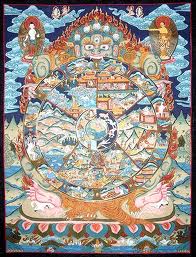
The wheel of transmigration

Although whatever is understood by transmigration or reincarnation does not strictly belong in this discussion on the “problem”, or the “reality” of death, it is so entrenched in people’s minds due to cultural and religious accretions, that a short account of it is not altogether out of place here. In the milieu of Hindu and Buddhist traditions reincarnation occupies the main doctrinal position in their exoteric or “religious” aspects, apart from belief in and worship of a deity or deities, and second only to the doctrine of karma – to which it is intimately related. Death of the body – the ‘gross body’ – is a foregone conclusion once it is irreversible (biological death).

A conventional account of reincarnation is as follows: ‘as for the jiva-atman carrying these vrittis, if during his lifetime the individual had performed some special acts of merit (punya) or demerit (papa), then the jiva-atman would proceed to heaven or hell. After spending his special karma-phala there, he comes back to the earth’. A more elaborate description is that once the seeker realizes nirguna Brahman he/she merges with Him/It, thus attaining immediate liberation (sadya mukti)’.Those who are eager to go beyond paths [the journey of life here and hereafter] tread no path’ (com. on Mu U. lll.2.6). ‘Just as the footmarks of birds cannot be traced in the sky or of fish in water, so is the departure of the illumined’ (Mahabharata). These two quotations are taken from ‘Methods of Knowledge’ – According to Advaita Vedanta’, by Swami Satprakashananda, p. 299. Continue reading

What is Death – Part 2

In the case of the human being, is death – whatever meaning we give to it – an ending, a transformation (in psychological terms), a recombination of parts (physics and biology), or a transfiguration, such as what is called reincarnation, transmigration  or metempsychosis (religious tradition)? Is it terminal, or a new beginning, a renewal – in someone of the senses enumerated above?

Or is death simply illusory? In the restricted sense we are now having in view (related to a human being), what is the meaning of ‘death’ – a question which, whether it has a precise answer or not, must have been asked countless times, at least ever since one or more individuals started to ask these kinds of questions, that is, to philosophize? It is frequently said that according to Plato philosophy begins in wonder. With such a broad view or approach of the problem we can appreciate how many possible answers, or rather areas of research and inquire are open to ourselves. We saw that, whether a (“short-lived”) event or a (gradual) process,  death can be defined in simple terms in what concerns the body, in fact the body of any organism, as was stated in Part 1. Going beyond this, and entering directly into the realm of philosophy – the philosophy of Vedanta in particular – the problem is also simplified by just saying that the only ‘things’ that ‘die’, or are annihilated, are forms, phenomena, which are impermanent. Essence or substance, being changeless, does not die. Continue reading

Invisible Energy In Empty Space

The Universe is overwhelmingly empty!

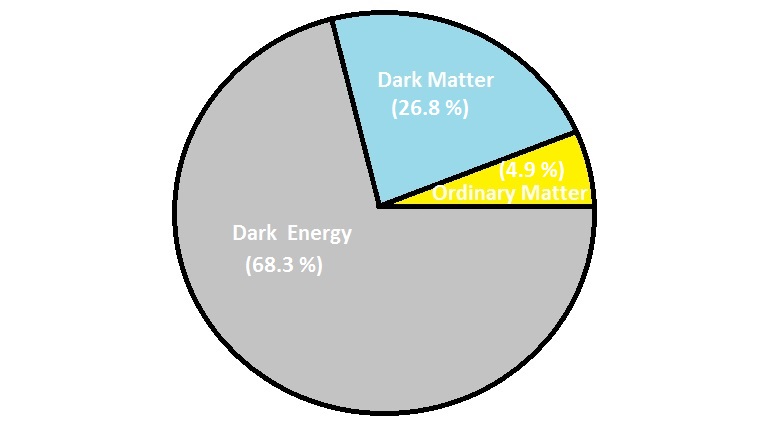
Up in the heavens, galaxies are interspersed by huge empty spaces. Matter constitutes less than one percent of the universe – about one atom in ten cubic meters of space.  structure of the universe (Planck 2013)Within an atom too, there is more empty space than substance.  If the atom is magnified to the size of a football stadium, matter (nucleus) in it will be no bigger than a golf ball, the remaining space being just emptiness.  However, many ancient Indian scriptures hold that there is energy aplenty in space.  Physicists unhesitatingly agree.  Evidence for energy in empty space comes both from Cosmology that deals with the astronomical objects of huge proportions and Quantum Physics which studies atomic- and subatomic-sized particles.

Continue reading

The Weird World Of Small Things

You are certain of your toothbrush being in the  bathroom when you walk in there after a good night’s sleep.  You have no doubt, the water comes to a boil in two minutes in the microwave for the delicious morning cuppa.  You are pretty sure how long it takes you to drive to the office.  That is all true. But the particles that constitute you or your toothbrush are not  predictable with that sort of certitude where they will be at any given time or when they appear at a given place!

Quantum Physics studies how the tiny particles like electrons, protons and atoms that constitute everything behave. Quantum Physics sobers us down quite a bit when it is a question of being sure of things.  It teaches us not to be so definite and deterministic.  It comes out with mind-bending mathematics and unbelievable concepts almost bordering Vedanta.  Dr. Niels Bohr, a giant among Quantum Physicists, famously said: “Anyone who is not shocked (by the concepts of Quantum Physics) has not understood it.”

For all that, Quantum Physics is not an esoteric theory. It comes with redoubtable experimental back up and unfailing proof.  Continue reading

We are all an entangled web

Quantum Physics is the science of small particles. The strange and counter-intuitive phenomena it predicts often leave us stunned. It says that if two particles were together once, they never lose their connectedness even after they get separated.  Each particle readjusts itself in response to any change in the state of its counterpart which might even  be several millions of miles away.  The readjustment is instantaneous and happens without any sort of messaging link between them.  So if you met Dr. Singh once, you can never escape from getting affected by what happens to him, even if you run away to another galaxy!

Unconvincing?  Do not blame yourself. Continue reading

Reality ‘Out There’ And Quantum Physics

 “Hello!”

Hello!”

“Is Dr. Singh there?”

Sure, he is.”

“Is he not in New York?”

Certainly not.”

Not in London either?”

No, he is definitely here in Delhi.”

“Is he sleeping?”

What?! …….  Sleeping? …….  No, he is in his office and very much awake.”

Dr. Singh’s Assistant, though a bit bewildered, sounded very confident in his replies. But I remained unconvinced.

If the probability of Dr. Singh being in New York is zero, and his being present in Delhi is one hundred percent, there must be some probability of his being in London in-between!  Further, his Assistant asserts that Dr. Singh is awake. How does he know Singh’s state so definitely without actually seeing him?  Don’t think that I lost my wits or I am an over the top Vedantin.

Continue reading