
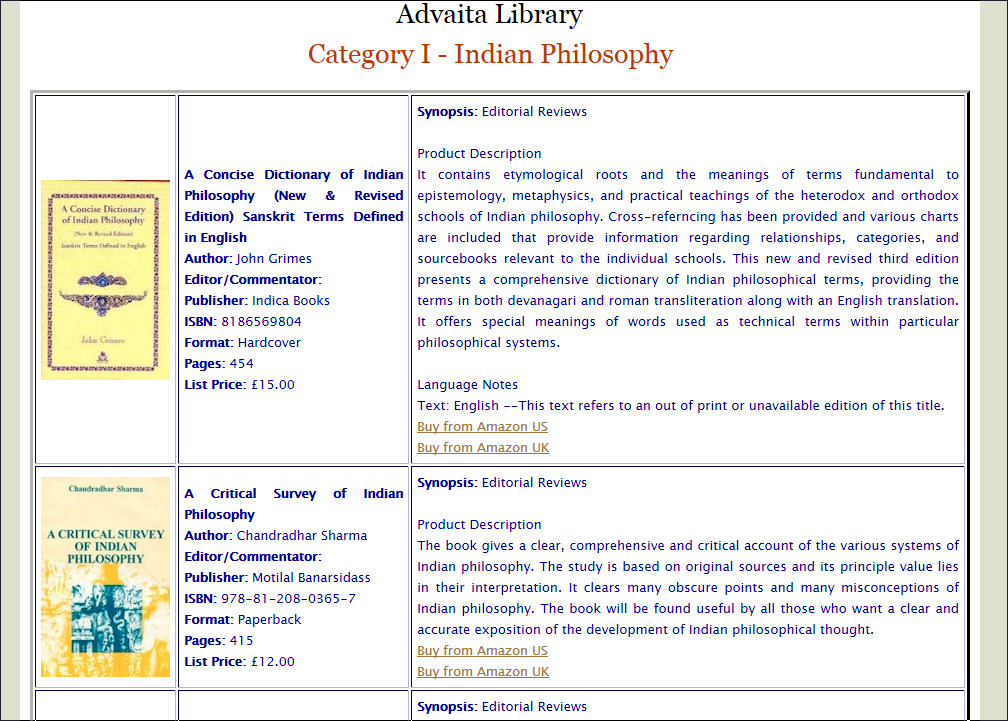
 The Advaita Library has been completely updated, with the number of separate categories (one page per category) now expanded to 35. There are nearly 1400 books, DVDs and audio tapes catalogued, including Amazon synopses where available, links to purchase from Amazon and elsewhere and links to reviews and extracts on the site, if we have them. If you want any advaita-related book, this is the place to look. (And if you link through to buy from Amazon, the site gains a small royalty towards future purchases.)
Tag Archives: Advaita
Puruṣārtha-niścaya, the beginning of the beginning
 What is puruṣārtha-niścaya? Of the two words, niścaya has a close English equivalent: certainty, conviction, unshakable clarity. So puruṣārtha-niścaya mean ‘doubt-free clarity and unshakable certainty’ about puruṣārtha. So what is this thing one has no doubt about?
Puruṣārtha is a compound made up of two words: puruṣa and artha. Puruṣa also has a close English equivalent: ‘person’, ‘human being’ (albeit with a lot behind it that reminds us of the true scale of what is indicated by the word – see footnote at the end).
Thus, so far, we have arrived at this meaning: ‘unshakable certainty about human artha’.
Artha is the last word that needs unpacking. Normally translated as ‘wealth’ or ‘meaning’, here it should be read as ‘aim or purpose’.
Puruṣārtha is the purpose of the human life. And puruṣārtha-niścaya is total clarity about what this purpose is – about what defines human life and drives human activity. Continue reading
Advaita – not the only teaching
As readers will know, this site is wholly dedicated to Advaita as the teaching of the non-dual nature of reality. But I came across a reminder today that there are other sources for this truth! It is an extract from a book on Hasidic Judaism, which was posted by Jerry Katz to his NDhighlights Ezine. It reads like pure Advaita:
Reb Yerachmiel ben Yisrael
19 Tevet 5636
My Dear Aaron Hershel,
You ask me of God: to define the Nameless to place in your palm the ultimate secret. Do not imagine that this is hidden somewhere far from you. The ultimate secret is the most open one. Here it is: God is All.
I am tempted to stop with this-to close this letter, sign my name and leave you with this simple truth. Yet I fear you will not understand. Know from the first that all that follows is but an elaboration on the simple fact that God is All.
What does it mean to be All? God is Reality. God is the Source and Substance of all things and nothing. There is no thing or feeling or thought that is not God, even the idea that there is no God! For this is what it is to be All: God must embrace even God’s own negation. Continue reading
Morality in the Brain
Year 2012 is coming to a close and we are getting ready for one more end-of-the-year celebrations. People are already in a festive mood – remembering friends, recalling favors received and planning for reciprocation with gifts. As you shop and bring home the packets, you plan to embellish them with a hand-crafted insignia to show your extra care and love. So you take a pair of scissors in hand and begin to cut a piece of paper molding it into an attractive shape. Your child suddenly comments: “Why do you purse your lips when you are cutting the paper?”
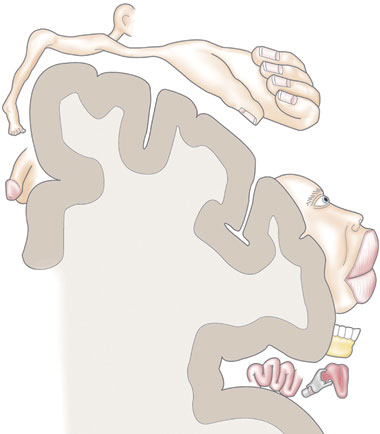
Fig. 1: Homunculus – Brain Real Estate Devoted to Touch in the Primary Somatosensory Cortex
What? Pursed the lips? You were not even conscious of the face, forget the lips.You were so much lost in the job with all your attention focused on the fingers and the scissors, you were unaware of the tightness in your face. Why should the lips tense up? And you don’t even know about it!
You may be a six footer weighing 60 – 70 Kg having seen half a century or more of summers (and winters); or may be a short and smart young man of 20. The wetware weighing less than a Kg and half (about 3 pounds) sitting between your ears contains an encrypted miniature model of who you are. It has all the maps representing your past, your knowledge, your expertise, tastes, likes, dislikes – everything that describes what you call as your ‘personality.’ Continue reading
Bhagavad-Gita and Advaita – Q. 329
Q: How would it be possible to deal with our common Bhagavad Gita in terms of Advaita Vedanta?
A (Ramesam): Please appreciate that Bhagavad-Gita is not the primary or basic text for Advaita. Though many of the verses in it are almost exact mantras from various Upanishads, prior to Sankara (8th Century A.D), Bhagavad-Gita was not perhaps as popular a scriptural text for teaching Vedanta as it is today. It was a part of the mythological story, Mahabharata. Some people hold that the Bhagavad-Gita of Mahabhrata contained 745 verses. Some others opine that the original Gita was much smaller and it was Sankara who compiled the present Gita putting together diverse verses from different sources. None of these opinions, however, have any credible supporting evidence. The first extant gloss on the Gita is by Sankara and it contains 700 verses (one or two verses are still disputed and said to have been later insertions). Continue reading
brahman and AkAsha – Q. 326
Q: My mind has this tendency of creating doubts every once in a while and I was able to find answers for every doubt I’ve had through contemplation, logic and reasoning. But not this one.
Before I begin, please understand that my mind simply will not accept anything that cannot be proven to it through logic and reasoning, which is why ‘Sruti says so’ has not satisfied my mind.
So, my question is, how can we say that Brahman is the cause of Akasha (I’m referring to the Vedic element which is the substratum of everything that exists) and not Akasha itself? How do we know that consciousness itself is simply not the Akasha our bodies are made of which happens to be a conscious entity?
I understand that reality is non-dual, but Akasha being omnipresent (basis of all things), omnipotent (since it is Akasha that takes all forms, it can be said to be the cause of everything), omniscient (if we cannot deduce that Akasha is an unconscious entity, it would become omniscient), infinite, eternal and able to take forms without changing its own nature makes it no different from what is described as Brahman. Continue reading
Can you accept that the world is mithyā? – 2/2

Read Part 1
It is extremely difficult to accept that what we see, what we experience, what we take to be real is not quite real. Even Swami Dayananda wrote of his utter shock on realising that the solid universe is made up of nothing but words and meanings. I personally remember the first time I saw his demonstration of close-up magic when he held up a clay tea cup in the meeting hall, one hot afternoon in his Gurukulam in Anaikatti. “What am I holding?” he asked and then answered for us: “You say cup, I say clay. Tell me which bit of this is cup? My fingers touch clay, the weight of what you call cup is the weight of clay. The feel of the cup is the feel of clay. The colour of the cup is the colour of clay. Where is the cup? Is it on the clay? If it is I can remove it. Maybe it is in the clay?” In this way, as we watched, the thing called ‘cup’ vanished in front of our very eyes. ‘Cup’ is nothing but the name given to a particular form of clay for the sake of distinguishing it from other things made of clay and all other things as well.
Now extend this to all objects that can be traced back to a common cause: even science supports this view. Then at each stage we just have names: Shirt is the name of a form of material, material is the name of yarn, yarn of cotton, cotton of fibres, fibres of atoms, atoms of sub-atomic particles, etc till we arrive at a single cause. (Vedānta śāstram goes one step further than science in stepping from the perceptible to the non-perceptible world.) Continue reading
QUESTIONS NOT RAISED OR ANSWERED – Part 2
It is about 40 days ago I had posted the first part posing what I thought would be questions that will interest many readers.
Shri Panigrahi and Shri Peter have been kind to respond giving their observations. I am grateful to them for their comments.
I do not know why there are not many more reactions. The reasons could vary from the reader profile, website personality to flippancy of the questions. But as you may have already anticipated, there cannot be ‘the one correct answer.’ There can only be different views. So without going into much elaboration, I shall spell out my thoughts for the answers. Continue reading
‘SELF-CONTROL’ AND THE BRAIN
We have Sankara exhorting us in Vivekachudamani: “The first step to Liberation is the extreme aversion to all perishable things, then follow calmness, self-control, forbearance, and the utter relinquishment of all work enjoined in the Scriptures.” And a little later he added: “He who is free from the terrible snare of the hankering after sense-objects, so very difficult to get rid of, is alone fit for Liberation, and none else even though he be versed in all the six Shastras.”
“Mind control is self-control,” said the highly revered Swami Krishnananda of Divine Life Society. And self-control is the way to awakening, he added.
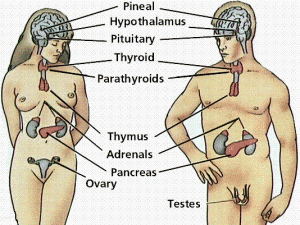
Fig 1. Endocrine Glands
Six passions of the mind called Arishadvargas were depicted as the internal enemies of the man on the path to attaining moksha (liberation). These correspond to the hormones produced at the six major nerve plexuses as shown in the figures 1 and 2 and Table 1.
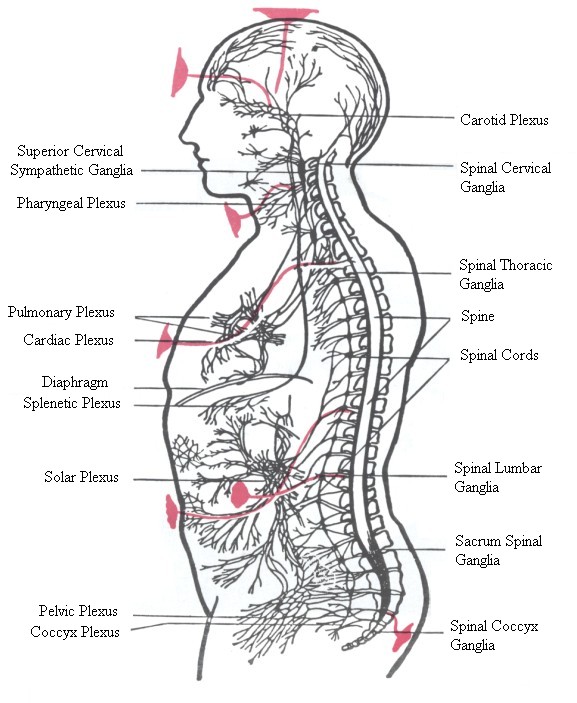
Fig 2. Nerve Plexuses
Psychologist Piercarlo Valdesolo writes “The power to resist temptation has been extolled by philosophers, psychologists, teachers, coaches, and mothers.” And then he adds, “Of course, this assumes that our natural urges are a thing to be resisted – that there is a devil inside, luring you to cheat, offend, err, and annoy. New research has begun to question this assumption.”
QUESTIONS NOT RAISED OR ANSWERED – Part 1
[Here are three questions that I did not come across a seeker raising them. Nor did I find any teacher discussing directly those specific issues and answering them in a logical way. Maybe my literature search is incomplete, I admit. Before I go on to provide my replies to these questions, I will very much appreciate to know the reactions / thoughts of the interested / knowledgeable readers – ramesam.]
The Questions:
A. Bhagavad-Gita related: Continue reading