Birth and Death

One of the most startling passages that I encountered when I first began to study advaita was that in chapter 2 of the Bhagavad-Gita in which Arjuna bemoans the fact that he is expected to kill his teachers and relatives. Krishna responds with the following amazing statement (II.19 – II.20): “He who thinks that the spirit kills, and he who thinks of it is killed, are both ignorant. The spirit kills not, nor is it killed. It was not born; it will never die: nor once having been, can it ever cease to be: unborn, eternal, ever enduring, yet most ancient, the spirit dies not when the body is dead.” (Ref. 1)

Needless to say, the idea of death is one that disturbs most people. Indeed, it is probably the most feared event for the vast majority whether or not they believe that it signifies the literal end of their existence. Life appears to have the profile of a hill. We start at the bottom; slowly we begin to make an impression on life, ‘making a name for ourselves’, acquiring all of those things that are considered to make life significant – job, spouse, peer recognition, house and money etc. And then, there comes a time when we feel that we have achieved all that we are going to achieve. Ambitions cease; physical and mental capabilities decrease; ailments become more frequent; there is a gradual slide into physical decay and ultimate death. As Macbeth puts it so depressingly:

Life’s but a walking shadow, a poor player
That struts and frets his hour upon the stage
And then is heard no more.

Or, as Jaques puts it in ‘As You Like It’:

Last scene of all,
That ends this strange eventful history,
Is second childishness and mere oblivion,
Sans teeth, sans eyes, sans taste, sans everything.
Continue reading

Vedanta the Solution – Part 30

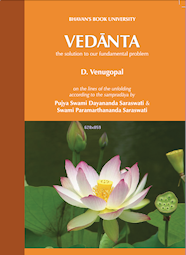
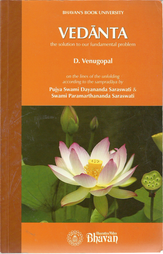
VEDĀNTA the solution to our fundamental problem by D. Venugopal

Part30 concludes the discussion on the ‘description’ of brahman as satyam j~nAnam anantam and then looks specifically at the meaning of ‘existence’ (sat) with reference to the body-mind-sense-complex.

There is a complete Contents List, to which links are added as each new part appears.

dhyAna and samAdhi

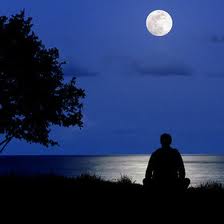
Meditation

dhyAna and samAdhi are quite fascinating, pretty alluring and romantically inspiring terms for an aspirant on the spiritual path. They are almost always spoken in a tone that creates an awe. They sound mysterious, other worldly and ethereal. Many stories are told in the Purana-s about highly revered Sages lost in deep meditation or samAdhi to the extent that they were unaware of their own body being buried in heaps of sand or eaten away by critters and crawlers. Hair-rising narratives too are often reeled out about the powers that dhyAna and samAdhi lead one to – clairvoyance, multiple accomplishments (aNimAdi siddhi-s), infinite longevity (ciranjIvatva), visitations to subtler worlds inaccessible to normal human beings and so on. There is hardly a spiritual Guru who does not harangue about the glories a seeker will be bestowed through practicing dhyAna and samAdhi. Some teachers would even make these as a pre-requisite before any true ‘knowledge’ is imparted. As a result, the words dhyAna and samAdhi acquired varying meaning. Teachers too historically used or interpreted them in different ways. We shall attempt to take a synoptic view particularly from a Non-dual perspective what these terms connote and their role and relevance for a seeker who has adopted the jnAna mArga (The Knowledge Path) in his/her pursuit of liberation.

The write up is structured as a Power Point Presentation downloadable as a pdf file at: http://www.advaita.org.uk/discourses/downloads/dhyAna_samAdhi.pdf. Continue reading

Nisargadatta terminology

A frequent contributor to the site, Vijay Pargaonkar has provided the following valuable information rearding the terminology of Nisargadatta Maharaj:

When references to Nisargadatta Maharaj and his teachings come up at the AV forum during discussions, the arguments often seem to become tangential. I think this is mainly due to the differences in terminologies and definitions used by the followers of Nisragadatta and the ones used in traditional Advaita forums.

Last week I came across a rare Satsang tape in Marathi where Maharaj clearly lays out his version of the Creation Model and Prakriyas while explaining various Advaita terms according to his definitions. I have excerpts of this Satsang translation (as I heard and understood) below, where I have indicated the Sanskrit/Marathi terms along with the English terms used by the translator – the translator has actually chopped the live recording and inserted his English translation in between.

Creation Model

Prior to your waking is Nirguna, the substratum of Waking. The Nirguna is not at all bothered by this samara (samara = ‘war (of life)’). In Nirguna appeared knowledge (Bodha).  This is pure Consciousness or Beingness or the Sense “I am” that has no shape or form. In this pure Consciousness there appeared a slight perturbation or movement and the pure Consciousness then grabbed a body-form (deharupa). After wearing this body form it started calling itself a man or woman while bound by different concepts (I am this; I am that; I am going; I am coming etc.). These concepts are all imaginary (Kalpana) and not real. Continue reading

The Mystery – Part 2

bimal_cover

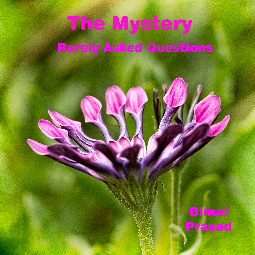
Continuing this new, short series presenting the booklet by Bimal Prasad, in which he answers some ‘Rarely Asked Questions’ on Life. Primarily from the perspective of Advaita, questions addressed include the nature of happiness, consciousness, mind and ego. There is also practical guidance on meditation in the final chapter. Answers are relevant and succinct, so that many of the issues of interest to the seeker are covered.

This second part looks at the distinction between ‘I’ and the body-mind and identifes ‘Consciousness’ as being who we really are. See the Contents List or go straight to Part 2 of the series.

The complete (electronic form) booklet may also be purchased from Amazon.

Tattvabodha – Part 9

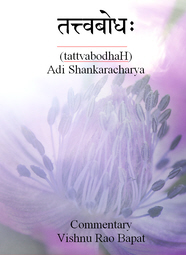
OLYMPUS DIGITAL CAMERAPart 9 of the commentary by Dr. VIshnu Bapat on Shankara’s Tattvabodha.This is a key work which introduces all of the key concepts of Advaita in a systematic manner.

The commentary is based upon those by several other authors, together with the audio lectures of Swami Paramarthananda. It includes word-by-word breakdown of the Sanskrit shloka-s so should be of interest to everyone, from complete beginners to advanced students.

Part 9 looks at the makeup of the subtle body, its functions and purpose, from one birth to the next.

There is a hyperlinked Contents List, which is updated as each new part is published.

Vedanta the Solution – Part 23

venugopal_vedanta
VEDĀNTA the solution to our fundamental problem by D. Venugopal

Part 23 begins the chapter on ‘Analysis of the subject in its three states of experience’. This first part looks at the three aspects of the body-mind-sense complex – the causal, subtle and gross bodies.

There is a complete Contents List, to which links are added as each new part appears.

Tattvabodha – Part 8

OLYMPUS DIGITAL CAMERAPart 8 of the commentary by Dr. VIshnu Bapat on Shankara’s Tattvabodha.This is a key work which introduces all of the key concepts of Advaita in a systematic manner.

The commentary is based upon those by several other authors, together with the audio lectures of Swami Paramarthananda. It includes word-by-word breakdown of the Sanskrit shloka-s so should be of interest to everyone, from complete beginners to advanced students.

Part 8 looks at the makeup of the gross body, its functions and purpose, and the modifications that it undergoes.

There is a hyperlinked Contents List, which is updated as each new part is published.

Vedanta the Solution – Part 22

venugopal_vedanta

VEDĀNTA the solution to our fundamental problem by D. Venugopal

Part 22 concludes the chapter on ‘Enquiry into the Self as subject’, equating Consciousness and Existence and looking at the relationship between the body-mind-sense complex and Consciousness.

There is a complete Contents List, to which links are added as each new part appears.