Q. 363 – Divine Grace

Q: Over the past eight years I have developed a personal relationship with a God of my understanding – or should I say with a God of my non understanding and I know that the term God is loaded and perhaps not word enough. I love God and naturally want to be with God.

 I have some experience of Hinduism and spent time studying Buddhism, I even spent time living at a Buddhist center while going about my ordinary business of work, life and family. I couldn’t continue with Buddhism even though they were wonderful people because in my heart I knew it was not the right path for me and I felt conflicted. I returned to my love of Hindu practices because it felt more right for me and over the past two years I have tried to find my way. I have deepened my understanding through reading books, internet teachings on you tube and meditation. 

 More recently I have ventured upon Advaita Vedanta and it feels right for me. However, I have no teacher and no one to ask when I have questions.  Sometimes it all gets a bit too non dual for me and I feel disconnected from the love part with all the philosophy and intellectual explanations.  I experienced the grace of God eight years ago when I was in a desperate plight and Divine Grace is an absolute for me. What I want to know is how does Grace happen, is it Brahman or Divine consciousnesses. Thank you for any time and consideration you might give to answer my question. Continue reading

What is Brahman? (Part 4)

(Read Part 3)

Leo Hartong also uses the metaphor of clouds, as thoughts, in the blue sky of ‘I am’ awareness:

“Ramana Maharshi recommended that one investigates by asking the question ‘ Who am I?’ When asked who you are, there might be a hesitation as to what to answer; but when asked if you exist, there is no such doubt. The answer is a resounding, ‘ Yes, of course I exist.’ When the answer to the first question is as clear as the answer to the second question, there is understanding.

“The realization is that both questions have in fact the same answer. That which is sure of its existence –the innermost certainty of I Am- is what you essentially are. In other words: I Am this knowing that knows that I Am. The Hindus say Tat Tvam Asi (Thou Art That). In the Old Testament, God says, ‘ I Am that I Am.’ This undeniable ‘ I Am’ is not you in the personal sense, but the universal Self. Ramana Maharshi called the fundamental oneness of ‘ I Am’ and the universal Self ‘ I-I.’ Continue reading

What is Brahman? (Part 3)

(Read Part 2)

The superficially contradictory ‘descriptions’ of Brahman as ‘neti, neti’ and ‘sarvaM khalvidaM brahma’ [all this is verily Brahman] are brought out in adjacent verses of the Atma bodha, attributed to Shankara (Swami Chinmayananda translation):


  1. Brahman is other than this, the universe. There exists nothing that is not Brahman. If any object other than Brahman appears to exist, it is unreal like the mirage.
  2. All that is perceived, or heard, is Brahman and nothing else. Attaining the knowledge of the Reality, one sees the Universe as the non-dual Brahman, Existence-Knowledge-Bliss-Absolute.

Here, it is first stated that the universe is not Brahman. But it is also said that any other appearance will be unreal, like a mirage. The mirage is a powerful metaphor because the water that appears is in reality only the sand upon which the appearance takes place. I.e. sand is the substratum of the water appearance, just as Brahman is the substratum of the world appearance. It is then stated that all appearances are, in fact, nothing other than Brahman. But this is realized, of course only upon enlightenment. Until then, the world remains very real. Similarly, to the seeker after water in the desert, the mirage is very real. Continue reading

Brahman is undefinable

The entire visible world, including mind, intellect, actions, Iswar, etc., disappear at the final ending of the Great Period (maha kalpa), i.e. at the time of Great Dissolution (maha pralaya). Space and time also become extinct at that position. The immutable substrate Brahman only will remain. It is not time, space, the five fundamental elements or any other thing. We cannot describe or define what it is. Only Knowers of Self can understand It. The rest of the folk has to take recourse to Vedic aphorisms to talk about it.

YOGA VAASISHTA – Part Vl, Nirvana (Liberation), Book ll, transl. Dr. Vemuri Ramesam

What is Brahman? (Part 2)

brahman4(Read Part 1)

Positive ‘definitions’ of Brahman are given by such expressions as satyam j~nAnam anantam brahma, in the Taittiriya Upanishad. The words are to be understood as svarUpa lakShaNa, i.e. a definition that differentiates what is described from all other objects. The example often given for svarUpa, which literally means ‘own form or nature’ is sweetness, as being the svarUpa of sugar. But the word ‘sweet’ does not actually convey the quality of sweetness; it only works if we have had the experience of tasting something that is sweet – then there is no problem at all. In the case of Brahman, however, we cannot have the experience of Brahman because it is not an object of experience. Our understanding of Brahman comes from the shruti.

In the expression, Brahman functions as the noun with satyam, j~nAnam and anantam functioning as adjectives. But, as already noted, Brahman cannot have any attributes so that we cannot really use adjectives at all. Therefore, instead of the noun-adjective relationship [visheShya-visheShaNa], this is what is called a lakShaNa-lakShya sambandha [relationship between an indirect pointer and the thing to be defined]. anantam means eternal, limitless; satyam incorporates the ideas of truth, reality and existence, and j~nAnam means knowledge. But a simple translation will not do – this is where the guru needs to come in to ‘unfold’ the explanation step by step. satyam, for example, has to convey the meaning of absolute existence; anantam, free from all limitations of time and space; never changing; j~nAnam, pure awareness, consciousness (neither knower, known object nor means of knowledge), and again unlimited. And so on! Continue reading

Topic of the Month – Brahman

brahman3The topic for Sep 2014 is brahman.

This is, of course, THE topic of Advaita – what else is there?

I posted part 1 of the 3-part essay, which I wrote back in 2009 on the subject of Brahman, last month. I will post part 2 within the next 24 hours.

I recently started looking at Shankara’s dakShiNamUrti stotram for the first time and encountered there a way of looking at tat tvam asi that I hadn’t previously encountered. jIvAtman is treated as Consciousness (tvam – you) and paramAtman is treated as Existence (tat – brahman – every’thing’). asi is aikyam – identity. You are That. Consciousness is Existence. Maybe others have studied this text and can elaborate?

Please submit your quotes, short extracts or personal blogs on this topic!

What is Brahman? (Part 1)

Enlightenment is the realization in the mind of a person that ‘I am Brahman’. So what is this ‘Brahman’ that I am supposed to realize? Knowing this must constitute a significant aspect of the Self-knowledge that I need to acquire in order to become enlightened.

(The following analysis is loosely based upon Swami Paramarthananda’s talks on Shankara’s bhAShya [analytical commentary] on the Brahma Sutra.)

Before we can investigate anything, two criteria must be satisfied:

1) We must know what it is we are investigating (a definition)

2) We must have an appropriate means of acquiring data (a pramANa). Continue reading

Q. 362 – Knowledge and Belief

Q: What does it take to become God-realized? Is it simply to accept that I am brahman,or to really believe I am brahman, or to really, really believe I am brahman, etc? I understand that to have knowledge of something does not automatically transform me. I believe that in order to really know something one has to assimilate and implement the teaching. I know I am already That, but then, how can I ensure the attainment of mokSha in order to stop the illusion of saMsAra

A (Dennis): Knowledge, according to Western philosophy (I think) occurs when you believe something and that belief is both justified (by experience and reason) and true. In order to become Self-realized (I don’t know what you mean by ‘God-realized), you have to subject the ideas of Advaita to doubt and questioning and repetition and consideration etc until such time as your beliefs become knowledge.

I had an experience about 25 years ago which provided me with a powerful illustration of how different knowledge is from belief.  You will have to bear with me as it takes a little while (and two diagrams!) to explain.

101_1 I used to attend philosophy lectures at a school called SES, which holds its talks in rented buildings scattered about the country. At this time, they were held in a house on a circular avenue as in the first image on the left. I always approached along the road at the top, turned left into the avenue and then clockwise to the school. On leaving, I always returned the same way – anti-clockwise, then right and right.

Then, one night, for some reason, I carried on in the same, clockwise direction and then turned left, and then right at the main road as usual. Except that I suddenly hit some traffic lights that had not been there before and I realized that I was somewhere completely different! I quickly recognized where I was and took corrective action but I was completely mystified as to how I had got there.

I puzzled over this for some time, wondering if I had had some sort of mental blackout or been so involved in thinking about what we had been talking about that I hadn’t been paying attention and went the wrong way for some reason.
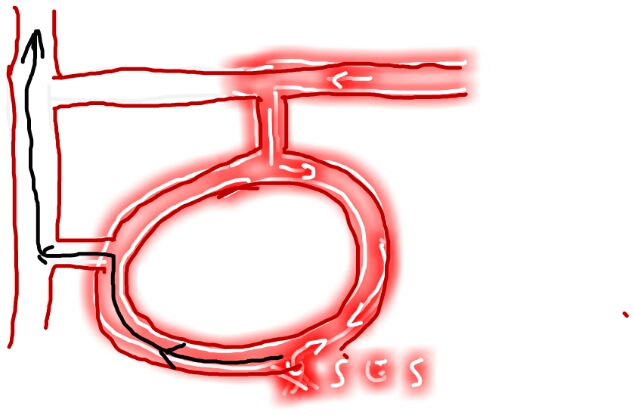
101_2And then, at some point, the explanation came to me and I knew beyond any doubt what must have happened, even though I had not looked at a map or spoken with anyone about it. The actual layout of the avenue had to be as shown in the second diagram. And so it was of course. But the point is that, when the answer came to me, it came as certainty, not as some working hypothesis or plausible explanation. (Apologies for poor quality of diagrams – I did them on my tablet using software I haven’t used before.)

So this is the certainty for which you are looking. It comes of itself when your mind is ready. You simply know that there is no other answer, even though you cannot look at a map to check your conclusion. If you have the belief already, you have presumably had sufficient shravaNa. You now need to give yourself more manana and nididhyAsana.

Bhakti in Advaita

“Bhakti” in common parlance is generally taken to mean a sort of Master – slave relationship of a seeker towards a superior Guru/Master/Lord/God, an attitude that in a way does reinforce duality.

Historically speaking, Bhakti as a cult took root in India after the Muslim invasions. The Abrahamic monotheistic religions with their proselytizing spirit attracted the masses offering the promises of a personal God who would fulfill their wants. Perhaps to counter this, indigenous Bhakti cults developed and continue to do so today. 

The Advaita scriptural texts, strictly speaking, do say that devotional approach to a personal deity is an inferior path for Enlightenment. Further, some of them explicitly state that the devotee has to be a “Shiva” himself in order to worship Shiva. Yogavaasishta says a Vishnu only can truly worship a Vishnu. The implication in these statements is that the devotee should lose the sense of being a separate individual from what is being worshiped – it insists on a total identity, Oneness, of the subject-object.

I feel that the techniques like meditation, Bhakti, rituals, pilgrimages etc. are useful at two levels to a seeker:

  • Bhakti etc. will work as a sort of aid to train the mind in its ability to stay focused (instead of wavering) and unbiased (being aware of one’s own hidden prejudices). These two aspects sharpen the mind and make it ready to take up Self-inquiry on one’s own.
  • Bhakti and other such techniques are useful once again at a later stage after the Advaitic message is completely ingested without any doubt but a seeker experiences some difficulty to abide constantly in Brahman. The mind out of its sheer old habit pulls him/her back to the lures of the world from unceasing abidance as Brahman. Using Bhakti and other such things as little crutches, it will be easy for the seeker then to come back to rest as Awareness instead of being driven by the vagaries of the mind.

From:  Place of Bhakti in Advaita – The Reply to the Question, Jul 27, 2012