There are no beliefs here

I’ve heard that in the sage, everything happens spontaneously.

Yes. And do you want to know what else? In everyone, everything happens spontaneously. In you, everything happens spontaneously.

I don’t experience it like that.

Exactly. That’s the difference.

Do you believe that the Understanding can happen to anyone?

I don’t believe anything.

What?

There are no beliefs here.

That’s an extraordinary statement.

Not at all. It’s really quite simple. You either know something or you don’t. If you know something, you don’t have to believe it’s true or have faith that it’s true; you know it beyond doubt, it simply is, and there’s no belief involved. On the other hand if you don’t know something, the honest thing is to simply say you don’t know. But of course there are many psychological and political and social reason why people can’t admit, even to themselves, that they don’t know something, so they create a belief; which is essentially saying that you don’t really know something is true, but you’re going to pretend you do. It’s all activity in the dream. There’s really only one thing which is not of the dream, only one thing that can be known, and that is the basic consciousness, “I Am.” Everything else is just a concept, a construct of mind in the dream, something “I don’t know.” Everything.

Okay, but can this Understanding happen to anyone, any body/mind?

Of course.

Could it happen to me?

No, of course not. That’s the difference. But it could happen in the case of the body/mind organism which at the moment you think is you, and then there would be the understanding that there never was a ‘you,’ a ‘me’ for anything to happen to, and that who You are is the Consciousness in which all this appears to happen. The Understanding and the belief in a ‘me’ are mutually exclusive: if one is there the other will not be.

From ‘Perfect Brilliant Stillness’, David Carse, Non-Duality Press, ISBN: 954779282.
Extract Link, Review Link
Buy from Amazon US, Buy from Amazon UK

Q. 362 – Knowledge and Belief

Q: What does it take to become God-realized? Is it simply to accept that I am brahman,or to really believe I am brahman, or to really, really believe I am brahman, etc? I understand that to have knowledge of something does not automatically transform me. I believe that in order to really know something one has to assimilate and implement the teaching. I know I am already That, but then, how can I ensure the attainment of mokSha in order to stop the illusion of saMsAra

A (Dennis): Knowledge, according to Western philosophy (I think) occurs when you believe something and that belief is both justified (by experience and reason) and true. In order to become Self-realized (I don’t know what you mean by ‘God-realized), you have to subject the ideas of Advaita to doubt and questioning and repetition and consideration etc until such time as your beliefs become knowledge.

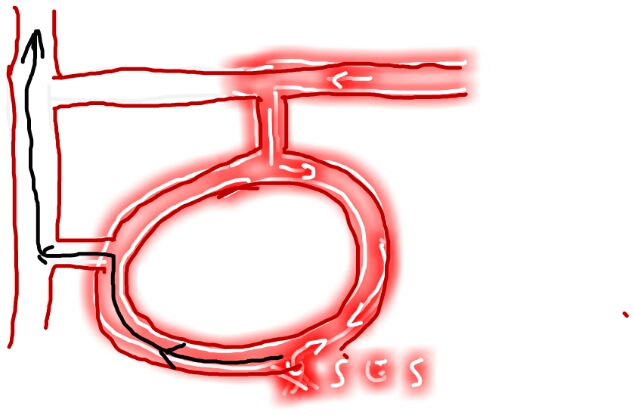
I had an experience about 25 years ago which provided me with a powerful illustration of how different knowledge is from belief.  You will have to bear with me as it takes a little while (and two diagrams!) to explain.

101_1 I used to attend philosophy lectures at a school called SES, which holds its talks in rented buildings scattered about the country. At this time, they were held in a house on a circular avenue as in the first image on the left. I always approached along the road at the top, turned left into the avenue and then clockwise to the school. On leaving, I always returned the same way – anti-clockwise, then right and right.

Then, one night, for some reason, I carried on in the same, clockwise direction and then turned left, and then right at the main road as usual. Except that I suddenly hit some traffic lights that had not been there before and I realized that I was somewhere completely different! I quickly recognized where I was and took corrective action but I was completely mystified as to how I had got there.

I puzzled over this for some time, wondering if I had had some sort of mental blackout or been so involved in thinking about what we had been talking about that I hadn’t been paying attention and went the wrong way for some reason.

101_2And then, at some point, the explanation came to me and I knew beyond any doubt what must have happened, even though I had not looked at a map or spoken with anyone about it. The actual layout of the avenue had to be as shown in the second diagram. And so it was of course. But the point is that, when the answer came to me, it came as certainty, not as some working hypothesis or plausible explanation. (Apologies for poor quality of diagrams – I did them on my tablet using software I haven’t used before.)

So this is the certainty for which you are looking. It comes of itself when your mind is ready. You simply know that there is no other answer, even though you cannot look at a map to check your conclusion. If you have the belief already, you have presumably had sufficient shravaNa. You now need to give yourself more manana and nididhyAsana.

Q.360 – Suffering

OLYMPUS DIGITAL CAMERAQ: I have tried several spiritual paths and I was always stopped in my search by this question: How do we explain suffering?. Why does all pervading, partless, actionless Consciousness create, allow, dream of Auschwitz? Surely Consciousness could do better than this?

Answers are provided by: Ted, Martin, and Sitara. For answers by Dennis, see Q.24 and Q.33 and Q.62 and Q.120 and Q.294.

A (Ted): Your question is certainly understandable. It is the same question just about everybody has at an early stage in their spiritual understanding. It is based on a fundamental erroneous assumption we make about the nature of reality due to the conditioning we receive either directly from religion or indirectly from the religious beliefs that undergird the generally accepted perception of reality that informs the society.

 Our mistaken assumption is that awareness is an anthropomorphic (i.e. human-like) entity who has some overarching personal agenda and is orchestrating—or at least overseeing—the activities and events transpiring in the world with a vested interest in their nature and results. But this is not the nature of awareness. Continue reading

Revision of ‘Review of article on Shankara’ – part 4

Under the section ‘Tarka vs Sruti’ the more or less unconscious devise (upadhi) of removing the subject from the ‘picture’ aimed at understanding the world is broached, and the author (RB) quotes E. Schrödinger in that connection: “It became inherent in any attempt to form a picture of the objective world such as the Ionians made”. And so, “…the desire for understanding the world through our imperfect sensory knowledge invariably leads to certain, frequently overlooked, assumptions”.

It is curious that the first sleight of hand – by ‘primordial man’, the demiurge of mythology and Platonic philosophy – consisted in carrying out a scission within reality so that subject and object would emerge in opposition to each other: God and man (the Garden of Eden), the One and the many. A second scission was done by philosophical, or ‘thinking’, man, by removing the human subject altogether – provisionally, for the Ionian ‘physiologoi’ knew what they were doing, though, it is related, Thales of Miletus fell once into a ditch while absorbed looking at the firmament’s stars in utter wonder. Certainly, this device – or both combined – made possible all the empirical sciences, literature, art, and everything we know about the world. If there were no division or separation (no adhyasa and it’s attending ‘names and forms’), there would be no ‘world’. Allusion was made to this parallel mythological account previously, as well as to the kind of ignorance that became knowledge (with small case). Continue reading

Who Slept Well – Part 4

This is the final part of the series from AchArya Sadananda, (only edited by myself).

Deep-Sleep State

When we go into the deep sleep state, we start withdrawing each of the kosha-s, one by one, with the desire or thought of going to sleep. The ‘I want to sleep’ thought forms the contents of the vij~nAnamaya kosha or the intellect, when it goes to sleep or when it goes into an unmanifested state.  In the process of sleeping, there is a withdrawal of each of the grosser kosha-s into the subtler ones: annamayakosha to prANamayakosha, prANamaya to manomaya, manomaya to vij~nAnamaya.  At the time of sleep, the vij~nAnamaya or intellectual sheath becomes unmanifested with all the kosha-s as part of its ingredients, but in undifferentiated form. That unmanifested state of the intellectual sheath with all its constituent kosha-s is now called Anandamayakosha, since there is absence of any discriminative thoughts and associated relationships, other than the homogeneous thought of ignorance or avidya. This is referred to as avidya vRitti.  It is, in a sense, an experience involving the knowledge of the absence of anything and everything.  Hence the Mandukya (mantra 5) says – na ki~nchana kAmam kAmayate – there is absence of desire for any object, since there is no perception or recognition of any particular object of any kind in that unmanifested state. Continue reading

How Vedanta Works

OLYMPUS DIGITAL CAMERAHow words work in Vedanta
(based on essays from Sw. Dayananda and Ramji)

by Tan

Vedanta is a means of self knowledge through words called shabda pramANa.

It is able to give you direct knowledge of your eternal nature through words. In spiritual circles this will be generally criticized with the argument that the eternal self, enlightenment, the absolute, Brahman, the Tao or whatever you want to call it, is beyond words and indescribable. Therefore the conclusion is that it is impossible to get direct knowledge and know your “real” self through words. Continue reading

Who Slept Well?

OLYMPUS DIGITAL CAMERAThis is the first of a four-part article by Acharya Sadananda of Chinmaya Mission Washington (edited by myself) clarifying the nature of the deep-sleep state and addressing a number of problems which frequently cause confusion in seekers.

I wish to express my appreciation to Pujya Sastriji and Shree Subbuji for directing me to the Panchadashi Ch.11, where the deep-sleep aspects are discussed extensively by Shree Vidyaranya.  This article is in response to a question posed by a sincere seeker in a private mail. His question focused on the following:  Who is the experiencer, knower, and the recollector of the deep-sleep state, when the mind is not there? In essence, who slept well and knows that he slept well and is now recollecting that information when he is awake.  This response to the question is based on my understanding of the 11th Chapter, together with a private communication from Shree Sastriji the post to Advaitin by Shree Subbuji.

In searching for answers, I came across the article by Shree Ananda Wood on the topic of Shree Atmananda Krishna Menon’s understanding of the deep sleep state. Given the fact that all descriptions of the deep-sleep state are necessarily from the vantage point of the waking state, we can only rely for analysis on 1) shaastra pramANa and 2) those experiences that are universally common.  The problems with Shree Atmanandaji’s interpretation of the deep–sleep state are noted at the end, since there are many people that I see on Facebook, as well as elsewhere, who follow Atmanandaji writings relating to deep sleep state. Continue reading

Q. 353 – Witness to the boredom

Q: I have a problem with the boredom of everyday life. Nothing seems to satisfy me. I just find it so difficult to be just here in the moment and be content with that. You say: go through life and work etc, but as a witness to it all.

Am I living in moment as I should? Should I give all my attention to each action, so that the ego is absent or should I just be the witness of everything every action on a moment to moment basis?

Maybe if I understand how to live in the moment better and had some clarification, that would help me stay present and focused on just living. My mind lives in the future.

(Note: I have reworded the question slightly but some of the replies quote from the original question. Apologies for any confusion!)

Answers are provided by: Sitara, Ted, Ramesam, Martin and Dennis. Continue reading

Experience

111472_web_R_by_Dieter Wendelken_pixelio.de

For most advaitins, traditional as well as Western, the term ‘experience’ seems to be a red rag. I would like to open our minds to a more comprehensive understanding of the word.

What exactly is an experience? It is a mind phenomenon, possibly following a sense perception or an action. Tasting food  is a sense perception. But to evaluate it as enjoyable or as disgusting makes for a pleasant or unpleasant experience. Similar with activities: just to be active – walking, talking, gesticulating etc. – is not an experience yet. Experiencing comes about when the mind gets involved, usually with an evaluation of the activity. An experience can also come about without a sense perception or activity: understanding a joke or having a nightmare can make for purely mental experiences, the first usually pleasant the latter unpleasant.

The whole world of non-advaita is ruled by the hunt for experiences of various kinds. Continue reading

Q.349 – Guru’s grace

Q: Do you have any comments on the concept of “guru’s grace” or ‘shaktipat guru’; the idea that some teachers are able to ‘induce’ experience in seekers or ‘transmit’ knowledge or ‘spiritual power’? Numerous reports of this sort of thing abound in the literature, and I myself have experienced something along these lines many years ago from a “mystical teacher” I followed for a couple of years in 1978-1980. I wonder what is actually going on in this sort of incident. Is it just 100% psychology at work, pure self-deception? Such “transmission” experiences can often be the seed or catalyst which spurs further effort on the path. There are so many examples of an aspirant “feeling something” in the presence of a teacher or guru that it seems inappropriate to just dismiss such claims outright.

A (Ted): It is true that some teachers can “induce” experiences in seekers.  The teacher’s ability to do this might be called a “spiritual” power in the sense that is seems both extraordinary – i.e. something most people can’t do – and mystical – i.e. beyond the normal range of mundane or worldly occurrences. The qualitative effect of this energy transmission on the seeker might, as well, be referred to as “spiritual power” in the sense that it powers up one’s mind-body-sense complex – most specifically the subtle body – in the same way that an influx of warm air heats up a room or the blare of dance music livens up a party. Continue reading