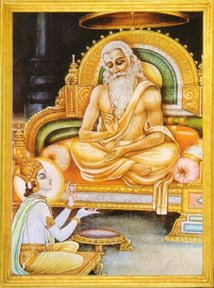
Part 11 of the New Book Serialization!
The second dialog between the sage Vasishta and the Dreamer begins.
The dreamer asks about the difference between an avatar and a lunatic and Vasishta explains that the Absolute never assumes name and form.
Part 11 of the New Book Serialization!
The second dialog between the sage Vasishta and the Dreamer begins.
The dreamer asks about the difference between an avatar and a lunatic and Vasishta explains that the Absolute never assumes name and form.
Q: What is the difference between the witness, witness consciousness and consciousness? I know myself as the witness or maybe as witness consciousness but I do not know myself as all there is which, I guess, would be knowing myself as consciousness. But how can I ever not see the world of objects? So do I not remain a witness choicelessly?
A (Sitara): Contained in your question are seven questions (which I have passed on to the other bloggers, so some may refer to them):
1. What is the difference between the witness, witness consciousness and consciousness?
This will be answered below along with the last question.
2. (implied question) Is there a difference between the witness and witness consciousness?
Answer: no, not in the way I use the terms. But there is the possibility of a flawed use of the term ‘witness’. Witness means the ultimate subject that cannot be objectified. If witnessing is attributed to the mind, the so-called witness is nothing but a thought, i.e. it is just another object. And the so-called witnessing is nothing but an experience.
If, however, witness is used in the sense of ‘ultimate subject’, you can use ‘witness’ and ‘witness consciousness’ interchangeably. I prefer the term ‘witness consciousness’ (or simply ‘witnessing’) because the term ‘witness’ suggest too much of a personality. Continue reading
What is puruṣārtha-niścaya? Of the two words, niścaya has a close English equivalent: certainty, conviction, unshakable clarity. So puruṣārtha-niścaya mean ‘doubt-free clarity and unshakable certainty’ about puruṣārtha. So what is this thing one has no doubt about?
Puruṣārtha is a compound made up of two words: puruṣa and artha. Puruṣa also has a close English equivalent: ‘person’, ‘human being’ (albeit with a lot behind it that reminds us of the true scale of what is indicated by the word – see footnote at the end).
Thus, so far, we have arrived at this meaning: ‘unshakable certainty about human artha’.
Artha is the last word that needs unpacking. Normally translated as ‘wealth’ or ‘meaning’, here it should be read as ‘aim or purpose’.
Puruṣārtha is the purpose of the human life. And puruṣārtha-niścaya is total clarity about what this purpose is – about what defines human life and drives human activity. Continue reading
Q: I have seen from articles and questions on your website that Brahman cannot ‘know’ or ‘do’ anything; that it (as if) acts and knows only through the body-mind of the jIva. What I would like to know is: why would anyone want to become enlightened if this means the end of rebirth, and ‘becoming’ one with Brahman? OK, this may mean the end of suffering but does it not also mean the end of enjoyment? If ‘I’ (even though this is only a reflection in the mind) cease to exist (when the body-mind finally ceases to exist) on the death of the enlightened person, then there is no more experiencing of any kind for me as that person, and none for the Brahman that I (as it were) become.
You will perhaps say that, as Brahman, I will still experience through all the other body-minds but this does not sound like enlightenment to me! And don’t I do that already anyway since there is only Brahman? In which case what is the meaning (and point) of enlightenment? Continue reading
One of the more difficult ideas for some Western seekers to accept is God, the Lord. The usual picture is of a highly judgmental white-bearded figure, sitting in heaven, dispensing punishments and rewards. God, in this picture, is all-controlling, all-powerful and thus I am small and insignificant and a mere pawn in his game. This sort of idea of the Lord is also prevalent in the East. For the godless, prayer and worship obviously have no place, and for the theists, prayer and worship are ultimately to secure a place in heaven or worldly comforts and pleasures. In one of her talks to her London students, Swāminī Ātmaprakāśānanda put all of this into perspective so that anyone with an open mind could get a wider, more liberating vision of these important and vital matters. This part deconstructs the concept of Lord…
What is this world? The world is nothing but a world of objects – different objects, perceptible through different senses. You can reduce the whole universe into five types of objects, perceptible through the five different senses. Every object becomes as good as non-existent if it is not perceived by the appropriate sense organ.
Despite its size, the universe would be as good as non-existent if you didn’t perceive it. The universe has the status of being existent only when it is perceived by you. The Gītā says: “They say the sense powers are superior (to sense objects); the mind is superior to the sense organs; the intellect is superior to the mind. Whereas the one who is superior to the intellect is He (ātmā).” (BhG 3.42) Continue reading
Pramāṇam the word means, “means of knowledge”. Pratyakṣam is direct knowledge – indriya viṣaya sannikarṣa jñānam – the knowledge gained when objects come into contact with the five sense organs, viz., sight, hearing smell, taste and touch. The sequence in which the senses are listed is meaningful and relevant, as it goes from gross to subtle. Eyes can see hundreds of meters; ears can hear within tens of meters; nose can smell upto a few meters; taste and touch have to be immediate and intimate.
In knowing, the means and the knowledge, there is no option –one has no choice over what one sees, the moment one open’s one’s eyes.

Part 9 of the New Book Serialization!
The Sage tells the dreamer about the various levels or stages that he must pass through (i.e. his knowledge and understanding must progress) on the ‘path’ to jIvanmukti.
Q: What happens to creativity (writing painting music… ) when you awake from the dream of dualism ?
A (Peter): What happens to waves when they are known to be nothing but water? Do all waves lose their distinctiveness? Do they suddenly freeze mid-motion?
It is an error to believe that either there is a blank, distinctionless ‘non-duality’ or a rich, exciting, variegated universe. There is only consciousness and every exciting, beautiful thing – gross and subtle – is an expression of it. The painting, the act of painting, the impulse to paint, the paint, the brush, the painter are all an expression of the secondless, non-dual consciousness. Continue reading
The Kaṭhopaniṣad with Śaṅkarabhāṣyam
Based on Swami Paramārthānanda’s lecture
Compiled by Divyajñāna Sarojini Varadarājan
The main teaching of the Kaṭha Upaniṣad is Death’s response to the request by a young seeker, Naciketas, for Self-knowledge. Any serious student of advaita will want to know the answer as this is our own question too: using logic we may well be able to arrive at what we are not, but we still need to know clearly what we are. For this reason this book by Smt. Sarojini Varadarajan, based on Swami Paramarthananda’s traditional unfoldment of the Upaniṣad and Śaṅkara’s commentary theron, is a valuable addition to any seeker’s library.
One way of approaching this Upaniṣad is to note that Naciketas standing at Death’s door (literally) remained steady-minded enough to press his request for Self-knowledge – in spite of Death’s initial resistance to answer. And, by the end of the Upaniṣad, after Death finally gave in to the young man’s request, Naciketas ‘became pure and immortal’. Is it really possible that we can also reach the same point by closely following the teaching that Naciketas hears, especially as we are living lives grounded in fear? Continue reading
Q : I am a “solo practitioner” of the advice of Ramana Maharshi, as I understand what I absorb of it. My enquiries move between an apophatic and cataphatic flavor.
When I do this, I am moved to an absolute stillness. Upon ‘coming back’, there is a sensation of still not passing the barrier of stillness. I am not sure how to continue. Should I continue to practice just like this? Until I have destroyed differentiation? Should this be a lesson on what the real really is?
[Note (Dennis): Here are the meanings of those terms from my Oxford dictionary –
apophatic /ap’fatk/ – adjective Theology (of knowledge of God) obtained through negating concepts that might be applied to him. The opposite of cataphatic.
cataphatic /kat’fatk/ – adjective Theology (of knowledge of God) obtained through defining God with positive statements. The opposite of apophatic.] Continue reading