Questions by Peregrinus

[Reference: https://www.advaita-vision.org/life-is-a-dream-the-world-is-real/#comment-3266 ]

Gary Crowley 2006Dear PtN,

Great Questions!

In providing answers to those very  questions, volumes have been written, several concepts have been floated and related downstream issues have been under constant debate from several centuries (if not millennia) ago up to even now . The positions taken are so extreme and contradictory to each other that protagonists of different propositions do not see eye to eye.  Unable to wrap their minds around the Advaita concepts and unconvinced by the Advaita models, some people (Tatva vadins – followers of the 13th century Madhvacharya) ascribe as much reality to the individual as to brahman but deny the identity of the two. The fights between them and the Advaitins are legendary. And there are notorious disagreements even within the Advaitins also on subtle details of the theories they propose as answers. Hence it is quite safe to say at the outset that there are no straight answers to any of these fundamental questions, as you may be already knowing from your voracious reading. Hence, switching on all caveats and disclaimers …… …… ……, I stick my neck out. Continue reading

Panchadashi and Prarabdha

OLYMPUS DIGITAL CAMERA(Another salVo in the ongoing battle over jIvanmukti, j~nAna phalam, pratibhandaka-s and prArabdha – see Knowledge, Action and Liberation and Knowledge, Action and Liberation – AV)

The following is an extract from Chapter 7 of Vidyaranya’s Panchadashi:


indra-jAlam idaM dvaitam achintya-rachanAtvataH
ityavismarato hAniH kA vA prArabdha-bhogataH

[7:174] Never forgetting that the world is unreal and its cause unascertainable, the wise man stands secure from harm in the midst of the enjoyment of his fructifying karma.

nirbandhas tattva-vidyAyA indra-jAlatva-saMsmRRitau
prArabdhasyAgraho bhoge jIvasya sukha-duHkhayoh

[7:175] The function of knowledge of the real is to promote (constant) remembrance of the fact that’ world is unreal; that of the fructifying karma is merely to provide the jIva with experience of pleasure and pain.

vidya-rabdhe viruddhyete na bhinna-viShayatvataH
jAnadbhir apyaindra-jAla-vinodo dRRishyate khalu

[7:176] The knowledge of the spiritual truth and the fructification of prArabdha karma refer to different objects and are not opposed to one another. The sight of a magical performance gives amusement to a spectator in spite of his knowledge of its unreality. Continue reading

Q. 366 – Self-knowledge – should we bother?

Q: At the end of the day, what does knowledge of self give us ?

It does not help answer the burning question of why the appearance/dream/mAyA that we are experiencing as humans or animals exists.

(I am not clear on this one but..) It appears that even though one attains knowledge of self in one janma, he/she can actually become a cockroach in the next due to karmic effect, i.e. we are not really liberated from the birth-death cycle.

The only benefit I do see in a janma where one attains knowledge of self is that such a person might lead a life devoid of misery in the mind as they sail through good and bad times (although they may still experience physical pain).

A (Sitara): In Advaita Vedanta we ask the question “who or what is the true Self” because we trust (in the scriptures and/or statements of those who claim to have answered this question for themselves) that the true Self is one without a second, meaning the true Self is all there is. So knowledge of the true Self, i.e. Self-realization, equals the realization that the perceived world is nothing but the Self alone. As to why it is perceived as world and not as the Self there are many answers within Advaita Vedanta and in Sri Atmanandaji’s Direct Path. I cannot sum them up in a few sentences, as they belong to an extended teaching methodology. I recommend, for a taste, to watch an interview with Greg Goode.) Continue reading

Brahman is undefinable

The entire visible world, including mind, intellect, actions, Iswar, etc., disappear at the final ending of the Great Period (maha kalpa), i.e. at the time of Great Dissolution (maha pralaya). Space and time also become extinct at that position. The immutable substrate Brahman only will remain. It is not time, space, the five fundamental elements or any other thing. We cannot describe or define what it is. Only Knowers of Self can understand It. The rest of the folk has to take recourse to Vedic aphorisms to talk about it.

YOGA VAASISHTA – Part Vl, Nirvana (Liberation), Book ll, transl. Dr. Vemuri Ramesam

Reality, appearance, and mind

Quote:

Sage Vasishta:  Please listen to me carefully as I shall now teach you the most supreme of all topics — ways to calm down the mind. Just like pillars bear the weight of a building, raajasic and taamasic people carry on their shoulders the unlimited illusion of a world. But saatvic natured persons like you can leave this burden as easily as a snake sheds its skin. The only way to do it is through an understanding of the essence of Truth (tatva vichaaraNa).

Whatever is not existent at the beginning and also at the end, but appears only in-between cannot be Real. Whatever stays permanently at all times (past, present and future) only can be True. How does a thing that has no existence at the beginning and at the end appear to be born and to exist in-between? The fact of the matter is neither anything is born nor anything has grown. All of this is entirely a play of the mind!

जायते मन एवेह मन एव विवर्धते ।

सम्यग्दर्शन दृष्ट्या तु मन एवहि मुच्यते ॥  — shloka 11, sarga 5

What is born here is mind, what develops is also mind. If you consider properly, what is liberated also is mind.”

Extracted from p:7 of the book:  Yogavaasishta Part IV: The Calm Down by K.V. Krishna Murthy, (English rendering by Dr. Vemuri Ramesam), Avadhoota Datta Peetham, Mysore 570025, India, 2008, pp: 194.

The Male Chauvinist Pig in Us!

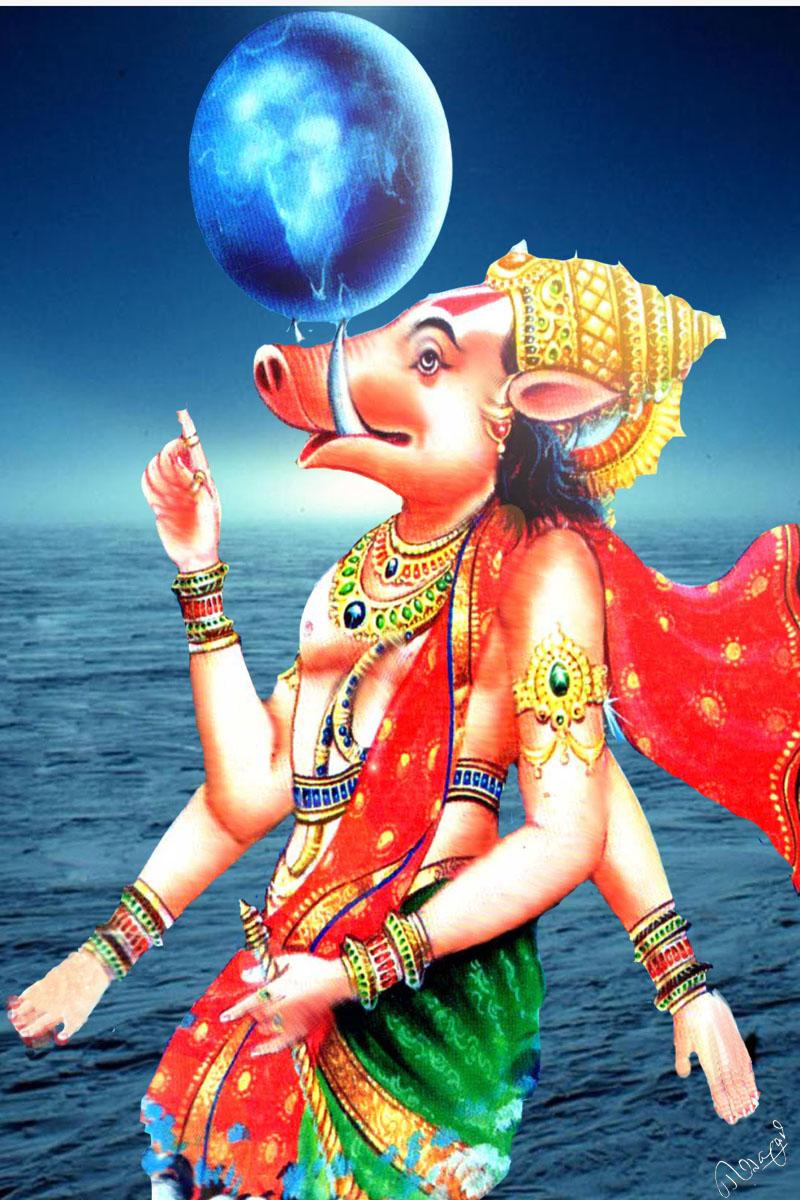
varahavatara

Varaha avatar – Vishnu’s Incarnation as a Boar

vivekacUDAmaNi is a famous text on advaita teaching, usually  ascribed to Shankara. The very first verse, after the formal salutation for auspiciousness, speaks of the rarity to be born as a male human being. It says:

jantUnAm narajanma durlabham atah pumstvam tato vipratA …

(For all beings, the human birth is difficult to obtain; much more so is a male body; rarer than that is brahminhood…)

Now we have genetic support!

Dr. E.M. McCarthy, a Georgia University geneticist, comes up with a controversial new hypothesis of humans evolution. He says that the genetic evidence overwhelmingly suggests that we are a rare cross between  a male Pig and a female Chimp.

Can 48/2 of Chimps chromosomes + 38/2 of pig = 46 of a man? Well, don’t ask such silly math questions. Who  can remember  what happened after all over 80 million years ago?

So Sitara, Dhanya and Meenakshi, Don’t blame us if we are boastful of ourselves!

(If you are more curious see: http://www.macroevolution.net/human-origins.html#.Upoej8RDuSr)

upadesha sAhasrI part 12

Part 12 of the serialization of the  presentation (compiled by R. B. Athreya from the lectures given by Swami Paramarthananda) of upadesha sAhasrI. This is the prakaraNa grantha which is agreed by most experts to have been written by Shankara himself and is an elaborate unfoldment of the essence of Advaita.

Subscribers to Advaita Vision are also offered special rates on the journal and on books published by Tattvaloka. See the full introduction

upadesha sAhasrI Part 11

Part 11 of the serialization of the  presentation (compiled by R. B. Athreya from the lectures given by Swami Paramarthananda) of upadesha sAhasrI. This is the prakaraNa grantha which is agreed by most experts to have been written by Shankara himself and is an elaborate unfoldment of the essence of Advaita.

Subscribers to Advaita Vision are also offered special rates on the journal and on books published by Tattvaloka. See the full introduction and part 1 of the new series.

Not the Doer – Q.338

Q: It seems like a contradiction to me to say that we are the observer and not the doer and, at the same time, suggest that we can do something such as paying attention. I encounter this “apparent contradiction” often when I read about Advaita. If there is no doer, why are there suggestions as to how to remove ignorance, for example? Who would remove the ignorance if there is no doer?

 – Is it that in the dualistic world it appears as if there is a doer and therefore we act “as if”, even though we might know that there is no doer?

– If we realize that there is no doer but we act “as if”, is it like playing our part in a “game”?

– If the ignorance is removed, “who” apperceives the truth? Continue reading

‘SELF-CONTROL’ AND THE BRAIN


We have Sankara exhorting us in Vivekachudamani:  “The first step to Liberation is the extreme aversion to all perishable things, then follow calmness, self-control, forbearance, and the utter relinquishment of all work enjoined in the Scriptures.” And a little later he added:  “He who is free from the terrible snare of the hankering after sense-objects, so very difficult to get rid of, is alone fit for Liberation, and none else even though he be versed in all the six Shastras.”

“Mind control is self-control,” said the highly revered Swami Krishnananda of Divine Life Society. And self-control is the way to awakening, he added.

Fig 1. Endocrine Glands

Six passions of the mind called Arishadvargas were depicted as the internal enemies of the man on the path to attaining moksha (liberation). These correspond to the hormones produced at the six major nerve plexuses as shown in the figures 1 and 2 and Table 1.

Fig 2. Nerve Plexuses

Psychologist Piercarlo Valdesolo writes “The power to resist temptation has been extolled by philosophers, psychologists, teachers, coaches, and mothers.” And then he adds, “Of course, this assumes that our natural urges are a thing to be resisted – that there is a devil inside, luring you to cheat, offend, err, and annoy. New research has begun to question this assumption.”

Continue reading