
Nāma-Rūpa

The Architecture of Duality in Advaita Vedānta

In the quiet depths of Advaita Vedānta, a single question often haunts the seeker: if reality is truly non-dual—one without a second—how do we account for the dizzying array of objects, people, and events that populate our daily lives? If there is only Brahman, where did the “world” come from? The traditional teaching provides a technical and profoundly insightful answer through the concept of nāma-rūpa, or “name and form”.

Understanding nāma-rūpa is not merely a lesson in Sanskrit vocabulary; it is the master key to unlocking the nature of mithyā (dependent reality) and realizing that the world we perceive is not an independent entity, but a specific way of viewing the Absolute.

Continue reading
The Three Orders of Reality

Paramārtha, Vyavahāra, and Pratibhāsa

In the study of Advaita Vedānta, the seeker is often confronted with an apparent paradox. On one hand, the scriptures declare that “all is Brahman” (sarvam khalvidam brahma) and that reality is non-dual. On the other hand, our daily experience is one of persistent multiplicity—a world of separate objects, people, and suffering. To resolve this without denying our direct experience, the tradition, as systematized by Ādi Śaṅkara, utilizes a vital pedagogical framework: the three levels of reality.

This framework—comprising paramārtha (absolute), vyavahāra (transactional), and pratibhāsa (illusory)—is not a description of three different “worlds,” but rather three ways of viewing the same non-dual reality based on our current state of understanding. Understanding these levels is the key to navigating the “path through the jungle” toward Self-knowledge.

Continue reading

Q.505 Creation and Enlightenment

Q: I am struggling to reconcile the empirical account of what may be called ‘creation’ (the Big Bang, followed by billions of years of mechanically unfolding interactions with no sense of self, until the absurdly *recent* emergence of consciousness after further millions of years of blind evolution) with the advaitic concept of ‘creation’ (the absolute Being, timeless and changeless, manifesting in Itself as experience). 

A: The ‘bottom line’ of Advaita is that there has never been any ‘creation’. There is only Brahman. Everything is Brahman. You are Brahman. The ‘universe’ is simply a ‘form’ of Brahman, to which you have given ‘names’ implying that there are separately existing entities.

The scriptures (from which Advaita derives) certainly give ‘empirical accounts’ of a creation. But these are interim explanations only to satisfy the enquirer temporarily until ready to accept the truth.

Science does attempt to rationalize consciousness as an emergent phenomenon, but it is doomed to fail because it cannot objectify the ultimate subject. See my article on ‘Consciousness – Not Such a Hard Problem’ beginning https://www.advaita-vision.org/consciousness-not-such-a-hard-problem-1-of-2/. Also https://www.advaita-vision.org/science-and-consciousness/. Science in general is intrinsically unable to address the problems dealt with by Advaita. See my 4-part article on ‘Science and the nature of absolute reality’ beginning https://www.advaita-vision.org/science-and-the-nature-of-absolute-reality-part-1/, which may contain useful pointers. And the 3-part article by Dr. Sadananda beginning https://www.advaita-vision.org/science-and-vedanta-part-1/

Continue reading

Q.488 Reading Minds

[Note: This is a long Q&A. Any help that other bloggers and readers can give to resolve the questioner’s concerns will be welcomed!]

Q: If waking life is a kind of dream or modulation of awareness then why is it so continuous? Many Advaitins see waking life as some form of dream, correct me if I’m wrong.

Dreams when asleep are always very new, different and unpredictable. And then they disappear and you wake up and forget the dream. And most likely you will not continue where it ended next sleep. On the other hand, waking life reappears after sleep and it is the ‘same’ as yesterday and it only seems to disappear if you die.

A: There is a lot more to it than that. And it cannot all be explained in a couple of sentences. Pretty much all of my book ‘A-U-M: Awakening to Reality’ was about this. (It is a commentary on Mandukya Upanishad and the explanation by Gaudapada.)

There are 3 states of consciousness – waking, dream and deep sleep and none of them are ‘really real’. Waking seems to be real for the waker. The dream is equally real for the dreamer (who thinks he is a waker)! The true reality is the Consciousness that is the basis of all 3 states. Waking life is said to be like a dream so that you can use this as a metaphor for gaining enlightenment. Continue reading

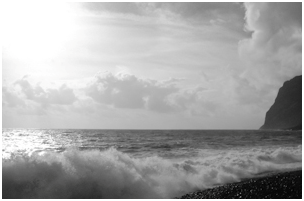
Wave and Ocean

The ‘ocean-wave’ metaphor is a potentially powerful one but is often misunderstood. Here are a few quotes pulled off the Internet from a Google search:

 “The waves emerge briefly as a separate entity; however, just as quickly merge back into the ocean of which it is a part. Us, as human beings, are very much like the waves of the ocean. We briefly surface and display a uniqueness that cannot be duplicated; however, in the end, we reunite with the Whole.”

 “Actually our existence is just like an ocean. You are a wave of the ocean. You may be the most powerful, most thunderous, most beautiful and most inspiring wave of this ocean. But in the ultimate analysis you are just a wave. And the destiny of a wave is to merge again into the ocean. One day your little wave will also merge in the ocean of existence. Contemplate on this and understand the reality. We all are simple and ordinary in front of this huge cosmic play that is going on.”

 “To explain this further, Babaji gave beautiful example of wave – the wave by itself has no identity, it has identity of wave only for a certain time.  When it rises it is known as wave, but once it merges back into the ocean the wave no longer remains the wave, it becomes the ocean.  We have the karmic illusion of different and separate identity.  When we go in, there is no difference, we are particles of that One.” Continue reading