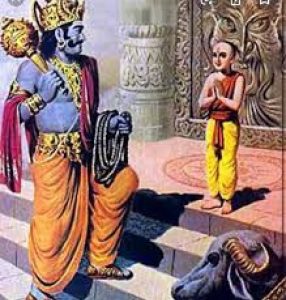
 On the insistent questioning of the highly determined Naciketas, Lord Yama had no alternative but to reveal the secret code to ending the transient mortal world and realizing the “immortality” that one actually and already is. It is not some thing new that one acquires. It is prAptasya prAptiH (प्राप्तस्य प्राप्ति:). Or, as kaTha says at 2.5.1, विमुक्तश्च विमुच्यते (i.e. becoming freed, one becomes emancipated. In other words, he does not take up a body again).
Shankara explains it in his own inimitable way unpacking the involved intricacies in simple words. He writes in his commentary at 1.3.14, kaTha in the following way:
एवं पुरुषे आत्मनि सर्वं प्रविलाप्य नामरूपकर्मत्रयं यन्मिथ्याज्ञानविजृम्भितं क्रियाकारकफललक्षणं स्वात्मयाथात्म्यज्ञानेन मरीच्युदकरज्जुसर्पगगनमलानीव मरीचिरज्जुगगनस्वरूपदर्शनेनैव स्वस्थः प्रशान्तः कृतकृत्यो भवति यतः , अतस्तद्दर्शनार्थमनाद्यविद्याप्रसुप्ताः उत्तिष्ठत हे जन्तवः | — Shankara at 1.3.14, kaTha Upanishad. Continue reading
 The Post on “
 Narada climbs up the staircase from Name up to Spirit almost hopping and jumping spurred by his own enthusiasm and curiosity. He asks his venerable teacher at each step after meditating, “What’s next?” He, however, falls absolutely silent after meditation at the level of Spirit, the 15th itself. He has another flight of steps to take to reach the Ultimate, the Absolute!
 Shankara opens his commentary on the 6th chapter of chAndogya with a very brief intro. bringing out the context of Svetaketu’s story and its relationship (sambandha) to the rest of the Upanishad. He says that the 6th chapter explains two important points, which are: