
Vision Of Truth (sad darshanam) – Part 17


भूतम् भविष्यच्च भवत् स्वकाले

तद्वर्तमानस्य विहाय तत्त्वम् ।

हास्या न किम् स्यात् गत भावि चर्चा

विनैक सन्ख्याम् गणनेव लोके ॥—१७


bhUtam bhaviShyachcha bhavat svakAle

tadvartamAnasya vihAya tattvam

hAsyA na kim syAt gata bhAvi charchA

vinaika sankhyAm gaNaneva loke—17


bhUtam bhaviShyachcha = the past and the future; bhavat svakAle = are in their own time,

present tadvartamAnasya vihAya tattvam = giving up the truth of that present; hAsyA na kim

syAt gata bhAvi charchA = will the discussion on past and future not be laughable; vinaika

sankhyAm gaNaneva loke = like counting in the world without the number one.


The past and the future are in their own time, present. Giving up the truth of that present , will not the discussion on past and future be laughable, like counting without the number one in the world?


What is time? It is a subjective phenomena. The sense organs are equipped to perceive objects. The ‘is-ness’ of the object is understood and this is not limited by time since it is eternal.When an object is perceived, the is-ness is known. Is indicates the present tense.  It is never the past nor ever the future. ‘Now’ is the word we use to indicate the present. The essence of ‘now’ is the self alone. How? Let us look into it. Continue reading

Three neo-Advaitin Quotes

Three quotes from neo-Advaitin teachers on the value of seeking, and finding the truth (or not):

Spiritual seeking is the art of walking in very small circles. This does two things: it creates the illusion of motion, of getting somewhere; and it prevents one from stopping, from becoming still, which is where one would look around and see the futility of it all. David Carse

We all have a deep longing and a deep fear of the discovery of what we are, and the mind devises any way it can to avoid this discovery. The most effective way it avoids awakening is to seek it. Tony Parsons

Spiritual seekers do not become finders. Nathan Gill

How Vedanta Works

OLYMPUS DIGITAL CAMERAHow words work in Vedanta
(based on essays from Sw. Dayananda and Ramji)

by Tan

Vedanta is a means of self knowledge through words called shabda pramANa.

It is able to give you direct knowledge of your eternal nature through words. In spiritual circles this will be generally criticized with the argument that the eternal self, enlightenment, the absolute, Brahman, the Tao or whatever you want to call it, is beyond words and indescribable. Therefore the conclusion is that it is impossible to get direct knowledge and know your “real” self through words. Continue reading

More on ekajIva vAda

Rather than add more comments to the ‘mokSha for All’ thread, I thought it better to make this a separate post. It is the same topic but here I posed a question to AchArya Dr. Sadananda of Chinmaya Mission, Washington, whom I have known for a long time. I have interposed comments in his response and his follow-up comments have been added in green.

Dennis:

 Obviously any statement about the ‘nature’ of absolute  reality can only be made from the jIva’s standpoint; i.e. an  ‘as though’ pAramArthika statement made in vyavahAra. Thus, any talk about a world is clearly a vyAvahArika statement;  aham brahmAsmi is an ‘as though’ pAramArthika statement.

Sada:

Dennis – aham brahmaasmi is statement of understanding of the truth – it is recognition of that paaramaarthika state but expressed using the instruments available in vyavhaaha that is the BMI. It is not just vyaavahaarika statement about paramaarthika state. It is like when I say sugar is sweet – it is statement which may not mean much to a listener who may not know what sweetness means, but it means a lot to one who knows and is the statement born of direct experiential understanding – or aparoxaanubhuti. Continue reading

Vision Of Truth (sad darshanam) – Part 16

तद् युष्मदोरस्मदि सम्प्रतिष्ठा

तस्मिन् विनष्टे अस्मदि मूल बोधात्

तद् युष्मदस्मन् मति वर्जितैका

स्थितिर् ज्वलन्ती सहजात्मनः स्यात्—१६

tad yuShmadorasmadi sampratiShThA

tasmin vinaShThe asmadi mUla bodhAt

tad yuShmadasman mati varjitaikA

sthitir jvalantI sahajAtmanaH syAt—16


tad yuShmadoH = third person and second person; asmadi sampratiShThA = depend

on first person;tasmin vinaShThe asmadi = first person eliminated; mUla bodhAt =

by knowledge of the source;tad yuShmadasman mati varjitaikA= the one division-less

without the notion of‘that’,’thou’, and ‘I’;sthitir jvalantI sahajAtmanaH syAt = the self shines

and emerges

The third person and second person depend on the first person. By the knowledge of the source, the one division-less without the notion of ‘that’, ‘thou’ and ”I’, the self shines and emerges.

The words ‘you’, ‘that/he she’ etc (the third and second person) have their basis in the first person. The other becomes the second or third person only with reference to the first person.

Continue reading

Q. 355 – Faith in a Path

Q: How do we get the conviction to go on a spiritual quest?  Unlike science, there are no indicators to give feedback if this is even the right path. We need to have blind faith in the general idea itself before we venture into it. Can we only do this through negation of the other paths, where apparent validations are possible by material feedback.

A devil’s advocate argument could be to dismiss everything associated with the vedas/upanishads as nonsense, since nothing can be proved. Another way to look at this is to acknowledge that the ancient sages have come up with practices such as yoga and meditation, which sort of proves their intellect and extrapolates on their ability to see things farther than a average person can and thereby have faith in their judgements.

 I am not able to articulate my question very well but I hope I got my point across.

Answers are provided by: RamesamDhanya, Ted and Dennis.

A (Ramesam): Man, by his/her very nature, feels incomplete. He seeks fulfillment of what he lacks through effort using his natural or acquired talents.  In fact, it is this “lack” that drives his passion for action along the path of the means chosen by him suiting to his comfort-level.

At the most basic level the drives that motivate a man for action are the biological and physiological needs.  As described by the Psychologist Maslow, the subtlety of these needs changes from a lower to higher level in the following manner: Continue reading

Q. 354 – Consciousness and reality

Q: I have an odd question, a question that I am not even sure how to formulate, it concerns consciousness. Why does Advaita philosophy insist on calling the ultimate reality consciousness? The word consciousness implies intelligence and thought – how do we know that anything outside of brains is in any way conscious?  Does this mean that physical reality amounts to the “thoughts” of this consciousness? Can the transcendent consciousness send messages to an embodied consciousness? 

 I know that an advaitin will say that there is only a non-dual reality but I mean this (however unreal or relative a reality my individual reality may be from an ‘ultimate’ perspective’) in much the same way that, until you received this e-mail from me, you were not aware of any ‘message’ or meaning from me.

  If I see a figure in clouds or a face in some wood-grain, should I see this as information with meaning? Does the consciousness ‘behind’ or ‘underneath’ everything communicate meaning with physical events (pictures, or ‘my thoughts’ , or even ambiguous hand-writing!) the way we normally communicate meaning with words and concepts? In other words–if the entire universe is consciousness, can anything be truly mindless or meaningless? Continue reading

The Ghost of Bharcchu

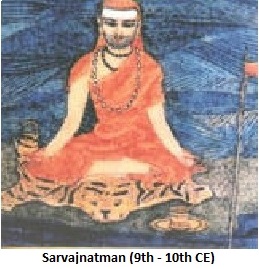
SarvajnatmanSarvajnatman, a well-reputed advaita Acharya of the 9th-10th century, was the author of samkshepa shArIraka.  As the title indicates, this book is a brief presentation of Sankara’s sUtra bhAshya in four chapters corresponding to the four adhyAya-s of the brahma sUtra-s.

Sarvajnatman sums up the essential nature of brahman in ten words. They are:

nityasuddha, buddha,  mukta, satya,  sUkshmasatvibhuadvitIya and Ananda

(eternal, pure, knowing, free, true, subtle, existent, auspicious, without a second and infinite (or happy)).

advaita teaches that you and brahman are one and the same. You being already brahman, the above ten words, therefore, describe you also. That means you, yourself, are Happiness.  So Happiness should be known to you like you know the back of your hand. You do not have to search for or attain Happiness.

But an enigmatic question arises: Okay, I know that I am already eternally existing, knowing and  ever happy brahman.  How come then I don’t know the Happiness which should be present right here? What ghost of an obstruction would block me from feeling it, from seeing it?

The shAstra replies: Oh, Yea, something like the Ghost of Bharcchu can cripple you from seeing the very things that are right in front of you!

“The Ghost of Bharcchu?  What’s that?,” you ask in wonderment.

Continue reading

Vision Of Truth (saddarshanam) – Part 13

बोद्धारमात्मानमजानतः यः

बोधः स किम् स्यात् परमार्थ बोधः ।

बोधस्य बोध्यस्य च सम्श्रयम् स्वम्

विजानतस्तद् द्वितीयम् विनश्येत् ॥—१३

boddhAramAtmAnamajAnataH yaH

bodhaH sa kim syAt paramArtha bodhaH

bodhasya bodhyasya cha samshrayam svam

vijAnatastad dvitIyam vinashyet—13

बोद्धारम् = knower आत्मानम् = oneself; अजानतः = of one who knows not; यः बोधः = whichever knowledge (other than self knowledge);  परमार्थ बोधः = highest knowledge;  स्यात् किम् = is it;  बोधस्य बोध्यस्य च = of knowledge and the object of knowledge; सम्श्रयम् = basis; स्वम् विजानतः = for one who knows oneself;  तद् द्वितीयम् विनश्येत् = for that (person) the two are negated.

Is any knowledge( other than self knowledge) the highest when the knower knows not oneself? For the one who knows oneself, the basis of the knowledge and the object of knowledge, the two are negated.

Continue reading

Q.348 – Temporary Realization

Q: 2 or 3 years ago I had a profound realization of the truth of advaita which stayed with me for many months. I fear that I have lost it forever. Do you think that it can come back?

A (Shuka): If you think you lost it, please understand you never had it in the first place, even for the 2-3 months that you think you had it. For, Advaita is not an experience, it is an understanding. The classical example used to illustrate this is a story about ten boys who cross a river. When the ten arrive on the further shore, one of them counts but nine in the group, obviously neglecting to include himself. A passer-by, noticing the consternation of the boys, counts them and finds all ten present; verbal testimony immediately dispels the previous ignorance. Once the boy has realized he is the ‘missing’ tenth person, he can never lose himself thereafter, for the truth is ‘he was never lost’. So also, it was always Advaita, however, due to ignorance which results in wrong identification with one’s body-mind-sense-complex, a person is lost. On being pointed out by the śāstra (scriptures) through a guru (teacher) that his real nature is indeed different from what he has been thinking, he gets the knowledge of his original nature, that he was ever free. All this problem is caused because of the usage of the phrase self-realization instead of self-knowledge. If you are serious about your pursuit, study from a sampradāyavit, a traditionalist, who knows how to handle the words of the śāstra, and employs the prakriyā (methodology) as a teaching tool rather than as a system; all and sundries will only compound the confusion. My best wishes to you. Continue reading