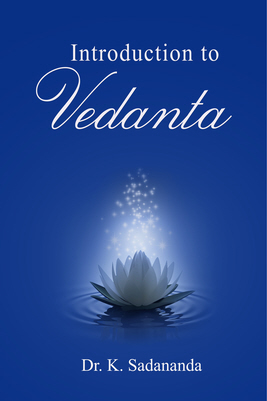
Acharya Sadananda new book

Introduction to Vedanta

Bad news: Some readers may have noticed that the series ‘Introduction to Vedanta’ by Dr. K. Sadananda disappeared from my website a few days ago.

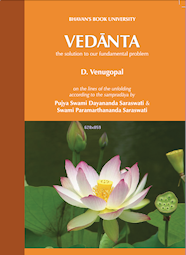
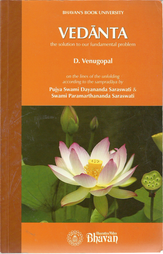
Good news: The series has now been published by Sethu R Rathinam in a quality, 218 page paperback and as an E-book on Amazon Kindle.

From my foreword to the book:

‘An Introduction to Vedanta’ was originally serialized on the Advaitin discussion group where it was justifiably well-received. As they say in the advertising media: ‘it does what it says on the box.’ It covers all of the material needed to introduce the subject to a new seeker, clarifying aspects that could otherwise prove difficult or even dampen enthusiasm. He never talks down to his listeners but speaks directly to them using everyday examples that resonate immediately. No doubt he benefits from having been taught directly by Swami Chinmayananda and more recently by many other teachers including Swami Tejomayananda and Swami Paramarthananda, but his scientific background also brings naturally clear reasoning ability to his analysis of the subject with the result that he seems able to explain the most difficult topics.

Anyone looking for an overview of the essential teaching of Advaita could not do better than to read this Introduction.

And I consider myself fully qualified to recommend the book since I editied it myself!

The paperback or Ebook may be purchased now from Amazon:
Buy from Amazon US (book) ….. $10.00 Buy from Amazon US (Kindle) ….. $5.00
Buy from Amazon UK (book) ….. £8.00 Buy from Amazon UK (Kindle) ….. £3.82
REALIZATIONISM

//amartingarcia.wordpress.com/2016/12/04/consciousness-existence-love/#comment-953

X. Belief is not the same as knowledge or understanding. Concepts and ideas are not reality itself – they are pointers to reality (a ‘finger pointing at the moon’); they are things of the mind to begin with, but it is un-logical to think or say that any one of them has, or can have, no contact with reality – directly or indirectly.

Y. We never really grasp what these teachings are talking about except in our conditioned mind. Continue reading

Physics and Vedanta – 6/6

[An INTERVIEW BY Paula Marvelly – Sixteen searching  Questions probing the Depths of Physics and Advaita Vedanta – Responses from Dr. Ramesam Vemuri – 2011]

Part 6:  Effect of Meditation, jIvanmukta  and Science as pramANa:

Part – 1, Part – 5

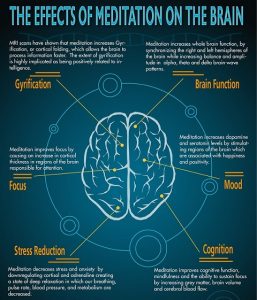
 14.  What are the benefits of meditation on the mind?

As we understand, mind is what the brain does. But as Neuroscience found out, the pulsing of the neurons as the brain acts has a feed forward and feed backward effect. The em field produced by the activity of the neurons affects the brain. Consequently, what we do mentally has an effect on the brain.

In fact, our scriptures hold that what we do mentally is much more forceful and effective than physical performance. Manasa Puja, or silent worship within our mind, is held far superior to pompous and ostentatious prayers. The mental worship in a way is meditation. Even in athletics and other sports, the candidates are asked to rehearse first mentally the subtleties of every fine move before they perform physically. I learnt a lot of my driving more by thinking before I got into a driver’s seat in a car. Continue reading

Physics and Vedanta – 5/6

[An INTERVIEW BY Paula Marvelly – Sixteen searching  Questions probing the Depths of Physics and Advaita Vedanta – Responses from Dr. Ramesam Vemuri – 2011]

Part 5:  End of the Universe, Thought and Meditation:

Part – 1, Part – 4

 11.  So then, what is the Big Crunch and what will exist beyond it?

Aha, this question is much like the first one and, therefore, we are coming full circle!

One of the significant finding in astrophysics nearly a decade and half ago was that not only is the universe expanding, but it is doing so at an alarmingly fast rate. ‘Before this discovery, the forecast was surprisingly simple. If the gravitational pull of all the matter in the cosmos was strong enough to rein in expansion — like the Earth’s pull on a rocket that can’t quite reach escape velocity — the universe would eventually come crashing in on itself.’ This is described dramatically as the Big Crunch. This is something like the Big Bang expansion reversing itself. So the Big Crunch would have happened only if the expanding universe is held back in its tracks. Continue reading

Physics and Vedanta – 4/6

[An INTERVIEW BY Paula Marvelly – Sixteen searching  Questions probing the Depths of Physics and Advaita Vedanta – Responses from Dr. Ramesam Vemuri – 2011]

Part 4:  Superimposition in Quantum Physics and Advaita and The Role of The Mind:

Part – 1, Part – 3 

9.  How does the theory of superimposition in Quantum Physics relate to theory of superimposition in Advaita Vedanta?

The concept of superimposition in Quantum Physics is just that – a concept. It is a good example of what I am speaking about.

We devised the concept of superimposition to explain to ourselves some observed phenomena because the observed things did not seem to fit into the simple cause-effect relationship for which our mind is accustomed to. Let me explain a little. Continue reading

Physics and Vedanta – 3/6

[An INTERVIEW BY Paula Marvelly – Sixteen searching  Questions probing the Depths of Physics and Advaita Vedanta – Responses from Dr. Ramesam Vemuri – 2011]  Part – 1, Part – 2

Part 3: Gamma wave synchrony, God Particle and Super String Theory:

6.  Returning to the subject of the mind and the brain, what is gamma wave synchrony and how does it tie in with our view of the world?

You see, we are conscious of a world out there and we are also conscious that we are conscious. How does this happen? Where is the seat of consciousness? The ancient Indian sages postulated an invisible entity about the size of the digit of the thumb to be residing in the heart overseeing the bodily functions and also providing consciousness to a human being.

To the extent my knowledge goes, the ancient scriptures did not talk of neurons or equivalent units or the working of the brain. They did, however, talk of nerves. They conceived the nerves to be the conduits of not only the life-forces but also food and other material. They said that all these nerves join in the heart. The Western philosophers, however, use consciousness in a different way. They thought of a soul.  Perhaps it was Descartes who identified the pineal gland in the brain as representing the soul. Continue reading