The Mystery – Part 7

Concluding this short series presenting the booklet by Bimal Prasad, in which he answers some ‘Rarely Asked Questions’ on Life. Primarily from the perspective of Advaita, questions addressed include the nature of happiness, consciousness, mind and ego. There is also practical guidance on meditation in this final chapter. Answers are relevant and succinct, so that many of the issues of interest to the seeker are covered.

This seventh and final part looks at the techniques and benefits of meditation for the spiritual seeker. See the Contents List or go straight to Part 7 of the series.

The complete (electronic form) booklet may also be purchased from Amazon.

Overview of Western Philosophy – Part 6

(Read Part 5 of the series.)

Science

The age of increasing importance of science is usually claimed to have begun with Copernicus in the early 16th Century when he argued that the sun is the centre of the solar system and not the earth as the church had always insisted. (This is stated in the Psalms of the Old Testament and by the Greek astronomer Ptolemy in the 2nd Century.) In fact, so afraid was Copernicus of incurring the wrath of the clergy that publication of his beliefs did not take place until after his death. Even Galileo, later confirming the facts by telescope, was forced to deny it since he wished to stay alive. Galileo advocated that all prior beliefs and opinion should be kept out of scientific observation, which should be completely objective. Needless to say, once such ideas gained support, the authority of the church began to diminish and their dogmatic pronouncements about the nature of everything began to be supplanted by more tentative suggestions based upon specific observation and experiment.

Isaac Newton was born in the same year that Galileo died and his discoveries were to have a devastating effect on religious faith. Once it became accepted that the workings of the universe could be understood through scientific laws, the idea of a divine creation became suspect. Man was just a tiny phenomenon in a vast universe, no longer the centre of everything. This had a profound effect upon man’s self-image and outlook. Previously it had been believed that our earth was effectively the creation and that man was the most important being in it, capable of communing with God and aspiring to union with Him. Henceforth it became increasingly apparent that the earth was insignificant in the immensity of the universe and the concomitant conclusion was that man himself was nowhere near so important as had previously been supposed. Continue reading

Understanding Reality

Understanding Reality
in the Vision of Advaita Vedānta

by Wolfgang P., wpl@gmx.net

We, as human beings, are interested in reality. Unlike animals, we are able to ask questions about the nature of our experience. We understand that experiences are numerous and fleeting, so the question arises: What is the reality behind those experiences? From this question subsequent ones emerge: What does it mean to say something is ‘real’ or ‘unreal’? What is the nature of reality? Vedānta is a body of knowledge to analyze the nature of reality and its relationship to the individual (jīva). It applies a teaching methodology that has been handed down from teacher to student since time immemorial. The aim of Vedānta is to make one understand its fundamental tenet:1

ब्रह्म सत्यं जगत् मिथ्या जीवो ब्रह्मैव नापरः

brahma satyaṃ jagat mithyā jīvo brahmaiva nāparaḥ

Brahman is the only truth (satyam), the world, jagat, is unreal (mithyā), and there is ultimately no difference between brahman and the individual self (jīva).

In this article I will explain the three categories Vedānta provides to understand reality: sat or satyam, asat, and mithyā.2 When we talk about reality, we need to distinguish that-which-is-real from that-which-is-not-real. This discriminative inquiry is called tattva-viveka. In Sanskrit, that-which-is-real is called satyam, whereas that-which-is-not-real is called asat. Continue reading

Advaita Vedanta – A Long Lost Tradition Revived

The terms  ‘Vedanta’ and ‘Advaita Vedanta’ are used loosely nowadays to describe teachings whose principles do not factually meet the subtlety within the profound truth of  ‘One-without-a-second’ or ‘There is only the Absolute.’ If this principle is corrupted or compromised then guidance to the truth can be affected from the beginning, which may in turn lead to an incomplete realisation. Alternatively, we may only hear statements describing the highest (Paramarthika) Reality without any means at our disposal for approaching such a Truth.

Being the foundation of its teaching, the principle of Advaita need not be compromised in allowing for the ‘mundane’, empirical experience of the seeker and the questions stemming from his or her experience – the entire Vedic system naturally accounts for development at all stages of life and Vedanta gives an understanding of the exact status of the world, as we experience it, in relation to Reality. Continue reading

Wave and Ocean

The ‘ocean-wave’ metaphor is a potentially powerful one but is often misunderstood. Here are a few quotes pulled off the Internet from a Google search:

 “The waves emerge briefly as a separate entity; however, just as quickly merge back into the ocean of which it is a part. Us, as human beings, are very much like the waves of the ocean. We briefly surface and display a uniqueness that cannot be duplicated; however, in the end, we reunite with the Whole.”

 “Actually our existence is just like an ocean. You are a wave of the ocean. You may be the most powerful, most thunderous, most beautiful and most inspiring wave of this ocean. But in the ultimate analysis you are just a wave. And the destiny of a wave is to merge again into the ocean. One day your little wave will also merge in the ocean of existence. Contemplate on this and understand the reality. We all are simple and ordinary in front of this huge cosmic play that is going on.”

 “To explain this further, Babaji gave beautiful example of wave – the wave by itself has no identity, it has identity of wave only for a certain time.  When it rises it is known as wave, but once it merges back into the ocean the wave no longer remains the wave, it becomes the ocean.  We have the karmic illusion of different and separate identity.  When we go in, there is no difference, we are particles of that One.” Continue reading

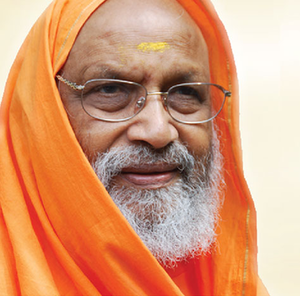
Homage to Pujya Swamiji

swamiday

Homage to Pujya Swamiji

D.Venugopal

Pujya Swamiji’s uniqueness has already been the subject matter of a book by that name, published in October 2008 and released by Pujya Swamiji himself. However, certain very significant details of his life and teaching need to be highlighted.


I

Right from his childhood, Pujya Swamiji was distinctively different from others. He was fearless by nature. He did things that others never dared to do, like catching any snake by its tail. During those days, owing to the anti-Brahmin movement, the school boys used to rag the Brahmin boys, who were conspicuous with their tufts. Pujya Swamiji also had a tuft. He once caught off guard a tough ragger and punched him so hard that he fell into a ditch. Also, for fear of being ragged, the Brahmin boys would not opt for Sanskrit as the second language. Unmindful of the repercussions, Pujya Swamiji chose Sanskrit. He did not also take lying down the ridiculing of religious practices by his class mates but countered them by thinking out the plausible reasons for those practices. They could never outwit him in the arguments that ensued. Continue reading

Tattvabodha – Part 16

Part 16 of the commentary by Dr. VIshnu Bapat on Shankara’s Tattvabodha.This is a key work which introduces all of the key concepts of Advaita in a systematic manner.

The commentary is based upon those by several other authors, together with the audio lectures of Swami Paramarthananda. It includes word-by-word breakdown of the Sanskrit shloka-s so should be of interest to everyone, from complete beginners to advanced students.

Part 16 looks at the ‘definition’ of Atman as sat-chit-ananda – existence-consciousness-bliss and concludes the section on Atma vichAra.

There is a hyperlinked Contents List, which is updated as each new part is published.

The Mystery – Part 6

Continuing this new, short series presenting the booklet by Bimal Prasad, in which he answers some ‘Rarely Asked Questions’ on Life. Primarily from the perspective of Advaita, questions addressed include the nature of happiness, consciousness, mind and ego. There is also practical guidance on meditation in the final chapter. Answers are relevant and succinct, so that many of the issues of interest to the seeker are covered.

This sixth part looks at the relationship between Consciousness, witness and ego, at the nature of the Self and reality, and asks what we mean by Self-knowledge. See the Contents List or go straight to Part 6 of the series.

The complete (electronic form) booklet may also be purchased from Amazon.

Overview of Western Philosophy – Part 5

(Read Part 4 of the series.)

Plotinus and Neo-Platonism

During the second century AD, Plotinus attempted to revise Plato’s concepts relating to the nature of reality in order to incorporate the objections that Aristotle had raised. Most people lived at a level below that at which the intellect was able to comprehend the ‘Forms’ that Plato had spoken of, the eternal and unchanging basis for the worldly approximations of concepts such as beauty, justice and so on. The highest of the Forms was the ‘Good’. From it, the entire universe emanated, becoming increasingly less ‘good’ as it spread outwards but nevertheless still being ‘one thing’. The origin, God if you like, first becomes mind (intellect) and then soul. All things, including ourselves, are souls. The purpose of man was to return to the original state by examining the world and following the good back to its source. It was concepts such as this that greatly influenced Christianity, though the philosophers themselves rejected it because of such notions as salvation through grace. The ideas also had a resurgence during the Renaissance, when the writings of Plotinus were translated into Latin. Continue reading