 Part 12 of the New Book Serialization!
The Dreamer asks Vasishtha about the usefulness of mind control and samAdhi and the value of yoga siddhi-s.

Part 12 of the New Book Serialization!
The Dreamer asks Vasishtha about the usefulness of mind control and samAdhi and the value of yoga siddhi-s.
Q: Is there a difference in the teachings of Ramana Maharshi and Nisargadatta Maharaj?
A (Dennis): This is too general a question, really. The short answer is that the bottom-line message of any teacher of Advaita must be the same, obviously. But the methodology depends upon the teacher lineage. Nisargadatta did have a lineage, although his own style developed somewhat! And Ramana did not have a lineage at all. The absence of a lineage means that what is said lacks rigor and is subject to differing interpretations etc. This is why the recommendation is always to try to find a qualified, traditional teacher.
Q: I do realize that my question was too general and could not be dealt with in a short answer. What I had in my mind was with regard to their approaches to meditation/ self enquiry or the “path” recommended by them. In self enquiry Ramana stated that while enquiring into “who am I?” the I that is enquired into is the individual or the ego and not the Self. According to him, focusing on the ego or I would make one realize that it is a phantom and thus lead one to the Self. Nisargadatta, on the other hand, seems to suggest that one should focus directly on I am, which is the same as the Self. In this sense, I thought there was some difference in their teaching. Continue reading
This book has arisen from Direct Pointing sessions that I’ve had with clients around the world. These deceptively simple inquiries and dialogues work. Men and women who have studied Nonduality for decades, both in and out of structured traditions, without experiencing even the first authentic glimpse of themselves have come to recognize their true nature during these talks. Some of them have been glimpses, and others remain ongoing. Still others, who were confounded by oscillation when we began to talk, have moved from there into stable Nondual awareness. And of course there are a few people who’ve reported no change at all; such is the way of it. Continue reading
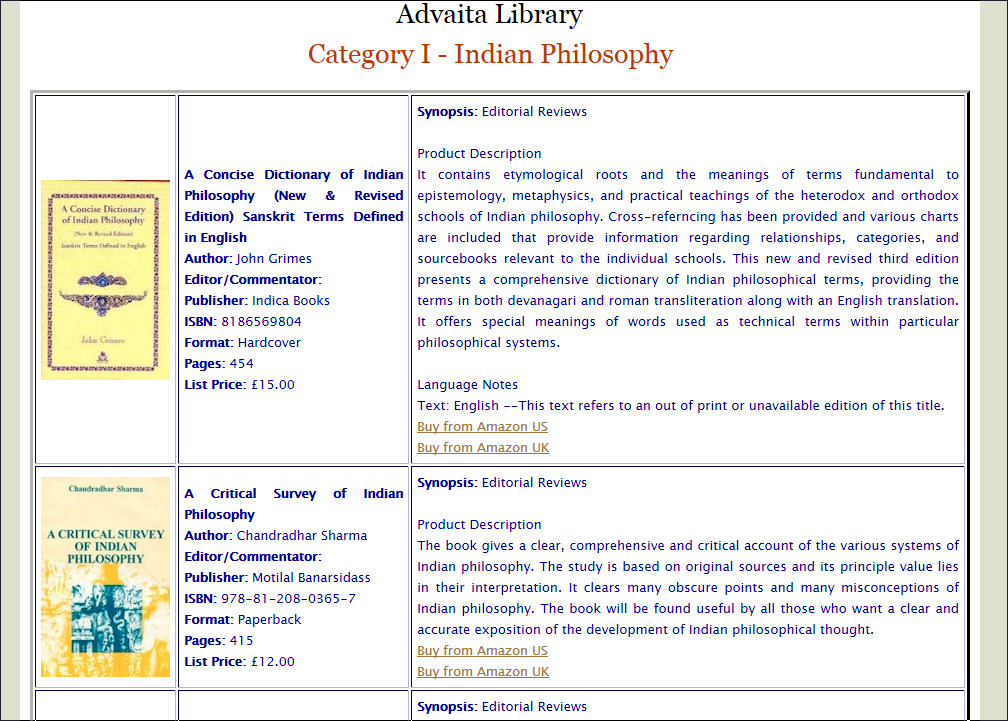 The Advaita Library has been completely updated, with the number of separate categories (one page per category) now expanded to 35. There are nearly 1400 books, DVDs and audio tapes catalogued, including Amazon synopses where available, links to purchase from Amazon and elsewhere and links to reviews and extracts on the site, if we have them. If you want any advaita-related book, this is the place to look. (And if you link through to buy from Amazon, the site gains a small royalty towards future purchases.)
Q: There are moments when I think I am the one that is creating my world with my specific positive thoughts – is that true?
Or is it the concsiouness bringing me those positive thoughts or negative thoughts? I know that I don’t have to ask for anything because in that way there is an infinite possibility of something fresh and new and totally different.
How do I pray? In silence only doing meditation?
A (Sitara): Yes, it is true. Your experiences (positive as well as negative ones) are constructs of your mind. The question is, what do you do with this information?
It seems that all of your questions are about, how to get a different life. For that you would like to know the mechanism of what in New Age (or Yoga, magic etc.) is called materialization of things, events, persons etc. Continue reading
Part 9 of the serialization of the presentation (compiled by R. B. Athreya from the lectures given by Swami Paramarthananda) of upadesha sAhasrI. This is the prakaraNa grantha which is agreed by most experts to have been written by Shankara himself and is an elaborate unfoldment of the essence of Advaita.
Subscribers to Advaita Vision are also offered special rates on the journal and on books published by Tattvaloka. See the full introduction and part 1 of the new series.
Here are a few more short Q & A’s which do not merit a separate post of their own: (Dennis’ answers, so don’t blame any of the other bloggers!)
Questions addressed are: how to improve one’s life; the value of japa meditation; who it is that removes ignorance; and (that perennial favorite) why bother seeking enlightenment? Continue reading
 Here is Part 4 of a new, short series (5 parts) on the Mandukya Upanishad, from James Swartz.
This post is not actually part of the Upanishad but provides a simple meditation technique for reaching ‘absolute silence’.
 Part 11 of the New Book Serialization!
The second dialog between the sage Vasishta and the Dreamer begins.
The dreamer asks about the difference between an avatar and a lunatic and Vasishta explains that the Absolute never assumes name and form.
Q: What is the difference between the witness, witness consciousness and consciousness? I know myself as the witness or maybe as witness consciousness but I do not know myself as all there is which, I guess, would be knowing myself as consciousness. But how can I ever not see the world of objects? So do I not remain a witness choicelessly?
A (Sitara): Contained in your question are seven questions (which I have passed on to the other bloggers, so some may refer to them):
1. What is the difference between the witness, witness consciousness and consciousness?
This will be answered below along with the last question.
2. (implied question) Is there a difference between the witness and witness consciousness?
Answer: no, not in the way I use the terms. But there is the possibility of a flawed use of the term ‘witness’. Witness means the ultimate subject that cannot be objectified. If witnessing is attributed to the mind, the so-called witness is nothing but a thought, i.e. it is just another object. And the so-called witnessing is nothing but an experience.
If, however, witness is used in the sense of ‘ultimate subject’, you can use ‘witness’ and ‘witness consciousness’ interchangeably. I prefer the term ‘witness consciousness’ (or simply ‘witnessing’) because the term ‘witness’ suggest too much of a personality. Continue reading