chidAbhAsa

The ‘Real I’ verses the ‘Presumed I’ – An Examination of chidAbhAsa

Ramana Maharshi’s instruction to seekers to ask themselves ‘Who am I?’ is lauded by many modern Western teachers as sufficient, on its own, to lead to enlightenment.  I suggest that this is not strictly true; that what it can do is rather to give us insight into what we are not and thereby point us in the direction of traditional teachings to learn about our real nature. It is inciting us to conduct Self-inquiry in the proven manner, i.e. by listening to a qualified teacher interpret the scriptures, rather than merely providing a mantra or formula to provide an answer directly.
An explanation of how traditional teaching can lead us to an understanding of who I am might begin with an analysis of our three states of consciousness – this is the so-called avasthA traya prakriyA of traditional advaita.
We almost certainly begin with the belief that who-I-really-am is only fully present in the waking state. In the dream state, I am not in command of my mental faculties so that the mind free-wheels outside of my control even though I am not actually unconscious. And we no doubt accept the deep sleep state as one in which mind and body rest and recuperate in order to be ready for the trials that the next day may bring. According to this interpretation, consciousness in deep sleep is in a resting state, as indicated by the lowered activity shown by EEG displays. (This view, also supported by many Western philosophers, claims that consciousness is a by-product or ‘epiphenomenon’ of the brain; an evolutionary advantageous development to enable an animal to find food and mate more efficiently than before. This is also the view of the chArvAka-s or materialists of thousands of years ago – it is certainly not new!) Continue reading

CIF Webinars

Here are further details about the on-line Vedanta courses being provided by Chinmaya International Foundation:

Chinmaya International Foundation is offering courses of Vedanta, Bhagawad Geeta, Sanskrit, Vedic Mathematics, Bhagavad and Make It Happen (Course on Self-Transformation) in the postal and online modes.

CIF has recently launched the Learning Sanskrit Grammar – the Paninian Way, a Webinar Course, and this has received enthusiastic response.

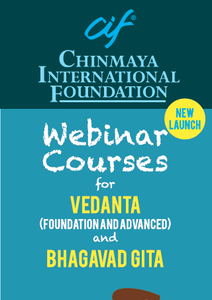
On the occasion of the Chinmaya Centenary Year, CIF is happy to announce launch of the Webinar Mode for its Foundation and Advanced Vedanta Courses and also its popular Bhagavad Gita Course. The uniqueness of the Webinar Course is that  participants will be directly and actively assisted by Chinmaya Mission Acharyas during their course study.  Hence the advantage of doing the courses through Webinar, as compared to the postal and online modes, cannot be overemphasised. Continue reading

Q. 385 – Is enlightenment meaningless?

Q: If Brahman is perfect, not ignorant, and the sole subject, what is the purpose of enlightenment as proposed by Advaita as the perfect one needs none?

If the ignorant jIva-s are nonexistent and Brahman is perfect, ignorance is nonexistent, therefore perception of separation is nonexistent.  It appears that Advaita, while advocating non dualism and a perfect sole subject, in fact is dualist, reaching out to a nonexistent audience to fix a nonexistent issue, to provide realization that the absolute already witnesses.   Can you shed some light on this?

A (Dennis): Coincidentally, an answer I gave recently to a different question effectively answers yours also:

<<< You have to decide whether you are talking form the empirical viewpoint or the absolute. If you don’t do this, you just get confused because the ‘explanations’ differ.

You are brahman, whether or not you know this. There is ONLY brahman from the absolute standpoint. No one has ever been born so there is no one to be reborn. Continue reading

Fear from wild creatures – 3

fear 3-1Part – 1           Part – 2

The fear most commonly experienced is the thought that I will end with the death of my physical body. Such a thought equating the ending of the “I” with the ending of the gross body indicates clearly the persisting misidentification of “I” with the body. It is the separate self which feels that it will disappear with the disappearance of the body. The cure for it is the recognition of the fact that the true “I” that I am, as Advaita teaches, is neither born nor will die; “I” is eternal, ageless, and imperishable (Bhagavad-Gita II-20). One who has really understood the Advaitic message abides as the true “I.”  ‘To abide as the true I’ means to be knowingly as that immortal and changeless Awareness and not to mistake oneself to be the body and the mind which are transient and perishable. Therefore, disciplining the body through a drill of practices (as done in skill development like car-driving or carpentry) or control of the mind through repeat exercises (as required for computer coding or mathematics) can hardly be called abidance as the true “I.”  Conscientiously feeling the difference between the phrases ‘I am the body’ and ‘I am aware of the body’ and experientially realizing that difference will help to firm up the understanding.

Continue reading

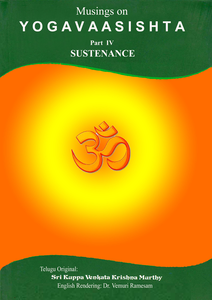
Serialization of Yogavasishta 5

Professor Sri Kuppa Venkata Krishna Murthy, Chairman and Managing Trustee of I-SERVE, the Institute of Scientific Research on Vedas, has kindly given permission for Advaita Vision to serialize his 6-volume ‘Musings on Yogavasishta’. Written in Telugu, the work has been painstakingly translated by our Dr. Ramesam Vemuri and published by Avadhoota Datta Peetham.

Rather than reproducing successive extracts from the books each month, as has been done with our other two serializations, the books themselves will be made available for download in PDF format. Each part will be associated with a page at the main website, which will contain a Contents List for that volume. Links to all of the volumes will be provided on a general Contents Page.

The present volume, “Musings on Yogavaasishta” – Part IV Sustenance, is a presentation by Brahmasri Kuppa Venkata Krishna Murthy, the Vidyadhikari of Avadhoota Datta Peetham, Mysore and Chairman, Institute of Scientific Research on Vedas (I-SERVE) and forms a part of his lectures on “Yogavaasishta” telecast by GEMINI T.V. in Telugu. This volume is a rendering of the same into English by Dr. Vemuri Ramesam. In it: The 3000 stanzas of the fourth chapter on Sustenance (Stithi) have been ably condensed and lucidly explained in simple words. Possible methods of alleviation from the state of Bondage and annulment of mind are described through the stories of Bhargava, Daama, Vyaala, Kata, Daasura, and others.

Please go to the Contents Page to read the Announcement and general introduction from Ramesam. The page for this Fourth Volume, Part 4 (SUSTENANCE) also contains the download link for the PDF file (0.6MB).

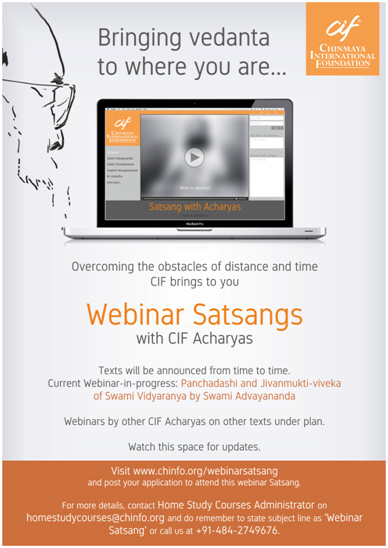
Webinars with Chinmaya International Foundation

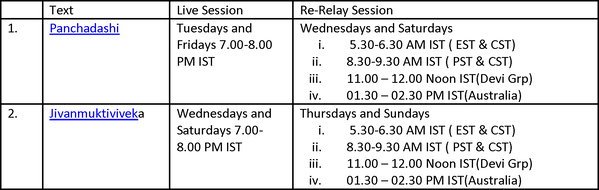
I have just received notification of the webinars which are being run by Chinmaya International Foundation. These are conducted on-line with audio and video content, covering both introductory and advanced texts – an opportunity to study with a traditional teacher when you do not have physical access to one! They are for serious students and feature Q & A sessions (in both directions!). Sounds excellent!

Here are brief details of current courses:

For more details about the courses and how to apply, look at their website.

If any visitor to this site takes up the offer, I would be interested in hearing back from them as to how they get on.

Knowledge and Enlightenment

Over the past few months, we have had several posts following which there were discussions in which some participants attempted to argue that knowledge was not the direct cause of enlightenment. Alternative suggestions have been that enlightenment comes with nirvikalpa samAdhi or that one has to pursue some course of action, such as asking ‘Who am I?’.

I argued that neither of these were the case; that ONLY Self-knowledge could give enltightenment. This is primarily because ignorance is the cause of saMsAra and knowledge, not action, is opposed to ignorance. And I said that I would endeavor to find quotations from scripture or from Shankara to support this contention (since some participants were not prepared to accept arguments from such as Swami Dayananda).

Below, I have compiled a brief list of some of those quotations and hope these should be adequate to convice readers that the above is the stance of traditional Advaita and it is supported by clear, reasoned argument. Continue reading

Three Q&As in Quora

Three Q/As from QUORA (on brain, philosophy, QM, NDE, consciousness)

1. How does the brain understand philosophy?

M. The brain… understanding philosophy? My reply to this is similar to the one I gave recently to another question and which was based on Socrates’ answer to an observation that someone was making. The man saw a pool of water being stirred by a stick held by a man and said that the stick was stirring the water. To which Socrates replied: ‘Is it the stick, or the man moving the stick?’ (Which one is the real agent – the material, or the instrumental cause, in Aristotelian terms?).

Equally, is it the brain, or the mind which ‘moves’ the brain which moves the stick which stirs the water?

Is it the brain, or the mind which (using the brain as an instrument) understands philosophy? Actually, it is consciousness (as a substrate) using the mind using the brain… Consciousness itself does not do anything Continue reading

Tattvabodha – Part 13

OLYMPUS DIGITAL CAMERA

Part 13 of the commentary by Dr. VIshnu Bapat on Shankara’s Tattvabodha.This is a key work which introduces all of the key concepts of Advaita in a systematic manner.

The commentary is based upon those by several other authors, together with the audio lectures of Swami Paramarthananda. It includes word-by-word breakdown of the Sanskrit shloka-s so should be of interest to everyone, from complete beginners to advanced students.

Part 13 concludes the exmaination of the states of experience with the deep-sleep state and begins to look at the metaphor of the five sheaths, from the Taittiriya Upanishad. This part explores the sheath made of food.

There is a hyperlinked Contents List, which is updated as each new part is published.