Overview of Western Philosophy – Part 11

(Read Part 10 of the series.)

Romanticism

Kant’s noumenal consisted of the reality of mental things – plural – though we could never be objectively aware of them in any sense, and effectively acknowledged the existence of many minds as well as that of God himself. Kant was very influential, thought by many to have been the greatest of modern thinkers, and a number of philosophers attempted to build upon or revise his ideas, in particular to do away with his unknowable reality.

Johann Gottlieb Fichte was the first of these and he conceived of an absolute mind or ego, divided up into the relative egos of human personalities, which together were evolving. Objects or ‘things in themselves’ became redundant. History is explained, and our sense of meaning is gained, by reference to this absolute ego. Even supposedly straightforward explanatory accounts of his philosophy, however, are incomprehensible without attempting to read any of the original material (and possibly with, too, but I have no direct knowledge of this). Continue reading
Q.396 – Atman cannot be known

Q: Swami Paramarthananda makes the following comments in his talks on upadeSha sAhasrI:

Atma, though a knower of everything, is not a known object, because, if Atma were to be a known object it will need another Atma to know, leading to what is known as infinite regress (anavasta dosham).  Atma cannot be known by itself, because, to be known by itself, it has to become both the subject and the object, which is not possible as one and the same entity cannot function as subject and object simultaneously.

We cannot also say that one part of Atma can be known by another part, as Atma is by definition partless.  Thus, Atma is ever the knower but not known by others or by itself. 

No Proof Needed

As Atma is self-evident, its existence needs no proof.  That I am conscious is evident to me.  The very search for proof is possible because of my being conscious.  Thus, Atma is revealed as self-evident Witness Consciousness which illumines everything and which cannot be objectified by anything.  This Atma is my real nature.  All the known attributes belong to the known objects and cannot belong to the knower, Atma (consciousness). Continue reading

It was seen (by no one)

“One early morning in October upon awaking from slumber, there arose a sensation of the sense of self being gone. It was seen that there was literally no one there and that all movement was happening spontaneously without central control.”  Nancy Dolen, interviewed by Jerry Katz.


Why the Neo-Advaitin is not an Advaitin at all

Recently, I asked the question: “Who or what is it that acts?” And it led me to think that this is a question that many modern teachers need to ask themselves. The above quotation immediately triggered my antipathy (my apologies, Nancy, nothing personal!) In fact, one could pick up virtually any book by modern neo-advaita teachers and find a similar statement. Here are a few:

What sees through it? There is simply seeing – there is no-thing, no one that sees.” (Nathan Gill – already awake)

For this body-mind, when liberation was seen, any sense of localization ended for a while. Awareness was seen to be everywhere. The room in which standing was happening, the street in which there was walking, the bodies and lamp posts and benches and space that were appearing, were not differentiated in the belonging from this arm, this thinking process, this seeing, these feet walking the pavement.” (Richard Sylvester – I Hope You Die Soon) Continue reading

Q.395 – Person vs Consciousness

Just to keep alive the thoughts on eka Jiva vAda…

Q: If we are just a ‘Stream of Consciousness’, how is it possible to introspect and know Reality? It is akin to the dreamer knowing that he is dreaming while still being in the dream. Also, the SOC’s suffering is really Brahman’s sufferring as Brahman alone exists. So is the SOC doing Brahman a favour by realizing the “Reality”? That doesn’t sound right!

A (Dennis): What do you (think you) mean when you say ‘I am a Stream of Consciousness’? In reality, there is only brahman (or Consciousness if you prefer). So it is correct to say ‘who-I-really-am is Consciousness’. But, if you are saying such things as ‘I know’, ‘I introspect’, ‘I dream’ etc, then you are speaking of the person. This is the level of the seeming world – vyavahAra. In reality (paramArtha), there is no world, no persons. I, the person, may suffer but  brahman does not suffer.

Q: My terminology is wrong but I meant ‘the thread of consciousness within Brahman’ which seems to be creating this impression of a ‘Creation’. This thread is running within Brahman and there are feelings of suffering. Since nothing exists but Brahman, Brahman is the sufferer through this thread. Suffering need not be physical it could be just psychological or some other means of pain.

A: There is no separate thing inside or outside of brahman; there is only brahman. The concepts that you are using are only of value to the extent that they help you to realize that truth. If they are not helping, discard them!

Vedanta the Solution – Part 36


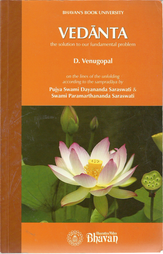
VEDĀNTA the solution to our fundamental problem by D. Venugopal

Part 36 describes the manifestation of the jIva into parts and the nature of the five koSha-s as ‘functional parts’.

There is a complete Contents List, to which links are added as each new part appears.

Pantheism, agnosticism/atheism — and Advaita Vedanta

How would you define your sense of pantheism?   www.quora.com/How-would-you-define-your-sense-of-pantheism/answer/Brad-Neil

Brad Neil, proponent of nonduality

I have devised this classification for reference: Modes of pantheism

(Divine pantheism; Natural pantheism; Spiritual pantheism; scientific pantheism)

Modes of pantheism

Within the range of categories given, I find myself somewhat ambivalent:

  • I most closely align with natural I believe the physical universe is all that there is, and that there are eternal forces and energies at play. I do not believe in the supernatural.
  • Scientific pantheism is least applicable to me because I really don’t have a problem being labeled an atheist. In my opinion, atheism and pantheism are almost (but not quite) two sides of a coin.
  • But when I’m feeling in my best of moods, I think I fall under spiritual or divine When my mood is high, I sometimes experience an awe and a gratitude that gives me a deeper feeling of connection to existence.

More generally, self-labels that I do not find objectionable include pantheist, nondualist, agnostic, atheist, and skeptic. However, I have none of these words tattooed on my forehead, and I reserve the right to change my thinking at any time. Continue reading

Interpreting shruti vAkya for eka jIva

eka jIva vAda – Part – VI

upanishad  The Upanishads are the records of the “Knowledge” gained by the supremely dedicated Sages and Seers in the distant times through their incisive questioning and unbiased inquiry. They are written in the idiom and style of the day, at the same time taking a great care to see that the purity and pristine nature of the message is preserved for the posterity without getting mutilated by the passage of time. Hence, access to them was highly restricted. Their wording is very cryptic, symbolical and often too profound to be apparent to a casual reader. The Knowledge Itself, however, does not come with any tags of intellectual property rights or authorship claims. But expounding the real meaning of the text (called as ‘mantras’) demands expertise in many auxiliary fields like logic (nyAya), grammar(vyAkaraNa), prosody (chandas), orthology (nirukta) and linguistics in addition to a familiarity of the cultural milieu of the times. The Upanishads were transmitted orally to a closed group of eligible and committed students either by a father to son or teacher to disciple tradition. This method of imparting the Upanishadic Knowledge is known as sampradAya. In the absence of a Guru explicating them, it is impossible to make sense of them or understand clearly the meaning in-depth. Prakashananada’s interpretation of the svetaswatara Upanishad mantra IV – 5 following a dialectical approach of taking the thesis of the opponent and then providing its rebuttal to establish the eka jIva vAda typically illustrates the point made above. It is presented here as a conversation between an opponent and Swami Prakashananda Saraswati. Continue reading

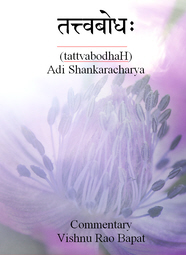
Tattvabodha – Part 21

Part 21 of the commentary by Dr. VIshnu Bapat on Shankara’s Tattvabodha.This is a key work which introduces all of the key concepts of Advaita in a systematic manner.

The commentary is based upon those by several other authors, together with the audio lectures of Swami Paramarthananda. It includes word-by-word breakdown of the Sanskrit shloka-s so should be of interest to everyone, from complete beginners to advanced students.

Part 21 begins the chapter on micro and macrocosm with a look at the jIva and its distinction from Ishvara.

There is a hyperlinked Contents List, which is updated as each new part is published.

‘shruti’ support for ‘eka jIva vAda’

eka jIva vAda – Part VI

boxing  ‘eka jIva vAda,’ the Doctrine that says “I Alone Am” is a perpetually  fascinating as well as a perplexing topic in Advaita. It has been debated at many Non-dual discussion fora in the past, both online and offline. Enthusiastic seekers no doubt will continue to do so in the future, if for nothing else, at least as a part of their manana (reflection on the shruti vAkya learnt by them about jIvabrahmaikatva (Identity of the individual and brahman). We are no exception here at this site, thanks to the indulgence from Dennis.

Even though neither Dennis desired nor I anticipated, willy-nilly another round of discussion on ‘eka jIva vAda‘ got opened up triggered by a few observations Dennis made at his latest Post on “Q.394 – Becoming One.” First he raised a few questions, then two, and then one more. The last question was the inevitable left hook: What are the “scriptural references for EJV?”

That’s off my kilter. I jumped out of the rink. Had to look for succour. Fortunately there is help available from redoubtable experts, highly knowledgeable Advaitins. Instead of presenting them in the ‘Comments’ section of the thread, I felt that their answers to the query deserve to be posted as a separate Blog.

I am very grateful to Shriman LalitAlAlitaH, Shri Venkataraghavan and Shri Praveen Bhat for their kind and prompt response and for their ready consent to letting me post their views here. Continue reading

Q.394 – Becoming One

Q: The question about Ishvara, Atman, Brahman gets confusing once a person starts reading and gaining knowledge from different branches of religions or schools of philosophy. So to put my question as simply as possible: If we are all Brahman then how does Karma come into play for us as individuals ? (As technically it’s Brahman acting against Brahman.)

One other thing:

Let’s say there are two people ( You and Me ) who realises the truth and doesn’t need to take rebirth again, so once their body dies, their Atman merges back with Brahman. So once that happens, do both these people become one ? At the highest level, Yes ! Because they were always One ! But would a part of them both remain ‘Them’ ? As in a person who sent a mail and a person who replied to it ? If so, then is that ‘Part’ what we’d call a soul ?

A (Dennis): In reality there is only brahman, non-dual, formless, eternal etc.

The world (including the ‘person’) is mithyA, neither real nor unreal, depending for its existence on brahman. The ‘person’ is a mind-body, ‘animated’ by Consciousness via a ‘reflection’ of brahman in the mind. This concept, called chidAbhAsa, is fundamental to understanding the seeming problems you raise. See my essays on this subject: There is an article called “The ‘Real I’ verses the ‘Presumed I’ – An Examination of chidAbhAsa” – https://www.advaita-vision.org/chidabhasa/ and a follow-up blog called ‘Continuing Reflections on Reflection’ at https://www.advaita-vision.org/continuing-reflections-on-reflections/. Continue reading