Q. 357 – Existence of Objects

Q.  Dear Dennis,
 
I bought and read two of your ebooks and liked them so much then I looked at your blog and came across this:

http://advaita-academy.org/blogs/DennisWaite.ashx?Y=2010&M=November

You say objects really exists, Advaita is not idealism, it is realism. I don`t understand this, in your book you use dream metaphor, you use “cinema” metaphor you even said in your book:
 
“He goes on to explain that our normal states of consciousness – waking, dream and deep sleep – are at the level of appearance. Reality is the non-dual background to these states. Just as our dreams seem real to the dreamer, so this world-appearance seem real to the waker. But, on waking, it is realized that those dreams are nothing but an illusion generated by the mind.
 
Similarly only on awakening to god-consciousness will you appreciate and realize the staggering truth that there exists nothing other than Brahman everywhere. Until that supreme state is reached, the universe will appear real. Living in your present state of ignorance you will have to accept the world that you experience. But at the same time try to contemplate and realize the truth proclaimed by Self-realized souls that Brahman alone exists.”
 
  So you changed your mind after writing the book and now you say World-appearance is real, Advaita is realism and there is no illusion at all?
 
I`m confused, can you explain? Continue reading

Two Genres Of Thought

“The Problem is I can’t tell the difference between a deeply wise, nudge from the Universe and one of my own bone-headed ideas!”

(Copy right: Bradford Veley)

It looks to me that we are besieged by two genres of thought.

When I say two genres, I do not mean the yes- no- thoughts or being double minded and undecided in our view about things. Nor do I refer to split personalities. Actually it has NOTHING to do about the “content” of the thought.  What I have in mind is about the suite or family of thoughts – based on their possible source of origin (real or apparent).

As advaitin-s, we all know that everything is a manifestation of brahman. We shall use the term ‘Universal Self’ for It. The Universal Self is kUTastha – does not do or intend to do anything. It is changeless, actionless, eternal and It is Beingness-Consciousness-Infinity. We also know that we act, talk, walk, eat, breathe and live as an individual.  We shall use the term ‘self’ for this separate entity. Continue reading

One with All

antique_blue_and_white_stoneware_salt_crock__lid_1_thumb2_lgw

A little story…

On the kitchen shelf of an apartment shared by students, there’s a colourful mixture of containers – a large box of teabags, a coffee tin, smaller jars with spices, a high glass with spaghetti, a blue and white saltshaker, a big muesli jar, etc.

The muesli jar squints at the glass with the spaghetti and sighs, feeling much too fat once again. But after a while, he realizes that the glass with the spaghetti is used a lot less frequently, which gives him a boost. Then he glances at the box with teabags, which is even more popular and moreover has an exotic design. His mood sinks. But luckily he remembers that actually the inner values count; he recognizes that he has a great variety of things to offer, exceeding all others, and he feels better immediately. But once he is placed back on the shelf, entirely empty after breakfast, the muesli jar falls into a deep depression. Continue reading

ROLE OF “REPETITION” — 2

ROLE OF “REPETITION” IN SPIRITUAL INSTRUCTION, PRACTICE AND UNDERSTANDING — 2


This is an alternative viewpoint regarding the role of “Repetition” in understanding the core message of advaita.  As it often happens, there is nothing like “the right perspective” in these matters. One may use one’s own discretion in evaluating these different points of view.

1.  There is no doubt that Repetition helps in getting a thing by heart or to memorize a quote, a mantra, a verse etc.

2.  We know ‘Practice maketh perfect’ and  practice necessarily involves repetition.

That means, we are making an operation (mostly those that involve neuromotor skills) into a more mechanically executed action – transferring a routine from being a cerebral activity to cerebellar activity.

3.  The ‘phala‘ (result) of certain ritualistic karma (like offerings made for the appeasement of gods, gaining merit etc.) is expected to increase proportionally with the number of times the ritual is carried out. (Please see Note: 2 at the end). Continue reading

Repetition-1

ROLE OF “REPETITION” IN SPIRITUAL INSTRUCTION, PRACTICE AND UNDERSTANDING — 1

All of spiritual instruction and learning has two aspects or dimensions:  The Theory and Praxis – a doctrine to understand and a method to practice, so that the former may dawn in the seeker’s mind as an experiential realization of his/her own. In advaita Vedanta the goal is to understand the Reality by dispelling the misunderstanding. The final understanding to arrive at is that there is no essential distinction between the jiva (individual self) and Atman (Universal Self), and further, that Atman, the Self, is Brahman (its cosmic extension, as it were). Here the two terms of the polarity, subject-object, get obliterated, given the intuition (anubhUti, akhandAkAra vRtti) that reality is One. Knowing and Being are no longer distinguishable from one another, when Happiness shines self-effulgently and this is encapsulated in the three-pronged expression, sat-chit-Ananda.

The method of imparting the above Non-dual message is usually by teaching (through gradual and progressive steps) so that the seeker intuitively grasps the Reality, the ‘what Is’. Normally a teacher is required for this education; otherwise, the scriptures (basically the prasthAnatraya; the purANas and specific treatises likes the prakaraNa grantha-s being the accessories) are the source to which one can access again and again. Saying ‘again and again’ implies repetition… or does it? Repetition of what? Continue reading

The Ghost of Bharcchu

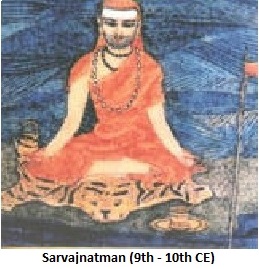
SarvajnatmanSarvajnatman, a well-reputed advaita Acharya of the 9th-10th century, was the author of samkshepa shArIraka.  As the title indicates, this book is a brief presentation of Sankara’s sUtra bhAshya in four chapters corresponding to the four adhyAya-s of the brahma sUtra-s.

Sarvajnatman sums up the essential nature of brahman in ten words. They are:

nityasuddha, buddha,  mukta, satya,  sUkshmasatvibhuadvitIya and Ananda

(eternal, pure, knowing, free, true, subtle, existent, auspicious, without a second and infinite (or happy)).

advaita teaches that you and brahman are one and the same. You being already brahman, the above ten words, therefore, describe you also. That means you, yourself, are Happiness.  So Happiness should be known to you like you know the back of your hand. You do not have to search for or attain Happiness.

But an enigmatic question arises: Okay, I know that I am already eternally existing, knowing and  ever happy brahman.  How come then I don’t know the Happiness which should be present right here? What ghost of an obstruction would block me from feeling it, from seeing it?

The shAstra replies: Oh, Yea, something like the Ghost of Bharcchu can cripple you from seeing the very things that are right in front of you!

“The Ghost of Bharcchu?  What’s that?,” you ask in wonderment.

Continue reading

Q.351 – Attributes of Brahman

Q: Advaita says that ‘sarvam khalvidam brahma – all this (including all objects, which have form) is brahman’. Therefore, how can we say that brahman is without any attributes at all (including form)? Surely brahman must be both with and without form? Isn’t this what neti, neti means (not this, not that)?

Answers are provided by: Ramesam, Ted, Martin and Dennis.

Continue reading

Vision Of Truth (saddarshanam) – Part 13

बोद्धारमात्मानमजानतः यः

बोधः स किम् स्यात् परमार्थ बोधः ।

बोधस्य बोध्यस्य च सम्श्रयम् स्वम्

विजानतस्तद् द्वितीयम् विनश्येत् ॥—१३

boddhAramAtmAnamajAnataH yaH

bodhaH sa kim syAt paramArtha bodhaH

bodhasya bodhyasya cha samshrayam svam

vijAnatastad dvitIyam vinashyet—13

बोद्धारम् = knower आत्मानम् = oneself; अजानतः = of one who knows not; यः बोधः = whichever knowledge (other than self knowledge);  परमार्थ बोधः = highest knowledge;  स्यात् किम् = is it;  बोधस्य बोध्यस्य च = of knowledge and the object of knowledge; सम्श्रयम् = basis; स्वम् विजानतः = for one who knows oneself;  तद् द्वितीयम् विनश्येत् = for that (person) the two are negated.

Is any knowledge( other than self knowledge) the highest when the knower knows not oneself? For the one who knows oneself, the basis of the knowledge and the object of knowledge, the two are negated.

Continue reading

What is Death – part 6 and final (metaphysics or spirituality – non- duality)

Image


Meditation

‘There is doubt concerning a man who has departed. Some say, “He is”, and others say, “He is not”. Taught by you [Yama, god of death], I would know this. This is the third of my boons’.

‘Do not, do not insist: release me from this’…. Choose a hundred years, sons and grand sons… elephants, gold, horses… Naciketas, enter a great realm of desires: I will make you the enjoyer of your desires… but do not ask me about dying’.

Naciketas, the young seeker, will have none of that.

‘Since you, Death, tell me it is not easily understood, and no one else can be found who can teach this as you can, there is no boon to equal this’.

…………………………………..

‘Yama continues: ‘The wise one [inner self] is not born, nor does it die. [Hidden in all beings] it is not from anywhere, nor was it anyone. Unborn, everlasting, eternal, primeval, it is not slain when the body is slain.’  Continue reading