Q. 357 – Existence of Objects

Q.  Dear Dennis,
 
I bought and read two of your ebooks and liked them so much then I looked at your blog and came across this:

http://advaita-academy.org/blogs/DennisWaite.ashx?Y=2010&M=November

You say objects really exists, Advaita is not idealism, it is realism. I don`t understand this, in your book you use dream metaphor, you use “cinema” metaphor you even said in your book:
 
“He goes on to explain that our normal states of consciousness – waking, dream and deep sleep – are at the level of appearance. Reality is the non-dual background to these states. Just as our dreams seem real to the dreamer, so this world-appearance seem real to the waker. But, on waking, it is realized that those dreams are nothing but an illusion generated by the mind.
 
Similarly only on awakening to god-consciousness will you appreciate and realize the staggering truth that there exists nothing other than Brahman everywhere. Until that supreme state is reached, the universe will appear real. Living in your present state of ignorance you will have to accept the world that you experience. But at the same time try to contemplate and realize the truth proclaimed by Self-realized souls that Brahman alone exists.”
 
  So you changed your mind after writing the book and now you say World-appearance is real, Advaita is realism and there is no illusion at all?
 
I`m confused, can you explain? Continue reading

Two Genres Of Thought

“The Problem is I can’t tell the difference between a deeply wise, nudge from the Universe and one of my own bone-headed ideas!”

(Copy right: Bradford Veley)

It looks to me that we are besieged by two genres of thought.

When I say two genres, I do not mean the yes- no- thoughts or being double minded and undecided in our view about things. Nor do I refer to split personalities. Actually it has NOTHING to do about the “content” of the thought.  What I have in mind is about the suite or family of thoughts – based on their possible source of origin (real or apparent).

As advaitin-s, we all know that everything is a manifestation of brahman. We shall use the term ‘Universal Self’ for It. The Universal Self is kUTastha – does not do or intend to do anything. It is changeless, actionless, eternal and It is Beingness-Consciousness-Infinity. We also know that we act, talk, walk, eat, breathe and live as an individual.  We shall use the term ‘self’ for this separate entity. Continue reading

Difference

differenceVive la difference!

I am still in the process of writing my next book on the Mandukya Upanishad and kArikA-s. I have just written the following section on the concept of ‘difference’. Since I posted a query to the Advaitin group, relating to what Swami Paramarthananda had said on the topic, I concluded by sending the completed section to the group. Accordingly, I am also posting this here.

In his commentary on this kArikA (2.34), Shankara touches on the logic of this concept of ‘difference’ and Swami Paramarthananda expands upon this. What, he asks provocatively, is the color of the difference between red and blue? Clearly, it is potentially a very important topic since, if it could be proven logically that the idea of ‘difference’ is incoherent on examination, it would effectively demonstrate the non-dual nature of reality. Numerous post-Shankara philosophers have looked into this and formulated involved arguments. There is extensive material in the post-Shankara texts of brahmasiddhi, iShTasiddhi, tattvashuddhi, khaNDanakhaNDakhAdya and chitsukhI/tattvadIpikA but, having looked at these, they seem too impenetrable to study in detail. (No references are given for these – you really don’t want to read them!) Continue reading

upadesha sAhasrI – Part 14

upadesha14

Part 14 of the serialization of the  presentation (compiled by R. B. Athreya from the lectures given by Swami Paramarthananda) of upadesha sAhasrI. This is the prakaraNa grantha which is agreed by most experts to have been written by Shankara himself and is an elaborate unfoldment of the essence of Advaita.

Subscribers to Advaita Vision are also offered special rates on the journal and on books published by Tattvaloka. See the full introduction

Q. 354 – Consciousness and reality

Q: I have an odd question, a question that I am not even sure how to formulate, it concerns consciousness. Why does Advaita philosophy insist on calling the ultimate reality consciousness? The word consciousness implies intelligence and thought – how do we know that anything outside of brains is in any way conscious?  Does this mean that physical reality amounts to the “thoughts” of this consciousness? Can the transcendent consciousness send messages to an embodied consciousness? 

 I know that an advaitin will say that there is only a non-dual reality but I mean this (however unreal or relative a reality my individual reality may be from an ‘ultimate’ perspective’) in much the same way that, until you received this e-mail from me, you were not aware of any ‘message’ or meaning from me.

  If I see a figure in clouds or a face in some wood-grain, should I see this as information with meaning? Does the consciousness ‘behind’ or ‘underneath’ everything communicate meaning with physical events (pictures, or ‘my thoughts’ , or even ambiguous hand-writing!) the way we normally communicate meaning with words and concepts? In other words–if the entire universe is consciousness, can anything be truly mindless or meaningless? Continue reading

Q. 353 – Witness to the boredom

Q: I have a problem with the boredom of everyday life. Nothing seems to satisfy me. I just find it so difficult to be just here in the moment and be content with that. You say: go through life and work etc, but as a witness to it all.

Am I living in moment as I should? Should I give all my attention to each action, so that the ego is absent or should I just be the witness of everything every action on a moment to moment basis?

Maybe if I understand how to live in the moment better and had some clarification, that would help me stay present and focused on just living. My mind lives in the future.

(Note: I have reworded the question slightly but some of the replies quote from the original question. Apologies for any confusion!)

Answers are provided by: Sitara, Ted, Ramesam, Martin and Dennis. Continue reading

Q. 350 – Heaven and Hell

Q: In Advaita, it is said that the heaven and the hell are mithya. They are just ideas for bhakti-natured people. But Advaita says this world is mithya too. So even though heaven and the hell are mithya, we are still gonna go there just as this world is mithya but it is still real enough for us? I mean the idea of heaven and hell is mithya but it is still as real as this world. So they indeed exist just as this world. Is that the correct interpretation?

A (Ramesam): Firstly the simple and straightforward answer: Yes, you are right, heaven and hell are mithya and are ideas for bhakti-natured people, in the sense that they are experienced by the people who believe in them but these loka-s (worlds) lack a substantive reality by themselves. However, we have to note that they are the second degree imaginations – imaginations of the already imaginary worldly people! By this logic, perhaps they will be strictly comparable to dreams in their order of reality. (The word mithya includes both the empirical (vyavaharika) reality and the dream world (prAtibhAsika) reality). Continue reading

What is Death – part 6 and final (metaphysics or spirituality – non- duality)

Image


Meditation

‘There is doubt concerning a man who has departed. Some say, “He is”, and others say, “He is not”. Taught by you [Yama, god of death], I would know this. This is the third of my boons’.

‘Do not, do not insist: release me from this’…. Choose a hundred years, sons and grand sons… elephants, gold, horses… Naciketas, enter a great realm of desires: I will make you the enjoyer of your desires… but do not ask me about dying’.

Naciketas, the young seeker, will have none of that.

‘Since you, Death, tell me it is not easily understood, and no one else can be found who can teach this as you can, there is no boon to equal this’.

…………………………………..

‘Yama continues: ‘The wise one [inner self] is not born, nor does it die. [Hidden in all beings] it is not from anywhere, nor was it anyone. Unborn, everlasting, eternal, primeval, it is not slain when the body is slain.’  Continue reading

Living In The Moment Eternally – 1

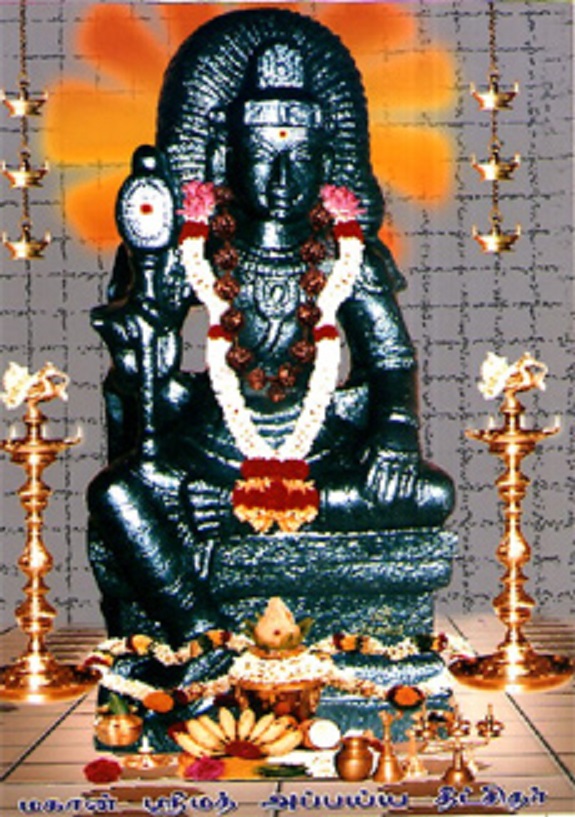
Appayya Dikshitar - (1520-93)

Appayya Dikshitar – (1520-93)

We, the traditional Advaitins, are a prejudicial lot – aren’t we?  Appayya Dikshitar’s words uttered in delirium when his brain was under the influence of the hallucinogenic Datura seeds are for us a beautiful AtmArpaNastuti in praise of Lord Shiva. But the mutterings of some other ordinary mortal with a differently affected brain is mere meaningless chatter unworthy of any notice. Let us not forget that both are actions done under conditions of an altered brain. And in both cases, an external agency is responsible for causing the change in the brain.

It was UG who famously said once that whether it was Beethoven’s 9th Symphony or pulling the chain in the WC sounded the same to him.  Some of the Zen Masters used to respond to the simple questions like “What is the time now?” with an answer that the mountain was running or some such response – totally frivolous and meaningless on the face of it. But their effort was to draw our attention to the way our mind functions in assigning ‘meaning and significance’ (which are actually not there) ever caught up in a habituated pattern which we  normally fail to detect.

Over six years ago, I prepared a comparative statement of the characteristics of an ordinary person and a ‘Self-realized’ man. I used the information  collated from many sources  that I could lay my hands on in preparing this tabulated compilation — almost like what a Purchase Officer does with the quotations (s)he obtains. There were several reasons behind this exercise of mine. Continue reading