I Am Awareness

An article by Eaden Shantay

shantay2

Experience is awareness cast through karma.

Every sensation, emotion and thought is the direct result of past karma (action). In each incarnation we bring forth parabdha karma – that portion of sanchita karma, our total karmic bank account, meant to be experienced, learned from and neutralized in this life.

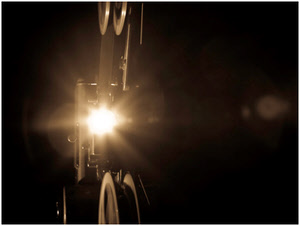
Think of parabdha karma as images on a film strip, vasanas (impressions) in consciousness left from past action. The light of true self, awareness, then shines through these impressions, creating a three dimensional, five sensory experience called me and my life.

Like any good movie, it’s easy to become hypnotized by the drama and lose touch with what is real. In realizing we are not the projected story but the awareness which animates it, we release the life or death grip we have on moment to moment experience. This is the process of dis-identification or non-attachment the Buddha spoke of.

Imagine the sky with clouds moving through it. The sky is a metaphor for awareness and clouds, the objects of sensation, emotion and thought. In meditation we practice welcoming the clouds, blessing them and then bringing our attention back to the breath. In time, we even let go of the breath and dwell in the space between the clouds – awareness, a reflection of our true nature appearing in the mind. Continue reading

Q.381 – Knowledge, belief and experience

Note: This discussion follows on from the last question on ‘Finding a Teacher’ (apart from the introductory paragraphs).

Many seekers think that the essence of enlightenment is ‘experience’; that they need to actually experience something for themselves before they can be regarded as enlightened. In line with this, they denigrate the notion that a teacher can convey whatever it is that the seeker needs by simply talking to them, answering questions and so on. Even worse, they feel, is the idea that enlightenment can be gained by reading a book!

Maybe the term ‘Self-inquiry’ is largely to blame for this misconception. Seekers attached to this idea think that subjecting their own experiences (perceptions, ideas, theories etc) to close examination is somehow the key.

Whatever is the case, such seekers are seriously confused and need to distinguish carefully between ‘experience’, ‘belief’ and ‘knowledge’. Below I provide a question and answer discussion I had early last year with a reader on this general subject. But first I would like to give an example from my own experience, which (for me) provided a very clear distinction between these three. (And I refer to this example in the question and answer session.)

The experience occurred about 30 years ago. You will have to bear with me as it takes a little while (and two diagrams!) to explain. Continue reading

Vedanta the Solution – Part 23

venugopal_vedanta
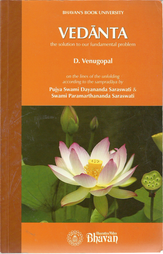
VEDĀNTA the solution to our fundamental problem by D. Venugopal

Part 23 begins the chapter on ‘Analysis of the subject in its three states of experience’. This first part looks at the three aspects of the body-mind-sense complex – the causal, subtle and gross bodies.

There is a complete Contents List, to which links are added as each new part appears.

Q. 378 – Existence and Experience

Q: Without hot, cold doesn’t exist. Without up there is no down, without in there is no out etc. The basic nature of duality. However if you apply this to the non-dual Brahman…

In the absence of that which is not (Brahman), that which is (Brahman), is not (doesn’t exist.)

My idea is that the Relative Reality is not only dependent on the Absolute (Brahman) but that actually both are interdependent on each other. I know this is counter to Advaita and forgive me and my lack of knowledge, especially of the Sanskrit terms, and I’m sure it makes your skin crawl to continually refer to things such as relativity as a reality.

Why do I say something can’t exist without it’s opposite? I will do my best to explain my ideas.

A thing cannot exist without it’s opposite because it cannot be experienced without it’s opposite, or rather awareness of it’s opposite. If a thing cannot be experienced then it does not exist, to the one experiencing it.

Ultimately, everything exists in one of two ways, either as a potential or possibility, or as a realized form. Continue reading

How could we merge absurdist and Buddhist philosophies?

www.quora.com/How-could-we-merge-absurdist-and-Buddhist-philosophies

M. Provisionally we could put side by side ‘absurd’ (or illogical) and ‘unprovable’, even if they are not synonymous; and the main tenets of all religions are such. They are not ‘rational’. On the other hand, neither science, ‘common sense’, or rationality are the ‘end all’. There are many things that escape explanation with the current state of our knowledge and understanding.

Paradox is a term related, one way or another, to the above. Just consider the following:

i) “How wonderful that we have met with a paradox. Now we have some hope of making progress”. Niels Bohr (famous physicist)

ii) Is there anything more absurd to ordinary understanding of the world and us than the following (taken from my blog): “That truth, put into words, is paradoxical: you are all (as Consciousness) and ‘you’ (as perceived individual) are nothing, or a phantom; you are the final witness, but ‘you’ are not a witness; the world is illusory (as appearance), but in essence is reality itself. That revelatory, transcendental experience is non-transferable, not provable to another.”

GL. If by absurdism you mean acknowledging that there is no absolute truth, then zen buddhism when asked what is enlightenment, answers “6 pounds of flax”, which is, I believe, trying to point out that absolute truth is impossible.

M. You probably mean ‘impossible to demonstrate, or to know, with the ordinary mind’, but ask a zen buddhist if it (absolute reality or truth) is impossible to grasp, to grok.

GL. I think the point of the flax koan is that you can’t know satori with certainty.

M. Is it not rather that the experience cannot be explained – or transmitted – with words, being ineffable? Such is a transcendental experience, where there is no individual per se present.

GL. Isn’t “ineffable” the same as saying we can’t know with certainty?

M. No, it means ‘inexpressible’, the experience being overwhelming (rather than being too sacred – another meaning).

GL. If you can’t describe it, then it isn’t knowable.

If it is purely a matter of experience, then there is no way for me to know you are experiencing something the same way I am. Color is ineffable. You experience red and green the way you do, and I experience it the way I do. And unless we have an objective test for color blindness, there is no way to know if you see what I see. Some people see color when they hear sound. And as long as that experience is ineffable, there is no way to know if we see color the same way. Only when we establish some objective explanation and some objective testing can we know with certainty if we are experiencing similar things.

M. You refer to what are called qualia, but I am not sure how far you want to go (can nothing be known? In what sense?) Most empiricists/scientists tend to disregard this question or deny that it presents any problem for their physicalist stance. In non-duality, which is what interests me, there are not, cannot be, any objective tests referable to either external or internal experiences of what generally is understood as reality (the world and oneself) except, perhaps, in one’s facial expression and/or demeanor. That agrees with what you say about qualia but, aside from non-duality (or as a preliminary to it), it doesn’t mean that there cannot be agreement, concurrence, in the realm of thought, sensations, and feelings. Two people reading the same book or page – if they are on the same wave length (let’s say interest in non-duality, or in a particular modality of art, like Baroque or modern) – will have similar thoughts and feelings. Language is for communication – even about the understanding of non-duality (like zen) – but certain experiences cannot be communicated, such as particular intuitions or epiphanies, regardless of what we understand as qualia, though related to it.


Consciousness/Awareness, the brain, and memories

(Q&A published recently in QUORA)

Q. ‘Why wasn’t my consciousness generated by another brain? Why am I linked with this brain?’

I heard that everybody experiences consciousness, but then why am I my consciousness and not another person’s consciousness? It’s hard to explain.

Paul Bush. Yes, it’s hard to explain. Basically it’s because the most important part of consciousness, which is awareness*, is the same for everybody. There is only one awareness, and in fact nothing else. All the other aspects of consciousness, the contents, are projections of awareness as it identifies with small parts of reality such as bodies and minds. Such misidentification creates a perspective. From each perspective the part of reality not identified with is seen as the external world. The observer with a particular perspective and the world observed as a consequence of that perspective are both inferences created at the moment of identification.

So, there is only one awareness that is continually pulled into the illusion of being this or that observer. The ongoing personal identity that we think of as ourselves maintains coherence through the construction of the concepts of time and space; memory and an apparent (though not total) physical separation from the rest of reality. Awareness has no personal identity, it is exactly the same for you and everyone else, because it is singular awareness that creates each experience depending on the perspective of the entity that it is identifying with.

*(AM Awareness and Consciousness are generally taken as equivalent in Advaita Vedanta – no distinction being made) Continue reading

Q. 371 – Deep-sleep state

Q: In advaita, we use the recall of a “good deep sleep” as a very important argument for proving continued presence of awareness… the question is, how does this recall happen? We have a process in advaita by which ‘the presence of a pot is known’. How is deep sleep known? Or – How is the fact that one slept well, recalled?

Responses from DhanyaRamesam, Martin, Ted and Dennis

A (Dhanya): When I was a child, there was a TV show I liked to watch.  It was called ‘You Are There.’  As I recall, the show depicted a famous scene from history, and then ‘you’ (meaning in this case the narrator), magically showed up in the scene and got to ask the historical figures all sorts of questions.  (I guess I should Google it to make sure I recall the details of the show correctly).  Anyway, I do remember that I enjoyed the show, and often these days recall the title, because one could ask oneself the question, ‘How is anything known?’ and the answer would be because ‘You are There!’  The whole point of deep sleep in the teachings of Vedanta is to is highlight ‘You are There’  Your nature is consciousness, i.e. that by which anything is known.  The absence of any thing is also known.  Thus one can recall the fact that one slept well.  Why?  Because You are There. Continue reading

Q. 370 – nirvikalpa samAdhi

Q: Should a person have compulsorily experienced nirvikalpa-samādhi in order to know that he has a mind which is prepared for jñāna? In other words, is experience of nirvikalpa-samādhi a must as a sādhana?

Responses from VenkatMartinTed, Shuka and Dennis

A (Venkat): Nirvikalpa-samAdhi is an experience of the absence of objects, for a finite period of time, which the experiencer eventually exits to re-perceive the world.  As it is not permanent, it is not real.  Any temporary experience that is witnessed cannot be a pre-requisite for j~nAna – since j~nAna is the permanent dissolution of the illusory I-thought.

“Abiding permanently in any of these samadhis, either savikalpa or nirvikalpa, is sahaja. What is body consciousness? It is the insentient body plus consciousness. Both of these must lie in another consciousness which is absolute and unaffected and which remains as it always is, with or without the body consciousness. What does it matter whether the body consciousness is lost or retained, provided one is holding on to that pure consciousness? Total absence of body consciousness has the advantage of making the samadhi more intense, although it makes no difference to the knowledge of the supreme.” – Sri Ramana Maharshi Continue reading

Science vs. Philosophy – Part II

Y – I can not parse your meaning, i.e. I have no idea what you are trying to say.

Still have no idea what you are trying to say.

X – What I’m trying to say is to point at core insights within Eastern philosophy (Hinduism, Buddhism, Taoism), particularly in advaita Vedanta – but also in Christianity and Islam in their highest metaphysical conceptions. If you are not interested in any of this, that’s alright.

Actually, whatever science – and its highfaluting ‘scientific method’ – is is shot through with difficulties and controversies, including the sacrosanct falsifiability principle (or dogma). Just read the Wickipedia article on this (and on rationality, etc.) and the respective positions of Khun, I. Lakatos, and P. Feyerabend among others. You must know something about all this already if you are scientifically inclined.

Y – What “core insights”?  There is nothing insightful about making up unevidenced tosh, anyone can do it and each piece of tosh has exactly equal validity, none.

And with regard to your ludicrous and unfounded “criticism” of the scientific method, I have one response, yea shall know them by their fruits.

Continue reading

Awareness of Self

OLYMPUS DIGITAL CAMERAAs you know, it is difficult to assess what another person ‘experiences’. It is also difficult to equate various words that might or might not mean the same thing to one person or everyone. Not sure if this is possible. Probably not. So, the following is not the gospel. I could be mad, mistaken, and a fool. Being foolish is not the worst thing. Feel free to call me names like Martin does.

For me, the word awareness has to constitute both subject and object. Someone or thing is aware. It is a function of the human being. We all have it and it is functioning right now. For me, all awareness functions within the context of self and consciousness, self and consciousness being virtually the same thing. I am talking about what constitutes self, not about self’s true nature. Self’s true nature has to be devoid of self completely and therefore out of the realm of all consciousness. Thus, it is also devoid of awareness as this is a function of our human nature, not our true nature. Normal death erases all experience and awareness but not our true nature.

Our human efforts can only concern itself with our human nature and that lasts maybe 70-90 years. To know thyself is a human endeavor that involves using observation. How else can we understand anything? Mind is involved to be sure. Everything we know is reflected in the mind. But this doesn’t seem to be the case with our true nature. Our true nature is not a reflection of our human life. No human faculty can know its true nature, only the human nature can be known. The only way we can ‘know’ our true nature is through the ending of this separate self that we call ‘me’, ‘I’, etc. And, it is not possible for our human nature to bring an end to itself. From what I have read of the sages, conversations I have had with sages (of course, the ones I think are sages!), it happens in a blink of an eye. You are simply swept away. It is a revelation, not an attainment. It is not a result. There are no levels of attainment, only levels of self. No true self. The body may remain, but no person inhabits it. True nature and human nature are not compatible. You can’t have your cake and eat it, too, as the saying goes.  To know the self is to forget the self. But forgetting the self is not erasing it from memory. It’s erased from your whole being.

As others have said our own existence is common to us all. By observing this sense of existence, me, self, being it, breathing it, living it, you by-pass all the mental analysis and duality that most are involved with. The sense of problem is relieved and a kind of centeredness that focuses this observation can be felt and deepened. This centeredness is a  gateway that our true nature reveals itself through and brings an end to all forms of self.

Posted by ‘Anonymous’