dhyAna and samAdhi

Meditation

dhyAna and samAdhi are quite fascinating, pretty alluring and romantically inspiring terms for an aspirant on the spiritual path. They are almost always spoken in a tone that creates an awe. They sound mysterious, other worldly and ethereal. Many stories are told in the Purana-s about highly revered Sages lost in deep meditation or samAdhi to the extent that they were unaware of their own body being buried in heaps of sand or eaten away by critters and crawlers. Hair-rising narratives too are often reeled out about the powers that dhyAna and samAdhi lead one to – clairvoyance, multiple accomplishments (aNimAdi siddhi-s), infinite longevity (ciranjIvatva), visitations to subtler worlds inaccessible to normal human beings and so on. There is hardly a spiritual Guru who does not harangue about the glories a seeker will be bestowed through practicing dhyAna and samAdhi. Some teachers would even make these as a pre-requisite before any true ‘knowledge’ is imparted. As a result, the words dhyAna and samAdhi acquired varying meaning. Teachers too historically used or interpreted them in different ways. We shall attempt to take a synoptic view particularly from a Non-dual perspective what these terms connote and their role and relevance for a seeker who has adopted the jnAna mArga (The Knowledge Path) in his/her pursuit of liberation.

The write up is structured as a Power Point Presentation downloadable as a pdf file at: http://www.advaita.org.uk/discourses/downloads/dhyAna_samAdhi.pdf. Continue reading

Serialization of Yogavasishta 6

Professor Sri Kuppa Venkata Krishna Murthy, Chairman and Managing Trustee of I-SERVE, the Institute of Scientific Research on Vedas, has kindly given permission for Advaita Vision to serialize his 6-volume ‘Musings on Yogavasishta’. Written in Telugu, the work has been painstakingly translated by our Dr. Ramesam Vemuri and published by Avadhoota Datta Peetham.

Rather than reproducing successive extracts from the books each month, as has been done with our other two serializations, the books themselves will be made available for download in PDF format. Each part will be associated with a page at the main website, which will contain a Contents List for that volume. Links to all of the volumes will be provided on a general Contents Page.

The present volume, “Musings on Yogavaasishta” – Part V The Calm Down, is a presentation by Brahmasri Kuppa Venkata Krishna Murthy, the Vidyadhikari of Avadhoota Datta Peetham, Mysore and forms a part of his lectures on “Yogavaasishta” telecast by GEMINI T.V. in Telugu. This volume is a rendering of the same into English by Dr. Vemuri Ramesam. In it: The 5000 stanzas of the fifth chapter on The Calm Down (Upasama)   have been ably condensed and lucidly explained in simple words. Possible methods of alleviation from the state of Bondage and annulment of mind are described through the stories of Janaka, Bali, Prahlada, Uddalaka, Gadhi, Sraghu, Parigha and others.

Please go to the Contents Page to read the Announcement and general introduction from Ramesam. The page for this Fifth Volume, Part 5 (THE CALM DOWN) also contains the download link for the PDF file (0.9MB).

Fear from wild creatures – 3

fear 3-1Part – 1           Part – 2

The fear most commonly experienced is the thought that I will end with the death of my physical body. Such a thought equating the ending of the “I” with the ending of the gross body indicates clearly the persisting misidentification of “I” with the body. It is the separate self which feels that it will disappear with the disappearance of the body. The cure for it is the recognition of the fact that the true “I” that I am, as Advaita teaches, is neither born nor will die; “I” is eternal, ageless, and imperishable (Bhagavad-Gita II-20). One who has really understood the Advaitic message abides as the true “I.”  ‘To abide as the true I’ means to be knowingly as that immortal and changeless Awareness and not to mistake oneself to be the body and the mind which are transient and perishable. Therefore, disciplining the body through a drill of practices (as done in skill development like car-driving or carpentry) or control of the mind through repeat exercises (as required for computer coding or mathematics) can hardly be called abidance as the true “I.”  Conscientiously feeling the difference between the phrases ‘I am the body’ and ‘I am aware of the body’ and experientially realizing that difference will help to firm up the understanding.

Continue reading

Serialization of Yogavasishta 5

Professor Sri Kuppa Venkata Krishna Murthy, Chairman and Managing Trustee of I-SERVE, the Institute of Scientific Research on Vedas, has kindly given permission for Advaita Vision to serialize his 6-volume ‘Musings on Yogavasishta’. Written in Telugu, the work has been painstakingly translated by our Dr. Ramesam Vemuri and published by Avadhoota Datta Peetham.

Rather than reproducing successive extracts from the books each month, as has been done with our other two serializations, the books themselves will be made available for download in PDF format. Each part will be associated with a page at the main website, which will contain a Contents List for that volume. Links to all of the volumes will be provided on a general Contents Page.

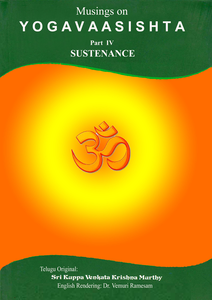
The present volume, “Musings on Yogavaasishta” – Part IV Sustenance, is a presentation by Brahmasri Kuppa Venkata Krishna Murthy, the Vidyadhikari of Avadhoota Datta Peetham, Mysore and Chairman, Institute of Scientific Research on Vedas (I-SERVE) and forms a part of his lectures on “Yogavaasishta” telecast by GEMINI T.V. in Telugu. This volume is a rendering of the same into English by Dr. Vemuri Ramesam. In it: The 3000 stanzas of the fourth chapter on Sustenance (Stithi) have been ably condensed and lucidly explained in simple words. Possible methods of alleviation from the state of Bondage and annulment of mind are described through the stories of Bhargava, Daama, Vyaala, Kata, Daasura, and others.

Please go to the Contents Page to read the Announcement and general introduction from Ramesam. The page for this Fourth Volume, Part 4 (SUSTENANCE) also contains the download link for the PDF file (0.6MB).

Fear from wild creatures – 2

pic2 for AVPart -1

Fear can be caused by a perceived threat which could be either from within the body-mind or from a source external to the body. The source of fear itself and consequently the type of fear can be either real or imaginary. We shall, however, not consider the issues related to the nature of the source causing the fear in this essay. We shall treat fear as a ‘signaling mechanism.’ Viewed thus, ‘fear’ includes all its other manifestations and variations like  anger, hatred, disgust, anxiety, revenge etc. The signal itself appears as tightening of muscles, fastness of breath, heaviness in the heart area, slowness of digestive processes, dilation of pupils of the eye, contortion in the facial muscles, perspiration and so on. Depending on the intensity of the threat, the flux of thoughts may alter and even the sense of a ‘separate self’ may disappear.

A point to be remembered is that, though all such reactions are commonly attributed to the source, the perceived source itself is not the cause. It is in the way one’s body-mind are programmed to react. Suppose you sweat on mistakenly seeing a rope as a snake in semi-darkness. The unreal snake in the rope has actually nothing to do with the way your body has reacted. Continue reading

Fear from wild creatures – 1

scared “I understand the Advaita teaching that everything is One only without a second, but I am always afraid of dogs and monkeys which are common in my place. Moreover, I also have a fear of snakes etc. as I live in a forest area.

Everything is brahman and therefore, ‘fear’ is also brahman.  Though my mind is convinced by the logic of Advaita, why do I suffer from various fears?”

If there is a perception of fear, it automatically implies that there is a ‘me’ as the ‘subject,’ the finite perceiver and there is the ‘other,’ an object, separated from ‘me.’  (For this analysis, we define an ‘object’ as anything that is perceived. Hence ‘fear’ is also an object). This in turn implies that I ignored my ‘Dimensionlessness’ (anantatva) and assumed finiteness to myself.

It is true that on the full understanding of the Oneness of “Whatever-That-IS,” there is no scope for any sort of ‘fear.’ After all, if all is One, and there is no second, where and who is the other to be afraid of?

We have a recent real-life example for this in the 35th Pontiff of Sringeri, Shri Abhinava Vidyatheertha Swami. He found a big cobra snake coiled around his neck when he was meditating in a remote forest area. He told his Successor: Continue reading

Does spiritual practice empower the ego?

Does sAdhana (spiritual practice) empower the ego?
An essay by Atman Nityananda

If you abandon sAdhana in order to avoid this sAdhana-ego you are left with nothing except egoism. Egoism plus sAdhana is better than egoism minus sAdhana.
~Swami Sivananda

Liberation is the dissolution or the death of the ego which is a field of energy crystallized in our bodies. Liberation has nothing to do with an enlightened ego. There cannot ever be an enlightened or liberated ego.

Liberation is neither for the ego nor for the consciousness which is already free. Liberation is for the mind. When the mind after intense spiritual practice (sAdhana) becomes free from all egoistic tendencies, rajas and tamas then liberation takes place for none and the mind celebrates its unity with the spirit or Consciousness.

But some neo-advaita or non-teachers as they call themselves like Tony Parsons claim that the spiritual practices empower the ego instead of dissolve it. They claim that is impossible the ego to be eliminated by sAdhana by the very fact that the sAdhana is done by the ego. They say that sAdhana and the dissolution of ego is a contradiction because the ego itself is engaged in sAdhana and this keeps the ego alive. Continue reading

My Tuppence Worth

tuppenceIt was over two scores and a half years ago. I remember an experience when I was living in that part of India venerated by the name AryAvarta, the holy land. The cows and other cattle had a right of way even on the so-called main roads, affectionately christened ‘M.K. Gandhi Marg’ ‘P.C. Chatterji Panth’ or some such tongue twisters by the locals. The citizens or rather the bodies of the inhabitants have a natural agility and ability to automatically adopt all the tricks of an expert contortionist in walking on the road avoiding the animals or their heaps and spurts of fragrant fresh just-in-time  deliveries – made, as though, just for you.  When you are all focused on keeping your balance as you never know where your next step may have to land, a hearty greeting jolts your auditory senses. You take time to locate the source of that sound, because there is obviously no face visible nearby. You see at a distance a half raised single hand, as a mark of showing respect for you. Adept practitioners of Zen may not know the clap of a single hand, but every one over there knows a salutation by one hand. Their shout says ‘su prabhAtaM,’ a literal translation for “Good Morning.” Continue reading

Should I stop enquiring???????

ripplesShould I stop enquiring???????

Vijay Pargaonkar

(मुञ्डकोपनिषत्) MundakaUpanishat 3-2-9

“Anyone who knows that supreme Brahman becomes Brahman indeed……….”


My search for Brahman started with aparokshAnubhUti (supposedly written by Shankaracharya) where it is stated that knowledge of liberation is obtained through enquiry. It then goes on to explain what constitutes enquiry:                                                               (अपरोक्षानुभूती) aparokshaAnubhUti (Shloka #11 & #12) (translation by Vimuktananda)

“Knowledge is not brought about by any other means than Vichara (Enquiry), just as an object is nowhere perceived (seen) without the help of light”.

“Who am I? How is this (world) created? Who is its creator? Of what material is this (world) made? This is the way of that Vichara (Enquiry)”. Continue reading

Q. 369 – mokSha

Q: What is meant by mokSha as a puruShArtha? (The answer should incorporate a definition of mokSha.)

Responses from Ted, Venkat, Ramesam, Martin, Shuka and Dennis

A (Ted): Moksha literally means, “liberation.” It indicates freedom from dependence on objects (i.e., anything perceivable, conceivable, or in any way experienceable) for happiness, contentment, or a sense of wholeness and completeness. And since it is our vain pursuit of permanent fulfillment through impermanent objects that is the cause of suffering, moksha also implies freedom from all suffering.

 Moksha is the essential purushartha (i.e. goal or end) that we are seeking, though in most cases not consciously, through our pursuit of artha (security), kama (pleasure), and dharma (virtue). If we analyze the objects we chase in any of these categories, we invariably find that it is not actually the object itself that we want, but rather the sense of peace and/or happiness that it seemingly provides us. Admittedly, the objects we seek to obtain in these areas are either necessary for our survival or enhance our enjoyment of life, but all are limited. And no limited object can provide limitless fulfillment. Thus, if we depend on these objects for our happiness, we doom ourselves to inevitable disappointment and certain suffering. Continue reading