ANESTHESIA, DEEP SLEEP, DEATH AND CONSCIOUSNESS – Part 2/3

[Part 1/3      Part 3/3]

Before going into a consideration of Deep Sleep, once again a small detour.

Dennis raised in an e-mail the question of Sleepwalking. Where would it fit in the Model?

Some people amble around in sleep and even hurt themselves.  A few persons could commit heinous crimes in the state of somnambulism.  A well-known case is that of Kenneth Park in 1987 when he strangulated his father-in-law and killed his mother-in-law. However, he was let out by the court on the ground that he was sleepwalking when he harmed and killed people.  A similar case of acquittal also occurred in 1846. Apparently the body of the sleepwalkers is active but the mind seems to be asleep.

Neuroscientifically speaking, in the case of sleepwalking, the motor cortex of the brain is functional whereas the frontal lobe vested with executive functions is at rest. This means that a part of the mind (that propels the body to act) is active while the part responsible for reasoning and self-control is asleep. Continue reading
ANESTHESIA, DEEP SLEEP, DEATH AND CONSCIOUSNESS – Part 1/3

Recently there was an interesting question about the disappearance of ‘me’ when a patient is administered anesthesia in preparation for a major surgery.  It is quite intriguing where the missing ‘self’ has gone and when under anesthesia (Q. 313).

Peter, Sitara and Dennis answered the question very ably explaining the Vedantic philosophy behind the various states of consciousness (as we usually understand the term).  The false concept of the sense of a separate ‘self’ we think we possess and the reality of an eternal Self; the misunderstanding that arises if we take the word Consciousness to mean the same in psychology (& medicine) and Advaita;  the possible existence of multiple ‘minds’ which derive their illumination from an unchanging, everlasting, self-effulgent One Brahman were dealt with by them. Hardly can anything be added to their clear exposition made from the stance of Non-duality beyond saying a word of our appreciation and gratefulness to them.

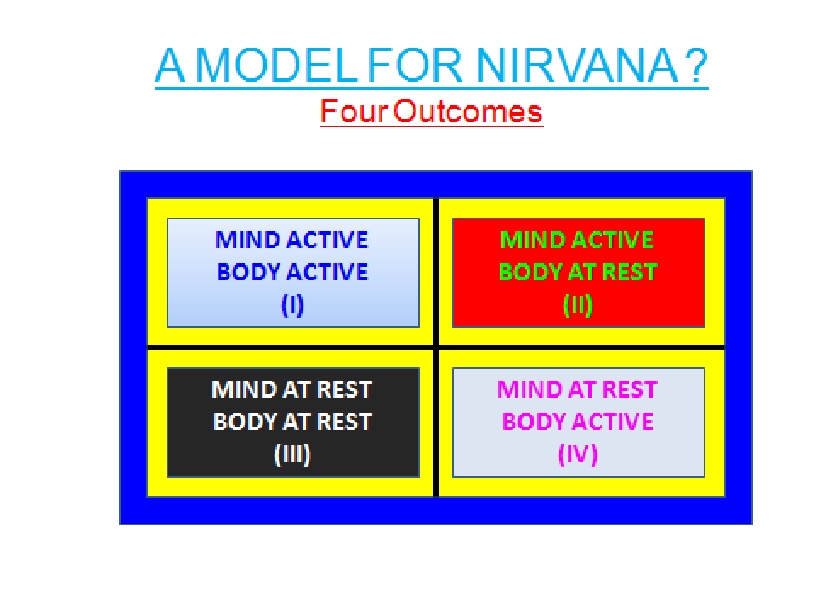
I would like to use this opportunity, if I may, to bring to the notice of a wider audience an approach I developed in 2004 relating the state of our alertness to our body-mind system in order to understand who we really are. We shall also in the process examine what are Deep Sleep and Death and what is the condition of the brain under different states, including awake, dream, deep sleep, death, coma, anesthesia etc.

Let me call this as “A Model for Nirvana.”

Four Outcomes

Four Outcomes


Continue reading

Under Anaesthesia (Q. 313)

Q: I recently had an experience that leaves me baffled. I have read your books, the sections on deep sleep consciousness, and it does not seem to match. The incident occurred when I will was given anaesthesia for hip replacement surgery. I went from eyes open in the operating room to who eyes open in the recovery room without any sensation in between at all. The experience was seamless and continuous from one consciousness to another. Time was absolutely absent. There was no reflection possible on the three-hour interlude. There was no interlude. There was no feeling of having slept well or otherwise.

  This experience has left me with a problem. This was the nonexistence of any kind of consciousness, even in retrospect It seems neither the small self or the real self existed at all. Please comment. Continue reading

manonAsha – not the literal death of the mind

Most seekers who have investigated the teaching of Ramana to even a small extent will be aware of the concept of manonAsha. This is often presented as the idea that enlightenment is synonymous with the ‘death of the mind’. And indeed this is its literal meaning. Consequently, some writers claim that, following enlightenment, the j~nAnI literally no longer has a mind. This goes along with similar ideas such as that, for the j~nAnI, the world literally no longer exists.

This way of thinking is unfortunate. Shankara himself emphasised that we should not discount either our experience or reason, when it comes to interpreting the scriptures. And, speaking for myself, whenever I have encountered writings on Advaita which significantly contradicted my perception of what seemed to be ‘reasonable’, they have always proved to be misguided or incomplete, if not plain wrong. Continue reading

Pleasure of Sex vs. Bliss of Self in Brain Scans

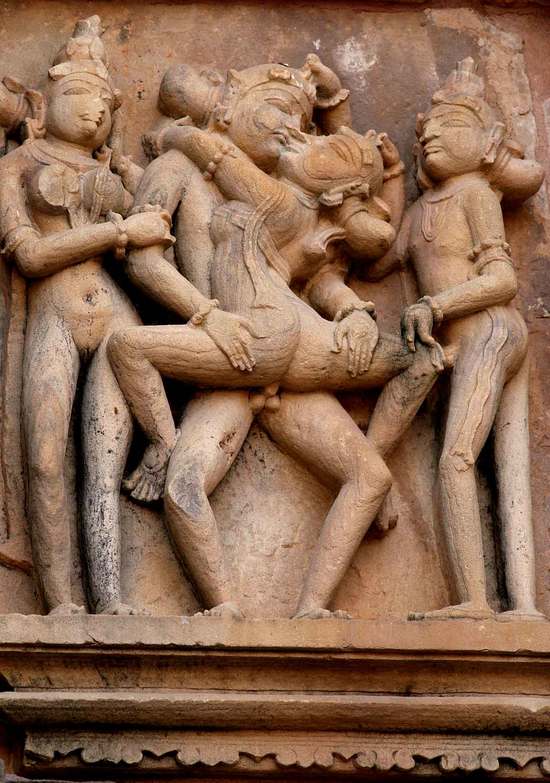
Khajuraho Temple Sculpture – 10th – 12th Century

Khajuraho and Kamasutra fire the fancy of any foreign tourist to India.  Add Spirituality and the heady mix becomes a killer app for seekers of quick-fix salvation for paying a visit to India!  Biologically sex evolved as a reproductive mechanism to possibly capture the advantageous heritable genetic traits from a partner.  Only humans and a few animals like bonobos and dolphins indulge in recreational sex.  Sex is closely tied to sensory perceptions and lies within the realms of the mind. Salvation transcends both senses and mind. “Rajneesh, the ‘horse’s mouth’ concerning the topic of enlightenment for Westerners for many years,” regrets James Swartz, “wedded two largely incompatible concepts, sense enjoyment and enlightenment.” One may lose ‘self identity’ and get enwrapped in an inexplicable joy in either of them as Brihadaranyaka Upanishad says. But the bliss of enlightenment and the pleasure of sensual gratification are totally different. Our brains can show it all very clearly!

Human brain is a mass of interlinked neurons piled up in three layers. At the bottom is the most primitive brain common to all animals. Continue reading

Clearing the mind (Q. 311)

Q: I come across a lot about clearing the mind….but if there is no person, no-one that can have a will of his/her own, surely a desire or will to clear the mind is a nonsense? The mind cannot be tamed because there is not a person to whom it belongs, someone with their own free will? Is that at all right? Surely a clear mind would only arise because it is the will of Brahman?

 A: It’s only nonsense once you know that you are not a person!

 Also, you have to be very clear when you are talking about Brahman. Strictly speaking, the term ‘brahman’ refers to the non-dual reality and, if you are using it in this sense, it is not meaningful to speak of ‘the will of brahman’ – brahman does not have any will; there are no ‘parts’ to brahman and there is nothing other than brahman.

 If you are talking about the person (appearance) within the world (appearance), then you have to refer to Ishvara as the ‘creator’ and the dispenser of body-minds in accordance with accumulated karma from past lives.

 You have to be clear in your own mind about this distinction because, for example, the Brahma Sutras uses the word ‘brahman’ in both senses and expects you to know which one is being referred to in any given instance!

Objectification (Q. 310)

Q. I’ve been thinking about two things.

 To determine that awareness is my true self and that my true self is not my ‘I’ concept, I’ve been looking into the ‘I’ concept. It is not my mind, because I can say ‘my mind’. It is not my body, because I can say ‘my body’, but could it be the mind body complex? Most would say no, because the mind and body are plural and the self cannot be plural. However, I’m confused because I don’t see it this way. I see the mind and body as acting as one, which means that the ‘I’ could possibly be it. It is difficult to determine where the mind begins and the body ends, and vice versa, so I see them as one, like the Yin Yang symbol. How do I know that the true self is not the ‘I’ concept that arises within me? Is it because I can make the ‘I’ concept the object of awareness, thus it cannot be the subject? Continue reading

Science and the nature of absolute reality (Part 2)

Read Part 1

Although science is good at investigating objects, even there it is doomed to fail – because the essence of objects, too, is ultimately the same non-dual reality. As Atmananda Krishna Menon puts it, in his ‘Notes on Spiritual Discourses’: “As long as the least trace of subjectivity remains, objectivity cannot disappear. And until objectivity disappears completely, the real nature of the object can never be visualized. This is the fundamental error committed by science as well as philosophy, both in India and outside, in trying to approach the Truth through the medium of the mind.” (Vol 3 Notes, 1386)

Notes on Spiritual Discourses of Shri Atmananda: Volumes 1, 2 and 3, Shri Atmananda and Nitya Tripta, Non-Duality Press 2009, ISBN 978-0956309129 (Vol 1) Buy from Amazon US or Amazon UK. Continue reading

Mind Reifies Or Deifies

Mind occupies a significant place in the teaching of Vedanta philosophy.

All the talk of liberation pertains to the mind only.  Maîtri Upanishad (VI-34-11) holds mind to be central for the liberation or bondage of human beings.  amRitabindu Upanishad (mantra 2) makes it further clear stating that “the mind engrossed in objects of senses leads to bondage but the same mind free from attachment to objects leads to liberation.”

But what is this mind?

Continue reading

Where the mind cannot reach (Q. 307)

Q: I am allowing life to teach me as I go through it, but I’m not finding it easy.  Most of the time I feel I don’t want to even speak because I feel nothing I say is ‘correct’.  At the same time, however, I feel that even if I do speak, whatever I say would not be ‘wrong’ because ‘right’ and ‘wrong’, ‘correct’ and ‘incorrect’ do not exist.  Words and concepts are a massive hindrance to my understanding, yet I cannot overcome them.

 I want to say that I know that everything is Brahman, but then something says, ‘you can’t ‘know’ that everything is Brahman because that cannot be known with the mind’, so I’m always hitting a wall. Continue reading