Revision of ‘Review of article on Shankara’ – part 3

RB: “Now the error in calling avidy¯a as something epistemic should be obvious. The following extract, from [SSS], is clearly putting the philosophical cart before the horse:

‘Avidy¯a is subjective and has been explained by ´ Sa ˙ nkara as the natural tendency of the mind to superimpose the self and the not-self on each other.’

When the conception of j¯ıva itself is due to avidy¯a, how can avidy¯a be the ‘natural tendency of the mind to superimpose the self and not-self’?” (*) Continue reading

adhikArah – fitness

Verses 795 – 818, Chapter 39,  in sarva vedAnta siddhAnta sAra sangrahah (The Essence of Entire Vedanta Theory in Brief) of Shankaracharya deal with adhikArah of the spiritual aspirant.  Though the word “adhikArah”  has several meanings like authority, right, privilege, position, prerogative &c &c, it is taken in this context to denote fitness or eligibility of the seeker. IMHO, “acuity” of the intellect is more important. Selected verses quoted here:

अध्यारोपापवादक्रममनुसरता देशिकेनात्र वेत्रा वाक्यार्धे बोध्यमाने सति सपदि सतः  शुद्धबुद्धेरमुष्य ।

नित्यानन्दाद्वितीयं निरुपममलं यत्परं तत्वमेकम् तद् ब्रह्मैवाहमस्मीत्युदयति  परमाखण्डताकारवृत्तिः ॥   — 797

(Meaning:  No sooner the meaning of the mahAvAkya (‘That thou art’) is made known to the aspirant by the teacher, who follows the method of superimposition and of negation, than there arises in the man of pure intellect that supreme mental modification which  knows no change, and he realizes: “I am that Brahman who is of the nature of eternal Happiness, Non-dual, incomprehensible, untainted, the One Supreme Reality.”)
अखण्डाकारवृत्तिः सा चिदाभाससमन्विता ।
आत्माभिन्नं परं ब्रह्म विषयीकृत्य केवलम् ॥                   —  798
(Meaning:  The  indivisible pure Consciousness makes Itself manifest in all that It reflects upon. It permeates everything. Because brahman is not other than Atman, it follows that it is only by means of brahman that the veil of avidya is lifted.)
श्रुत्योदितस्ततो ब्रह्म ज्ञेयं बुद्धयैव सूक्ष्मया ।
प्रज्ञामान्द्यं भवेद्येषां तेषां  न श्रुतिमात्रत: ॥                  —  808
(Meaning: brahman should, therefore, be known by the acute intellect. But those persons, whose understanding is limited, cannot directly attain that mental attitude merely by listening to what the shruti says. Such persons should recollect in mind what the shruti says and meditate upon it.)
स्यादखण्डाकारवृत्तिर्विना तु मननादिना
श्रवणान्मननाद्ध्यानातात्पर्येण निरन्तरम् ॥                      — 809
(Meaning: It is only by constantly listening to and reflecting on as well as by meditating upon what the shruti says, that the intellect becomes endowed with the power of ascertaining that which is subtle. It is only then that the Reality is known.)
बुद्धे: सूक्ष्मत्वमायाति ततो वस्तूपलभ्यते ।
मन्दप्रज्ञावतां तस्मात्करणीयं पुनः पुनः ॥                         — 810

(Meaning: That supreme reality is attained only by means of the sharp intellect. Those who are lacking in intellectual sharpness should therefore repeatedly do (hear and meditate over what the shruti says in order to attain the True Knowledge.))

Revision of ‘Critical review of article on Shankara’ – part 2

‘A New Approach to Understanding Advaita as Taught by ´Sa ˙ nkara Bhagavadp¯ada’ – by Ramakrishnan Balasubrahmanian – 2

We saw in the 1st part of this Review the primary or prior, not to say exclusive, importance that the author, RB, gives to the superimposition of a subject, individual mind or jiva, on the self: “the superimposition of an observer is avidy¯a and is prior to the reverse superimposition” – not mentioning that Shankara does not talk of a ‘reverse process’, as if it was something happening through time, but of mutual superimposition of self and non-self. Period.

As we noted in the first part of this Review, RB ‘half’ concedes the point:  “It is not completely incorrect to say that avidy¯a is the mutual superimposition of the real and unreal. ´ San˙ kar¯ac¯arya and Sure´svar¯ac¯arya do mention this … the superimposition of an observer on the inner-self naturally leads to the reverse process of superimposing the inner-self on the inner organ”. His objective in maintaining this priority of the subject in this ‘act’ seems to be to show that SSS is guilty of circularity (petitio principi, in logic). Even so, and rather surprisingly, he claims that avidya is not something subjective (neither is it ontic nor epistemic – see below). Continue reading

Topic of the Month – adhikArI

adhikariThe topic for March is adhikArI – meaning a qualified seeker, i.e. someone who is mentally ready and has the desire to learn from a qualified teacher. (The ‘qualifications’ are those identified by Shankara as sAdhana chatuShTaya sampatti.)

Please submit your quotes, short extracts or personal blogs on this topic!

Review of article on Shankara by Ramakrisnan Balasubramanian

(This is a slightly modified article published here one year ago, which was improperly and incompletely posted. Ramesam had asked me to review the following article, with which I complied after much hesitation. The article is over 40 p. long and quite dense and complicated in parts – in other words, ‘academic’: for specialists only; one could add: cutting the slices so thin, that the substance is practically lost, or forgotten).

Review of ‘A New Approach to Understanding Advaita as Taught by ´Sa ˙ nkara Bhagavadp¯ada’ – by Ramakrishnan Balasubrahmanian. Continue reading

Difference

differenceVive la difference!

I am still in the process of writing my next book on the Mandukya Upanishad and kArikA-s. I have just written the following section on the concept of ‘difference’. Since I posted a query to the Advaitin group, relating to what Swami Paramarthananda had said on the topic, I concluded by sending the completed section to the group. Accordingly, I am also posting this here.

In his commentary on this kArikA (2.34), Shankara touches on the logic of this concept of ‘difference’ and Swami Paramarthananda expands upon this. What, he asks provocatively, is the color of the difference between red and blue? Clearly, it is potentially a very important topic since, if it could be proven logically that the idea of ‘difference’ is incoherent on examination, it would effectively demonstrate the non-dual nature of reality. Numerous post-Shankara philosophers have looked into this and formulated involved arguments. There is extensive material in the post-Shankara texts of brahmasiddhi, iShTasiddhi, tattvashuddhi, khaNDanakhaNDakhAdya and chitsukhI/tattvadIpikA but, having looked at these, they seem too impenetrable to study in detail. (No references are given for these – you really don’t want to read them!) Continue reading

Repetition-1

ROLE OF “REPETITION” IN SPIRITUAL INSTRUCTION, PRACTICE AND UNDERSTANDING — 1

All of spiritual instruction and learning has two aspects or dimensions:  The Theory and Praxis – a doctrine to understand and a method to practice, so that the former may dawn in the seeker’s mind as an experiential realization of his/her own. In advaita Vedanta the goal is to understand the Reality by dispelling the misunderstanding. The final understanding to arrive at is that there is no essential distinction between the jiva (individual self) and Atman (Universal Self), and further, that Atman, the Self, is Brahman (its cosmic extension, as it were). Here the two terms of the polarity, subject-object, get obliterated, given the intuition (anubhUti, akhandAkAra vRtti) that reality is One. Knowing and Being are no longer distinguishable from one another, when Happiness shines self-effulgently and this is encapsulated in the three-pronged expression, sat-chit-Ananda.

The method of imparting the above Non-dual message is usually by teaching (through gradual and progressive steps) so that the seeker intuitively grasps the Reality, the ‘what Is’. Normally a teacher is required for this education; otherwise, the scriptures (basically the prasthAnatraya; the purANas and specific treatises likes the prakaraNa grantha-s being the accessories) are the source to which one can access again and again. Saying ‘again and again’ implies repetition… or does it? Repetition of what? Continue reading

upadesha sAhasrI – Part 13

upadesha13

Part 13 of the serialization of the  presentation (compiled by R. B. Athreya from the lectures given by Swami Paramarthananda) of upadesha sAhasrI. This is the prakaraNa grantha which is agreed by most experts to have been written by Shankara himself and is an elaborate unfoldment of the essence of Advaita.

Subscribers to Advaita Vision are also offered special rates on the journal and on books published by Tattvaloka. See the full introduction

Origin and Meaning of the word mithyA

mithya_head

Seekers often ask questions about the meaning of the word mithyA. It is, after all, one of the most important concepts in Advaita. Someone has just asked about the usage of the word itself: Did Shankara use it? Does it occur in the Upanishads? I had to do a bit of research on this one and thought others might be interested in what I discovered.

The dictionary definition of the word gives: 1) contrarily, incorrectly, wrongly, improperly; 2) falsely, deceitfully, untruly; 3) not in reality, only apparently; 4) to no purpose, fruitlessly, in vain. According to John Grimes, it derives from the verb-root mith, meaning ‘to dispute angrily, altercate’.

It seems that it only occurs in one Upanishad – the muktikopaniShad. This is the Upanishad which tells you which Upanishads you need to study in order to obtain mokSha or mukti. It says that you can, in theory, get away with studying only one – the Mandukya, with its bare 12 sutras. If this alone does not enlighten you, then you need to study the 10 major Upanishads (Isha, Kena, Katha, Prashna, Mundaka, Mandukya, Taittiriya, Aitareya, Chandogya and Brihadaranyaka). If you still haven’t got it, there are a further 22 making up the main ones. Failing that, you are doomed to have to study the 108 commonly recognized ones. (After that, you start again!) Continue reading

What is death – part 3 (Transmigration)

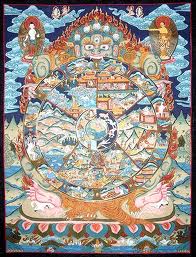
The wheel of transmigration

Although whatever is understood by transmigration or reincarnation does not strictly belong in this discussion on the “problem”, or the “reality” of death, it is so entrenched in people’s minds due to cultural and religious accretions, that a short account of it is not altogether out of place here. In the milieu of Hindu and Buddhist traditions reincarnation occupies the main doctrinal position in their exoteric or “religious” aspects, apart from belief in and worship of a deity or deities, and second only to the doctrine of karma – to which it is intimately related. Death of the body – the ‘gross body’ – is a foregone conclusion once it is irreversible (biological death).

A conventional account of reincarnation is as follows: ‘as for the jiva-atman carrying these vrittis, if during his lifetime the individual had performed some special acts of merit (punya) or demerit (papa), then the jiva-atman would proceed to heaven or hell. After spending his special karma-phala there, he comes back to the earth’. A more elaborate description is that once the seeker realizes nirguna Brahman he/she merges with Him/It, thus attaining immediate liberation (sadya mukti)’.Those who are eager to go beyond paths [the journey of life here and hereafter] tread no path’ (com. on Mu U. lll.2.6). ‘Just as the footmarks of birds cannot be traced in the sky or of fish in water, so is the departure of the illumined’ (Mahabharata). These two quotations are taken from ‘Methods of Knowledge’ – According to Advaita Vedanta’, by Swami Satprakashananda, p. 299. Continue reading