Tattvabodha – Part 10

OLYMPUS DIGITAL CAMERA

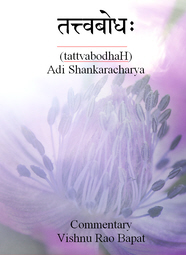
Part 10 of the commentary by Dr. VIshnu Bapat on Shankara’s Tattvabodha.This is a key work which introduces all of the key concepts of Advaita in a systematic manner.

The commentary is based upon those by several other authors, together with the audio lectures of Swami Paramarthananda. It includes word-by-word breakdown of the Sanskrit shloka-s so should be of interest to everyone, from complete beginners to advanced students.

Part 10 looks at the five organs of perception and the six means of acquiring knowledge.

There is a hyperlinked Contents List, which is updated as each new part is published.

The aim of Advaita VIsion

about2

If you click on ‘About’ in the menu bar at the top of the page, you will be taken to the page that lists the aims of this blog and the associated website at www.advaita.org.uk. This page was written by Peter Bonnici (with assistance from Ramesam), with whom I initiated Advaita Vision around 4 years ago. (As most readers will know, Peter is unfortunately no longer with us.) Despite its ease of accessibility, one wonders how many visitors actually read it. Certainly it would seem that some have never done so. Accordingly, I reproduce it below, since its content is so important.

*****************

This site provides a platform for all who are attracted to the vision of non-duality and like to share their views and their approaches.

Here’s why Advaita Vision will be an open platform for all committed to self-enquiry:

  1. People are at different points on their spiritual journeys.

Therefore different expressions of the fundamental principle of advaita are needed to meet their specific different needs. Continue reading

Tattvabodha – Part 9

OLYMPUS DIGITAL CAMERAPart 9 of the commentary by Dr. VIshnu Bapat on Shankara’s Tattvabodha.This is a key work which introduces all of the key concepts of Advaita in a systematic manner.

The commentary is based upon those by several other authors, together with the audio lectures of Swami Paramarthananda. It includes word-by-word breakdown of the Sanskrit shloka-s so should be of interest to everyone, from complete beginners to advanced students.

Part 9 looks at the makeup of the subtle body, its functions and purpose, from one birth to the next.

There is a hyperlinked Contents List, which is updated as each new part is published.
Dreaming of God

Here is an article I was asked to write recently for my publisher’s blog. It discusses my approach to writing about Advaita, with particular emphasis on my last book, ‘A-U-M: Awakening to Reaility’. It also touches upon that perennially thorny issue – experience versus knowledge!

Topaz-P1040197A philosophically-inclined wit once inquired into the difference between having God speak to one in a dream and dreaming about God. This metaphysical query is the basis of this article on Mind-Body-Spirit books in general and my own writing in particular.

Let’s assume for a moment that I am a ‘successful’ author (by which I mean that I have written books that are acknowledged as ‘worthy’ rather than that I have made much money from the pursuit!) There are effectively two elements to this success:
A) being able to write, and
B) being knowledgeable about the subject-matter of the books.

If I am deemed to have achieved those accomplishments, what were the principal factors? Continue reading

Serialization of Yogavasishta

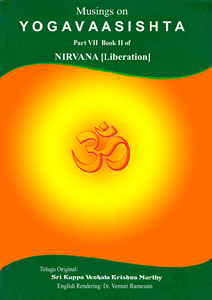
part7 cover300Professor Sri Kuppa Venkata Krishna Murthy, Chairman and Managing Trustee of I-SERVE, the Institute of Scientific Research on Vedas, has kindly given permission for Advaita Vision to serialize his 6-volume ‘Musings on Yogavasishta’. Written in Telugu, the work has been painstakingly translated by our Dr. Ramesam Vemuri and published by Avadhoota Datta Peetham.

Rather than reproducing successive extracts from the books each month, as has been done with our other two serializations, the books themselves will be made available for download in PDF format. Each part will be associated with a page at the main website, which will contain a Contents List for that volume. Links to all of the volumes will be provided on a general Contents Page.

The first part to be published is Part VII Book – II of NIRVANA (LIBERATION). We begin with Part 7 of the Series as it provides an overall summary of the Non-dual teaching and is a better introduction than simply jumping in at Part – 1. This (first posted) part also contains the Author’s submission and the Word Glossary. These will not be repeated in the other parts.

Please go to the Contents Page to read the Announcement and general introduction from Ramesam. The page for this First Volume, Part VII Book – II of NIRVANA (LIBERATION) also contains the download link for the PDF file (1.4MB).

New Authors

Just a brief note to announce (retrospectively!) the changes in our ‘blog role’.

I would like to thank Venkat and Shuka for all of their posts, support in the Q & A section, and participation in discussions over the past few years.

shuka
Shuka is busy with research on his doctorate until the end of next year. Hopefully we may see him rejoin subsequently.


venkatVenkat, too, has decided not to initiate any blogs for the time being, although he may continue to join in discussion (as can be seen from Charles’ first post). So hopefully we will not be without his earnest comments and fund of quotations.


In their place, I would like to welcome Melanie and Charles.

charlesWe have been seeing quite a few comments from Charles over the past months and it made sense, given their thoughtful and intelligent nature, to invite him to blog for AV, too. Though initially too busy to accept, he is now able to contribute, for a while at least.

melanie

Melanie is the first person actually to offer her services as a blogger. The quality of her writing and her obvious enthusiasm made this a foregone conclusion.


Prologue – Time for the Wind

time_for_windThe E-Book of this new thriller (with more than a few hints of Advaita) should be available in E-Book format now. The paperback version has been printed and should be avaialble for purchase within the next 2 – 3 weeks. I posted an article about the problems of wtiting a book such as this several weeks ago, together with an extract in which the philosophical dialog first begins.

Here, hopefully to whet you appetite, I have posted the entire prologue to the story, which is based on an actual incident: Weston, near Runcorn, Cheshire, England, Jan. 2000.

Language and Teaching

I think we have probably had enough discussion on the ‘Experience versus Knowledge’ question. I cannot imagine many visitors wanting to read through 50+ comments on the topic! So here is an article that I have just had published in the Newsletter of Ramana Maharshi Foundation UK. It is on a subject closely related to the above question and indeed was touched upon in some of the comments…

Language and Teaching

Language is something we tend to take very much for granted. When someone says something to us, and providing we recognize the words, we think that we understand what it is that the speaker intends to communicate. And we respond appropriately. This is often not verbal – when it is, there is a subsequent opportunity to resolve any misunderstanding. Our response is usually to form an immediate mental opinion or judgement upon what has been said. And this is probably not merely a spoken or unspoken comment upon the particular topic expressed but also upon the person who made the statement. This all happens instantaneously and automatically. Thus it is that it can actually be worse for our comprehension if we already know something about the topic to begin with than if we are completely ignorant. What we take in will be significantly coloured by what we believe to be our prior knowledge (which may actually be ignorance). Continue reading

Q.381 – Knowledge, belief and experience

Note: This discussion follows on from the last question on ‘Finding a Teacher’ (apart from the introductory paragraphs).

Many seekers think that the essence of enlightenment is ‘experience’; that they need to actually experience something for themselves before they can be regarded as enlightened. In line with this, they denigrate the notion that a teacher can convey whatever it is that the seeker needs by simply talking to them, answering questions and so on. Even worse, they feel, is the idea that enlightenment can be gained by reading a book!

Maybe the term ‘Self-inquiry’ is largely to blame for this misconception. Seekers attached to this idea think that subjecting their own experiences (perceptions, ideas, theories etc) to close examination is somehow the key.

Whatever is the case, such seekers are seriously confused and need to distinguish carefully between ‘experience’, ‘belief’ and ‘knowledge’. Below I provide a question and answer discussion I had early last year with a reader on this general subject. But first I would like to give an example from my own experience, which (for me) provided a very clear distinction between these three. (And I refer to this example in the question and answer session.)

The experience occurred about 30 years ago. You will have to bear with me as it takes a little while (and two diagrams!) to explain. Continue reading