S&T Developments You may Like To Take Notice Of

If our valued Readers are interested, I propose to start a New Series of Posts on some of the latest Scientific advances that could be of interest to our Community of Advaita Thinkers and Philosophers. These Posts will be infrequent and in the form of simple “Alerts” on the current research findings. What gets reported by me will obviously be constrained by at least two of my own limitations:

(i)  The conscious and or unconscious ‘filtering mechanism’ exercised by my mind in selection of the topics; and

(ii) What research papers happen to come to my notice.

For the present, here is a sample Post to show how I propose to structure this venture taking selections from the works published during the last couple of weeks:

[If Dennis agrees and if there is sufficient interest, we may continue and improve upon this idea.  Readers may like to send their views to Dennis (in confidence, if desired).] Continue reading
Eka jIva VAda – I Am Alone: Part III

Pat – II

Our esteemed colleagues Suka and Martin  made certain important observations on the earlier Posts of mine on this subject. So I felt it may be better to respond to the points raised by them without any further delay before resuming my presentation  with regard to Eka jIva vAda.

A:  About the similarity between Wakeful and Dream Worlds:

Suka pointed out to the three distinct orders of reality distinguishable from the way we experience them and opined that dream and awake world cannot be treated at par.  He said that a dream world was a ‘bhrama‘  whereas the awake world was ‘mithya.’

Continue reading

Eka jIva VAda – I Am Alone: Part II

Part – I

The quintessential teaching of Advaita is well encapsulated in the famous half-verse long apopthegm comprising eight words:

Brahma satyam

Jagat mithya

jIvah brahmaiva na aparah

(Brahman alone is Real; the world is unreal; and the individual (jIva) is in actual fact non-different from Brahman).

Thus the jIva-brahmaikya vAda (the Doctrine of the Identity of the individual and Brahman) effectively sums up the message of Advaita.

All of us are jIvas. Obviously then, without doubt, we are Brahman.

However, we outdo Brahman, if I may say so, with two additional qualities. These are (i) a delimited size, shape etc. (finitude in dimensions) and (ii) an ID (individual name, lineage etc.). Continue reading

The Past and Future Are In The “Now” Only

The 53 min long Physics Video on “Illusion of Time” is now available on Youtube.
If you have not already seen it, you should not miss as a Vedantin.
Please watch it to know the latest developments in Physics on What is Time, Time travel etc.  What does “Now” mean is covered from about 20th minute to 32nd minute.  There is nothing like a  ‘past’ that has given way to the ‘present’ in absolute one dimensional time. 
As Dr. Albert Einstein said: “The distinction between past, present and future is only an illusion, however persistent. (In a letter to Michelangelo Besso, 21 March 1955).
One aspect not covered in the Video is this: It is easy to imagine for any one that the present “now” (at this moment) can develop into any number of different possible scenarios in the “future.”  Each such possibility could happen in one or the other universe out of multiple universes (H. Everett’s hypothesis).  Similarly then, because of time symmetry in physical laws, one can imagine that the present “now”  (as an outcome) has multiple possibilities in the past.  (One strange consequence is one can never be sure that one is definitely the child of only a specific couple!).
The Link:  Click  here.

Eka jIva vAda – I Am Alone: Part I

The Question at # 340 is, IMO, a landmine!

It sounds quite innocuous but barely conceals the explosive depths of its profundity.

It’s a cleverly worded question on the very origins of you and me, of the world, nay, of the “creation” itself, pregnant with implications on what comes first – the ‘witnessed’ or the ‘witnessor.’

The answer would inevitably be a replay of the classic debate on perception-based-creation (dRshTi-sRshTi-vAda) vs. creation-based-perception (sRshTi-dRshTi-vAda). But Advaita holds, contrary to either view, quite counterintuitively, that nothing has ever originated (ajAti vAda). Continue reading

Traditional Teaching and Deep Sleep – III. mAyA & Creation

Part – I              Part – II              Part – III

[The latter part of the article requires a bit of mathematical (or at least arithmetic) orientation in the reader. If you know the addition, 1 + 1, that is enough. Otherwise, it could prove slightly boring!]

We shall tackle now the question of how we wake up to be what (we think) we were before we went to bed.

I said in my previous argument that our waking up to a new morning and into an awake state is comparable to another cycle of creation.  So I suggest we examine how creation itself takes place.

From a scientific perspective, creation seems to be happening from ‘nothingness’ and dissolving back into nothing.  Vedantins prefer to call nothingness as ‘Beingness’ simply because even ‘nothingness’ has to ‘Be.’

If we go by what Quantum Physics tells us, what we may refer to as ‘nothingness’ is not just emptiness.  There is an enormous amount of energy in ‘Emptiness.’ Physicists have been able to measure this energy of empty space.

The energy within the empty space of the nucleus of an atom is the main reason for the weight of the nucleus (and hence of the matter we are all).  The energy of the emptiness within the intergalactic space is the reason for the expanding universe causing the colossal and mighty galaxies to recede from one another at speeds exceeding the speed of light. This vast energy is the result of constant creation and annihilation of virtual particles smaller than sub-atomic particles. Thus creation-dissolution is an ongoing unstoppable roiling and boiling process from emptiness to emptiness within emptiness!

Continue reading

Traditional Teaching and Deep Sleep – II. Dreams

[The topic of Dreams is something I have not originally planned to include here in this series which was primarily designed to address the issue of Upanishadic support for considering deep sleep itself as Liberation (moksha).]

Part I      Part – II            Part – III

Please allow me here to take a short digression to discuss dreams because of a few questions raised by our esteemed readers.

Secrets of Sleeping Brain - Architecture of Sleep - Prof. M Walker, 2009

Fig. 1. Sleep Hypnogram (After M. Walker, 2009) – Click on the figure for enlarged view.

First of all, I would like to correct the misconception that some of us have that the moment we hit the pillow and get lost in sleep, we just flow through one continuous phase of dreaming, then deep sleep and, lo  behold, we get up refreshed in the morning. So, to this extent, the sequence of Awake state (A), Dream state (U), and  Deep sleep (M) corresponding to AUM as presented by Mandukya  Upanishad is awfully way out. ***  The Upanishad says that these three states arise in an everlasting turIya which is compared to the ‘silence’ at the end of AUM. ***  Several experimental studies carried out over a period of more than half a century demonstrate that the architecture of our sleep pattern is vastly different as experienced by us every night. A typical hypnogram (the nightly sleep cycle) we go through each night is shown in Fig. 1. (Please click on the figure for an enlarged view).

Continue reading

Traditional Teaching and Deep Sleep – I

Part – I        Part – II          Part – III 

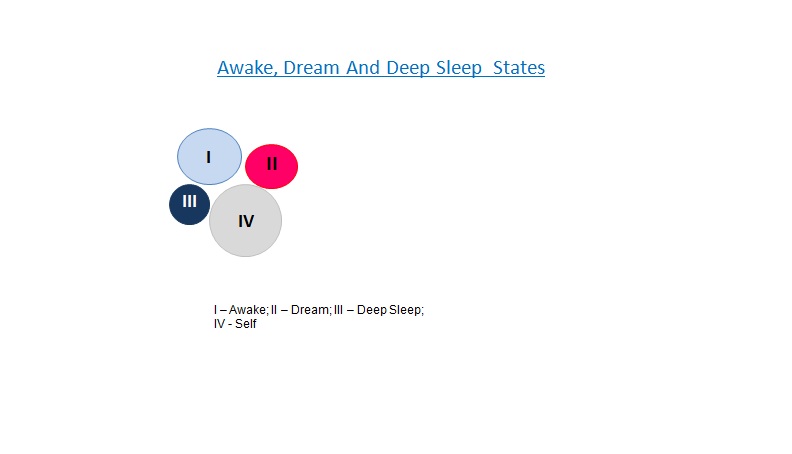
In my Talk on “Inquiry in Science and Vedanta “, the slides numbered 50 and 51 are about  the three states of  consciousness — Awake, Dream and Deep Sleep. (The full PowerPoint Presentation can be viewed at : http://beyond-advaita.blogspot.in/ ). The three worlds are represented by the three distinct circles I, II and III and a ‘Me’ is shown by the circle IV in the Slide 50 (Fig. 1 below). In our normal understanding, we think that “I am a separate ‘self’ (individual) and I pass through three distinct worlds viz. the Wakeful world, the Dream world and the Deep Sleep world.” We also take that the worlds to be external to ‘me.’

Fig 1: The Normal Worldview – an individual “I” (IV) passes through three distinct worlds (I, II, III) that are external to ‘me’ during a day of 24 hrs.

Continue reading

Morality in the Brain

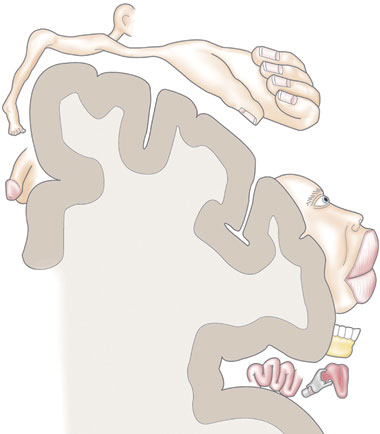
Year 2012 is coming to a close and we are getting ready for one more end-of-the-year celebrations. People are already in a festive mood – remembering friends, recalling  favors received and planning for reciprocation with gifts. As you shop and bring home the packets, you plan to embellish them with a hand-crafted insignia to show your extra care and love. So you take a pair of scissors in hand and begin to cut a piece of paper molding it into an attractive shape. Your child suddenly comments: “Why do you purse your lips when you are cutting the paper?”

Fig. 1: Homunculus – Brain Real Estate Devoted to Touch in the Primary Somatosensory Cortex

What? Pursed the lips? You were not even conscious of the face, forget the lips.You were so much lost in the job with all your attention focused on the fingers and the scissors, you were unaware of the tightness in your face. Why should the lips tense up? And you  don’t even know about it!

You may be a six footer weighing 60 – 70 Kg having seen half a century or more of summers (and winters); or may be a short and smart young man of  20.  The wetware weighing less than a Kg and half (about 3 pounds) sitting between your ears contains an encrypted miniature model of who you are. It has all the maps representing your past, your knowledge, your expertise, tastes, likes, dislikes – everything that describes what you call as your ‘personality.’ Continue reading

Bhagavad-Gita and Advaita – Q. 329

Q:  How would it be possible to deal with our common Bhagavad Gita in terms of Advaita Vedanta?

A (Ramesam): Please appreciate that Bhagavad-Gita is not the primary or basic text for Advaita. Though many of the verses in it are almost exact mantras from various Upanishads, prior to Sankara (8th Century A.D), Bhagavad-Gita was not perhaps as popular a scriptural text for teaching Vedanta as it is today. It was a part of the mythological story, Mahabharata.  Some people hold that the Bhagavad-Gita of Mahabhrata contained 745 verses. Some others opine that the original Gita was much smaller and it was Sankara who compiled the present Gita putting together diverse verses from different sources. None of these opinions, however, have any credible supporting evidence.  The first extant gloss on the Gita is by Sankara and it contains 700 verses (one or two verses are still disputed and said to have been later insertions). Continue reading