
 It was over two scores and a half years ago. I remember an experience when I was living in that part of India venerated by the name AryAvarta, the holy land. The cows and other cattle had a right of way even on the so-called main roads, affectionately christened ‘M.K. Gandhi Marg’ ‘P.C. Chatterji Panth’ or some such tongue twisters by the locals. The citizens or rather the bodies of the inhabitants have a natural agility and ability to automatically adopt all the tricks of an expert contortionist in walking on the road avoiding the animals or their heaps and spurts of fragrant fresh just-in-time deliveries – made, as though, just for you. When you are all focused on keeping your balance as you never know where your next step may have to land, a hearty greeting jolts your auditory senses. You take time to locate the source of that sound, because there is obviously no face visible nearby. You see at a distance a half raised single hand, as a mark of showing respect for you. Adept practitioners of Zen may not know the clap of a single hand, but every one over there knows a salutation by one hand. Their shout says ‘su prabhAtaM,’ a literal translation for “Good Morning.” Continue reading
Category Archives: Ramesam
Ignorance is Also Brahman
Rama: Maharishi Vasishta! Revered Teacher! Kundadanta whom I met on that day is here in this assembly. He has been listening to your instructions for all these days. That is why I have asked you if he has attained Self-Knowledge and if all his doubts have been clarified.
Sage Vasishta: Where is the need for me to say anything? Let us ask him directly.
(Addressing now Kundadanta): What do you say, Kundadanta? Could you understand the essence of Truth? Have you gained Self-Knowledge? Have your doubts been cleared?
Kundadanta: Oh, Greatest of the Sages! Maharishi! My Salutations. Yes, now I am totally free of doubt. I have learnt what all has to be learnt. I understood fully the nature of Consciousness. I realize that even a tiny mustard seed can contain infinite universes within it. I could also understand experientially that there are no worlds at all from an Absolute point of view. I can see clearly that a question on how a large earth can fit into a small room has no locus.
What every creature experiences in the world is only The Supreme Brahman. The ignorance they experience is also Brahman. There is nothing whatsoever anywhere anytime beyond Supreme Brahman. That is the last word!
Vasishta: He is a Great Man Indeed! Congratulations to you, Kundadanta! Continue reading
I-consciousness, Worlds And Brahman
Shri Vijay Pargaonkar, a frequent contributor at this site, recently drew my attention to the teaching of Sage Vasishta towards the end of the 32,000 verse-strong Yogavasishta. I wish to share the following extract from the teaching as it has a relevance to the discussions going on at another thread.
*****
Vasishta: Rama, there are essentially two types of (…) worlds. They are the Stable and the Mobile worlds. The Stable worlds are: Mahah, Janah, Tapah, Satya etc. They are located far away from us.
स यदि पितृलोककामो भवति सङ्कल्पादेवास्य पितरः समुत्तिष्ठन्ति तेन पितृलोकेन सम्पन्नो महीयते ॥ – VIII-ii-1, छान्दोग्य
sa yadi pitRilokakAmo bhavati saMkalpAdevasyapiraH samuttiShTanti tena pitRilokena saMpannomahIyate. — VIII-ii-1, chAndogya upanishad. Continue reading
Living In The Moment Eternally – 2
[Nobody has obviously noticed or pointed out that the continuation articles have not been posted for two years! So I am proceeding with the Series of articles here a bit hesitantly as I am not sure of the Reader-interest. In these two years my computer lost the “memory” of my notes and files stored on the subject (thanks to the hackers from Nigeria). I am hence obliged to go by whatever material I could harness in the ‘now’ from my computer. Part – 1 here. Part – 3 here . ]
The main question of interest for us here is “How does the body of a Self-realized man live eternally in the ‘Now’ and function in the day to day life of eating, moving, acting and interacting in the absence of ‘memory’ of past experience/knowledge for recognition? What does “Now” mean for him/her? Is the “Now” on a temporal dimension?”
Whether we are consciously aware of it or not, it is impossible to lead a normal life in the world without memory. Maybe it is simply responding to when your name is called or you have to find a solution to a much more complicated problem of technology, memory plays a significant role. Therefore, before we venture to answer the questions on the functioning of a jIvanmukta‘s body, one could be curious to know about the lives of those who are at a disadvantage in their worldly life because they do not have an access to their memory anymore . I shall list briefly a few such cases which are well studied by scientists. Their lives may look yet times hilarious and often poignant and heartbreaking but always harrowing to their care givers. Continue reading
How Many Universes?
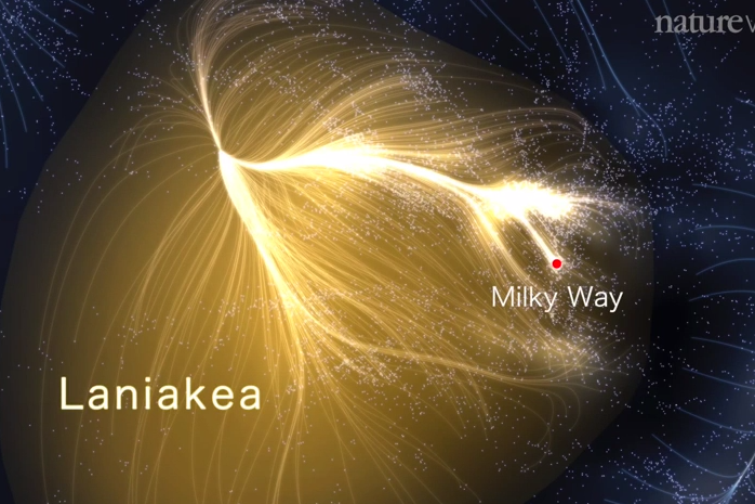 I wrote a Blog Post with the title “How Many Universes Make A Multiverse – The Story of Bhetala” inspired by a story narrated by Sage Vasishta in the first part of the Sixth Chapter: Nirvana in Yogavasishta. The Link to the Post dated Nov 4, 2009 is here. The metaphor described was as follows:
“Think of the universe that we are all living in to be a humongous fruit.
There is a bough with thousands of those fruits.
There is a tree with thousands of such boughs.
There is a wood with thousands of such trees.
There is a mountain with thousands of such woods.
There is an island with thousands of such mountains.
There is a huge globe (mahi peetha) with thousands of such islands.
There is a huge star system with thousands of such globes.
There is a heavenly egg with thousands of such star systems.
There is a sea with thousands of such heavenly eggs.
There is an ocean with thousands of such seas.
Thousands of such oceans will be the waters in the stomach of a man.
That man’s name is Vishnu. Continue reading
Dream Space, Awake Space and Mind-Space
[This short extract, in addition to providing the answers, also serves as an example of the incisive logic and inductive and deductive approach taken by Sage Vasishta in explicating the nature of the world to Rama in the well-known Advaitic scripture, Yogavasishta. The present material is from Chapter 2: mumukshu vyavahAra prakaraNa (The Conduct and Behavior of a committed Seeker), Original text: Shri K. V. Krishna Murthy; English translation: Ramesam Vemuri]
Where do the brahmANDa-s (multiverses) of the present time exist? They are in space. What is space exactly?
One definition for space is that because of which it is possible for two objects to exist separated from one another. We can also define it in another way. Space is that in which all the known objects are located. But your dream world is also known to you! Can you say where do the rivers, mountains and all the other things of your dream world are located in the present awake world space? Continue reading
Questions by Peregrinus
[Reference: https://www.advaita-vision.org/life-is-a-dream-the-world-is-real/#comment-3266 ]
 Dear PtN,
Great Questions!
In providing answers to those very questions, volumes have been written, several concepts have been floated and related downstream issues have been under constant debate from several centuries (if not millennia) ago up to even now . The positions taken are so extreme and contradictory to each other that protagonists of different propositions do not see eye to eye. Unable to wrap their minds around the Advaita concepts and unconvinced by the Advaita models, some people (Tatva vadins – followers of the 13th century Madhvacharya) ascribe as much reality to the individual as to brahman but deny the identity of the two. The fights between them and the Advaitins are legendary. And there are notorious disagreements even within the Advaitins also on subtle details of the theories they propose as answers. Hence it is quite safe to say at the outset that there are no straight answers to any of these fundamental questions, as you may be already knowing from your voracious reading. Hence, switching on all caveats and disclaimers …… …… ……, I stick my neck out. Continue reading
Knowledge, Action and Liberation – AV
 When Ed Witten, the legendary genius Physicist of Princeton, proposed his theory integrating the four or five disparate string theories during the mid-nineties, he called it the M-theory. He did not specify what exactly M stood for. So Science Communicators went wild with their own interpretations. Some said M is for Mother to say it is the mother of all theories. Others said M is for Meta. Still others said M is for Membrane or Matrix. Some even suggested M is for Mystery or Magic.
I leave it to the imagination of the reader what AV stands for in the title of this Post.
It can mean Another View, Advaita Vedanta, Alternate Version, Astonishing Vision, Absolute Veridicality or one can even split the two words and pair them to suit to their taste — like Absolute Vedanta or Another Version etc.
***
First Kudos to Dennis for a smooth and clear explication of a topic usually considered abstruse and difficult in his recent post titled “Knowledge, Action and Liberation.” He takes off with an elan and panache that only he can. But en route he hits a patch of misdirecting metaphor. The promised destination, alas is missed! Continue reading
Control Genes With Your Thoughts
The day is not far when you can control your genes with your mind! Effectively you can change not only your moods and behavior but also essentially what you are by the power of your thought!
The technological possibility is established through a ‘Proof of Concept’ research paper just published in Nature Communications.
“We wanted to be able to use brainwaves to control genes. It’s the first time anyone has linked synthetic biology and the mind,” says Martin Fussenegger, a bioengineer at ETH Zurich in Basel, Switzerland.
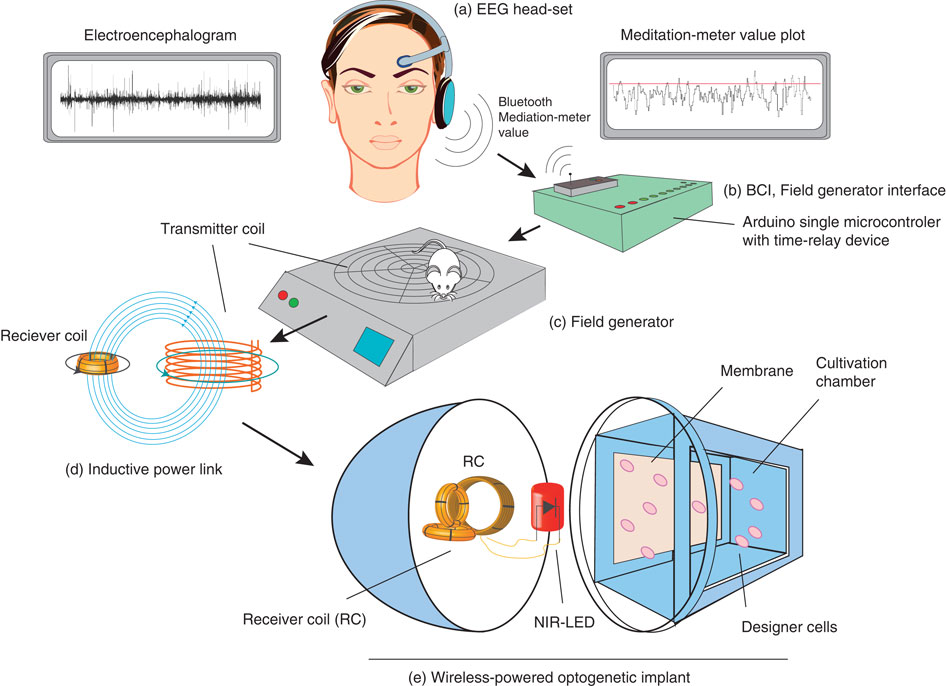
Schematic representation of mind-controlled transgene expression (After M. Folcher et al, 2014)
Sharp vs. Subtle Intellect
A suggestion has been made elsewhere in these columns that “Vedanta differentiates between what is called ‘sharp’ intellect (tIkShNa buddhi) and ‘subtle’ intellect (sUkShma buddhi).”
Experienced Vedantins may differentiate ‘sharp intellect’ from ‘subtle intellect’ in trying to make a point in order to explain contextually some specific concept they would like to amplify on. But it is doubtful if Advaita Vedanta itself has anywhere highlighted the difference between ” ‘sharp’ intellect (tIkShNa buddhi) and ‘subtle’ intellect (sUkShma buddhi).” If we ask whether there is a vedAnta vAkya or shruti mantra to support a claim of difference between the two types of buddhi, the answer is perhaps a resounding “No.”
Vedanta does, of course, contrast ‘sUkshma‘ in relation to ‘sthUla‘ form of many entities (e.g. sharIra, buddhi, loka-s). Bhagavad-Gita too talks of a stratified order from gross to finer when referring to objects to sensory organs to mind to buddhi &c.
****
There is also an idea promoted in some quarters that ‘sharp’ intellect (tIkShNa buddhi) is useful more often in Science whereas ‘subtle’ intellect (sUkShma buddhi) is utilized in Vedantic study. The reason given is that “The former is the analytical mind characteristic of the scientist [whereas] the latter [i.e.] the ability to integrate rather than divide [is the requirement of Vedanta], to see the unity in diversity.” Continue reading