Time for the Wind – Ending

time_for_windAn Explanation of the Ending

One or two readers of this book have expressed some mystification over the ending; and maybe the other three were too polite to comment…  Accordingly, it occurred to me that it might be helpful to write this brief essay to provide a little more explanation.

WARNING: If you haven’t yet read the book, what I am about to write will not be relevant to you and will spoil the experience if you do decide to read it later.

Here is the link to download the PDF document but, if you still haven’t read the book, here are links to purchase from Amazon first:

Buy from Amazon US (book)
Buy from Amazon US (Kindle)
Buy from Amazon UK (book)
Buy from Amazon UK (Kindle)

If you would like to read the Prologue to whet your appetite, read it here! The initial announcement for the novel also contained a further extract from the book.

Serialization of Yogavasishta 6

Professor Sri Kuppa Venkata Krishna Murthy, Chairman and Managing Trustee of I-SERVE, the Institute of Scientific Research on Vedas, has kindly given permission for Advaita Vision to serialize his 6-volume ‘Musings on Yogavasishta’. Written in Telugu, the work has been painstakingly translated by our Dr. Ramesam Vemuri and published by Avadhoota Datta Peetham.

Rather than reproducing successive extracts from the books each month, as has been done with our other two serializations, the books themselves will be made available for download in PDF format. Each part will be associated with a page at the main website, which will contain a Contents List for that volume. Links to all of the volumes will be provided on a general Contents Page.

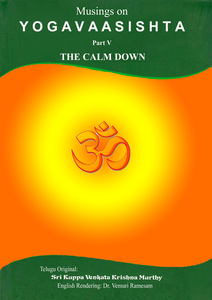
The present volume, “Musings on Yogavaasishta” – Part V The Calm Down, is a presentation by Brahmasri Kuppa Venkata Krishna Murthy, the Vidyadhikari of Avadhoota Datta Peetham, Mysore and forms a part of his lectures on “Yogavaasishta” telecast by GEMINI T.V. in Telugu. This volume is a rendering of the same into English by Dr. Vemuri Ramesam. In it: The 5000 stanzas of the fifth chapter on The Calm Down (Upasama)   have been ably condensed and lucidly explained in simple words. Possible methods of alleviation from the state of Bondage and annulment of mind are described through the stories of Janaka, Bali, Prahlada, Uddalaka, Gadhi, Sraghu, Parigha and others.

Please go to the Contents Page to read the Announcement and general introduction from Ramesam. The page for this Fifth Volume, Part 5 (THE CALM DOWN) also contains the download link for the PDF file (0.9MB).

Q. 387 – Value of Self-knowledge

Q: At the end of the day, what does knowledge of self give us ? It does not help to answer the burning question of why the appearance/dream/mAyA that we are experiencing as humans or animals exists. Also, it appears that even if one attains knowledge of self in one life, he/she can actually become a cockroach in the next due to karmic effect, ie we are not really liberated from the brith-death cycle. The only benefit I do see in a life in which one attains knowledge of self is that one might lead a life devoid of misery in the mind as we sail through good and bad times, even though we may experience physical pain.

A (Dennis): Self-knowledge removes Self-ignorance and it is that which makes us think we are limited, unhappy, doomed to old age and death. With Self-knowledge we realize that we are not human, living in an inhospitable world; we are brahman. The world appears as separate because of our ignorance. On gaining Self-knowledge, we realize that it’s substance is nothing but brahman.

From the perspective of the ignorant person, there is rebirth (possibly as a cockroach) and we are subject to karma. With Self-knowledge, we realize that there is no person, no birth or rebirth, no death, no creation.

The idea that knowledge is pointless is actually the main argument of the pUrvamImAMsika philosopher. They believe that only the karmakANDa portion of the Vedas is relevant – rituals that we have to perform in order to gain benefits. They say that the Upanishads etc are only supporting material to be meditated on. In the Brahmasutras, I.1.4, Vyasa effectively refutes all those philosophers who deny that brahman is the principal topic of the Vedas. But he does this with the single word ‘tu’ (tattu samanvayAt). Fortunately Shankara takes the opportunity to take up arms against pUrvamImAMsA. Whilst he agrees that knowledge in itself is often useless – we need actually to do something in order to gain some benefit – there is one situation in which ONLY knowledge bears fruit. That is when the problem is one of ignorance. The classic example is the rope mistaken for a snake. As soon as we find out that it is a rope, all our fears etc disappear. And our essential problem in life is that we believe we are a limited person. The knowledge that is to be gained from Advaita is that we are brahman – and that reveals that we have no real problems at all.

Tattvabodha – Part 14

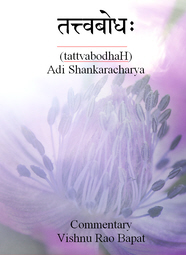
Part 14 of the commentary by Dr. VIshnu Bapat on Shankara’s Tattvabodha.This is a key work which introduces all of the key concepts of Advaita in a systematic manner.

The commentary is based upon those by several other authors, together with the audio lectures of Swami Paramarthananda. It includes word-by-word breakdown of the Sanskrit shloka-s so should be of interest to everyone, from complete beginners to advanced students.

Part 14 continues to look at the metaphor of the five sheaths, from the Taittiriya Upanishad. This part explains the vital, mental and intellectual sheaths.

There is a hyperlinked Contents List, which is updated as each new part is published.

Overview of Western Philosophy – Part 3

(Read Part 2 of the series.)

Part 3 – Plato, Aristotle and the Cynics

Socrates is famous for claiming that ‘the unexamined life is not worth living’. If we simply go through our lives seeking pleasures for their own sake without ever looking for some sense of purpose and meaning, then we might as well not have existed. The hedonist’s retort to this is that, if we spend all of our lives searching for significance and fail to find any (whether or not there actually is one), then we have wasted our opportunity to enjoy it while we are able. The fact that many claim that there is a purpose, and that they themselves have realised this, is not really any help. Most of such people will be held by us to be deluded religious fanatics and their opinions will carry little weight. If there is meaning then it does seem that we must discover it for ourselves, perhaps by systematically examining all of the claims and deciding whether they are in any way justified. Continue reading

If we do not experience from within a body, then where oh where do we feel-think-do from?

whirlpool

Image by valemngilda

Think of a whirlpool. There seems to be a definable shape that we can point to and know as a whirlpool, and yet there is nothing separate or fixed about its whirlpool-ness. All the water that constructs the thing we have labelled “whirlpool” is in flow, never the same water in any moment, and yet it appears to hold its shape/from so convincingly that we believe we can point to the moment our whirlpool began, measure it’s lifetime, and record the moment it ceases to be.

But what is it that convinces us that the whirlpool is separate and of its own causal relatedness to “other” forms we have labelled in the single field of All That Is?

For as much as we focus on the ways to practice into a consciousness immune to mithyA, we have the experiences we have as All That Is in constant flow, unfixed and inseparable, no matter how we might label that experience.

It seems prudent to mention at this point that we are prone to use the word experience to separate so-called “personal identity” from “other-ness”, so the concept of experience encompassing all that we have labelled inner, outer, before, present, and so on, is an unnatural leap… until one comprehends the arbitrary lines we have drawn (even in language being the means of defining ideas that can be fixed in objective transfer of meaning), and recognise these too as whirlpools in the ocean of All That Is.
13186929-Background-with-physical-formulas--Stock-Vector-physics-scientific-equation

Image by Andrey Alyukhin

Of course, the analogy can only go so far. According to the assumptions of our current cosmology, to know-observe a whirlpool is to be separate from it, and to literally form a whirlpool the ocean must exist within an atmosphere. But in our present physics of a causal universe, we have no means of explaining an alternative conceptual reality with words. Even the term “reality” inspires our perceptual bias dividing existence as dimensional from that which cannot be known/named/defined.

Which also means that while it seems that we can be taught the Vedantic mokSha; that there are those who trust innately, and perceive (for want of a better word) the whirlpool in its ocean state. Those who seek to trust, and devote themselves to practices which might reveal an ocean in all things. And those who examine trust through chemical, experimental, and philosophical means in order to demystify that which defies explanation (which will ultimately allow us to speak of that which language is yet to adequately express)… we do not experience (learn/live/know) from within a body because the “body”, the “self”, and experience as a point of separation, are all whirlpools within an ocean of All That Is.

“There is no dissolution, no origination, none in bondage, none possessed of the means of liberation, none desirous of liberation, and none liberated.” Gaudapada (K2.32)


The Pursuit of Happiness

Everyone wants to be happy. This is the motivational force for everyone. The Vedas acknowledge this. The first part of the Vedas – karmakANDa – is effectively aimed at those who look for their happiness in external, limited, objects and pursuits; the latter part of the Vedas – j~nAnakANDa – is aimed at those who are looking to find the happiness within, through gaining knowledge of their true nature.
Here is a brief article from Ramesh Pattni, called

WHAT IS VEDANTA? VEDANTA AND THE PURSUIT OF HAPPINESS

The pursuit of happiness has been the foremost goals of humanity from time immemorial. There is, however, a diversity of understanding and experience of happiness across traditions and cultures around the world. Eastern traditions which offer great insights into the human condition and psychological processes, have a universal appeal which point towards attainment of happiness by different means.

The development of Positive Psychology in recent decades has focused on the study of happiness and wellbeing and examined evidence for the ways and means to happiness.  Currently there are two dominant Western approaches to human happiness and well‐being: Hedonic and Eudaimonic perspectives. The former is based on the idea that pleasure is the only intrinsic good, and obtained through the contact with the world of objects. The eudaimonic approach is that happiness is an end in itself and the highest good and based on a life of virtuous living and contemplation. Continue reading

The Mystery – Part 4

Continuing this new, short series presenting the booklet by Bimal Prasad, in which he answers some ‘Rarely Asked Questions’ on Life. Primarily from the perspective of Advaita, questions addressed include the nature of happiness, consciousness, mind and ego. There is also practical guidance on meditation in the final chapter. Answers are relevant and succinct, so that many of the issues of interest to the seeker are covered.

This fourth part addresses  creation and the nature of the ego. See the Contents List or go straight to Part 4 of the series.

The complete (electronic form) booklet may also be purchased from Amazon.

Q. 386 – Has enlightenment been ‘dumbed down’?

Q: Self-Realization is a very rare occurrence – the Gita states something like 1 in a billion, and there are very few authentic, fully realized beings known to us, such as Ramana Maharshi, Nisargadatta Maharaj and a few others, (as well as the great anonymous ones). Granted, the world has changed and everything is much faster than it was, but this cannot surely apply to self-realization. The Neo-Advaitins’ awakenings or enlightenments cannot possibly be synonymous with the self-realizations of the great sages such as Ramana and Nisargadatta? 

Also, the hallmark of the great sages such as those mentioned above is that they have a transparent, translucent quality that emanates contentment and  peace.  The Neo-Advaitin teachers that I have observed do not emanate peace, instead, they come across with their body-mind personality traits/baggage as either ‘manic’, ‘neurotic’, ‘depressed’, ‘nihilistic’, etc. The talking, and so much talking at that,  is coming from the mind, and not from “mauna”. It is more like a mixture of counseling, psychotherapy and psycho-babble rather than pragmatic Advaitin philosophy. 

So my question is … has self-realization been dumbed down and redefined by the Neo-Advaitins, or do they not claim full self-realization, but only to be ‘awakened’ or ‘enlightened’?   Tolle comes to mind and Mooji, too… the talking never stops.

Responses from Melanie, Martin, Ramesam, Charles, and Dennis Continue reading