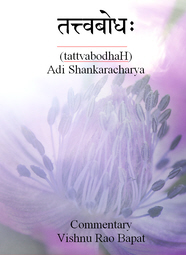
Tattvabodha – Part 12

OLYMPUS DIGITAL CAMERA

Part 12 of the commentary by Dr. VIshnu Bapat on Shankara’s Tattvabodha.This is a key work which introduces all of the key concepts of Advaita in a systematic manner.

The commentary is based upon those by several other authors, together with the audio lectures of Swami Paramarthananda. It includes word-by-word breakdown of the Sanskrit shloka-s so should be of interest to everyone, from complete beginners to advanced students.

Part 12 examines the waking and dream states of experience.

There is a hyperlinked Contents List, which is updated as each new part is published.

Overview of Western Philosophy – Part 1

TTopazwo-33832his is the first part of an 18-part overview of Western Philosophy. Originally written to be incorporated into ‘Book of One’, it became far too long and detailed. I posted the first 15 parts to Advaita Academy around 5 years ago but these are no longer available. Since we have a current interest in the subject with both Charles and Martin posting articles and comments, it seems like an opportune time to begin to repost the series!

Note that the depth to which the subject is addressed is fairly shallow for the most part. I am not a philosopher by education or employment and most of my understanding has been gleaned from secondary sources – I have read very few original philosophical texts! But I hope it provides a general introduction to the key ideas of most well-known Western philosophers so that the reader may go to the original source (or a good commentary) if interested. Needless to say, I tend to ‘cherry-pick’ those aspects that related to Advaita!

What Western Philosophers Have Said

A site such as this would be unthinkable without reference to what has been thought and written by Western philosophers. Philosophers used not to limit their investigation to those areas that we now think of as philosophy. Aristotle for example wrote books on physics, biology, mathematics, psychology, politics and meteorology, to mention just a few. Their interests ranged across the entire spectrum of human endeavour. It should not be too surprising, then, to find that many philosophers do not seem specifically to have addressed those questions that concern Advaita – there were simply too many other diverting subjects to investigate. Nevertheless, since the question of what we ought to do with our lives in order to achieve fulfilment and happiness is rather more important than most, it is perhaps surprising that it seems so difficult to discover clear guidance from this intellectual elite. Continue reading

The Relevance of Kant’s Transcendental Idealism to Advaita Vedanta, Part I

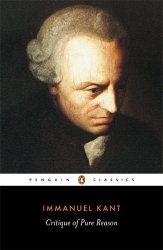
This the first of a three-part series discussing the relevance of Kant’s philosophy to Advaita. Kant-CPR

Immanuel Kant published the first edition of The Critique of Pure Reason in 1781, with an extensively rewritten second edition appearing in 1787. Between those editions he also published a shorter “easier” introduction to his philosophy, Prolegomena to Any Future Metaphysics (1783). With the later appearance of The Critique of Practical Reason (1788) and The Critique of Judgement (1790), Kant had articulated a complete system of philosophy of incredible depth and complexity, wholly original and unique in its solution to the age-old problems of reason, ethics, and logic. So great was the importance of this Prussian professor, we may justifiably think in terms of pre-Kantian and post-Kantian philosophy. Many have disagreed with his conclusions and offered refutations on one level or another, but all who have come after Kant have been required to address him. Continue reading

Tattvabodha – Part 11

OLYMPUS DIGITAL CAMERA

Part 11 of the commentary by Dr. VIshnu Bapat on Shankara’s Tattvabodha.This is a key work which introduces all of the key concepts of Advaita in a systematic manner.

The commentary is based upon those by several other authors, together with the audio lectures of Swami Paramarthananda. It includes word-by-word breakdown of the Sanskrit shloka-s so should be of interest to everyone, from complete beginners to advanced students.

Part 11 looks at the five organs of action and the nature of the causal body.

There is a hyperlinked Contents List, which is updated as each new part is published.

The Brahman Experience

Let’s discuss the possibility that Brahman is nityaptasvarupa, no exceptions. Let’s talk about what it means to truly live from a place where Brahman is all that is – our ideas, experiences, loves, violence. I’ll start with some of the comments made on a previous post, ‘Consciousness of Choice’, because let’s face it, Dennis made some great points!

Continue reading

Teasing Apart Maya’s Tricks – Black Hole Complementarity and Observer-Dependent Reality

blackhole This article was previously published in two parts on the Beyond Advaita blog maintained by our Dr. Ramesam Vemuri, in continuation of an ongoing series of articles exploring the relevance to Advaita of some of the latest research in theoretical physics. Science is converging to a view that no description of reality can be complete without the observer, and that so-called “objective reality” is really more of a holographic illusion than anything truly solid or substantial. Today’s scientists are busy trying to tease apart Maya’s tricks to see how this illusion works. Leonard Susskind’s theory of Black Hole Complementarity (BHC) — the topic of this article — provides a good example of this driving curiosity in action.

Continue reading

Tattvabodha – Part 10

OLYMPUS DIGITAL CAMERA

Part 10 of the commentary by Dr. VIshnu Bapat on Shankara’s Tattvabodha.This is a key work which introduces all of the key concepts of Advaita in a systematic manner.

The commentary is based upon those by several other authors, together with the audio lectures of Swami Paramarthananda. It includes word-by-word breakdown of the Sanskrit shloka-s so should be of interest to everyone, from complete beginners to advanced students.

Part 10 looks at the five organs of perception and the six means of acquiring knowledge.

There is a hyperlinked Contents List, which is updated as each new part is published.

The aim of Advaita VIsion

about2

If you click on ‘About’ in the menu bar at the top of the page, you will be taken to the page that lists the aims of this blog and the associated website at www.advaita.org.uk. This page was written by Peter Bonnici (with assistance from Ramesam), with whom I initiated Advaita Vision around 4 years ago. (As most readers will know, Peter is unfortunately no longer with us.) Despite its ease of accessibility, one wonders how many visitors actually read it. Certainly it would seem that some have never done so. Accordingly, I reproduce it below, since its content is so important.

*****************

This site provides a platform for all who are attracted to the vision of non-duality and like to share their views and their approaches.

Here’s why Advaita Vision will be an open platform for all committed to self-enquiry:

  1. People are at different points on their spiritual journeys.

Therefore different expressions of the fundamental principle of advaita are needed to meet their specific different needs. Continue reading

Tattvabodha – Part 9

OLYMPUS DIGITAL CAMERAPart 9 of the commentary by Dr. VIshnu Bapat on Shankara’s Tattvabodha.This is a key work which introduces all of the key concepts of Advaita in a systematic manner.

The commentary is based upon those by several other authors, together with the audio lectures of Swami Paramarthananda. It includes word-by-word breakdown of the Sanskrit shloka-s so should be of interest to everyone, from complete beginners to advanced students.

Part 9 looks at the makeup of the subtle body, its functions and purpose, from one birth to the next.

There is a hyperlinked Contents List, which is updated as each new part is published.

Reflections on Body-Mind and Liberation

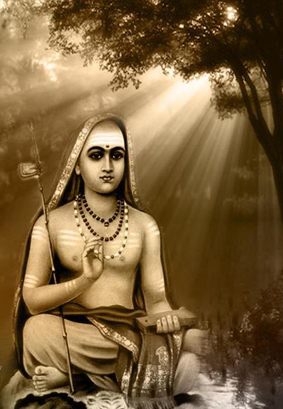
shankaraThere has been much healthy debate recently on the Advaita Vision Blog about Liberation, who or what is a jnani or jivanmukta, and what it means to follow traditional Advaita. The theme of this post is that we cannot resolve such questions without first gaining a clear understanding of the body-mind and its role in the context of Liberation. What follows are some reflections inspired by a spirited discussion with Ramesam, with due credit to him for stimulating many of the thoughts below. Any errors or possible misunderstandings are entirely my fault. Or perhaps not, since “Words fall back from it.” Continue reading