The “I-am-realized” Delusion – 2:

Part – 1

Dennis raised a question on how one can conclude that the word “this” in the 3.14.1, chAndogya would mean “the ‘Universal’ substratum of the world and not the nAma-rUpa-vyAvahAra which are the perceivables.” His contention is that “this” refers to the percept itself.

If what is directly available for the five sensory organs + mind is itself brahman, neither the Upanishads nor the Advaitic teachers right from Gaudapada, Shankara and so on need to have taken any trouble at all  to point out to the seeker what brahman is. On the other hand, all the teachers go to considerable pains to explain that what is available to perception “veils” the Reality, the Substratum and that what is available for perception is a superimposed “falsity” out of our ignorance.

Shankara, in fact, is so tired of repeatedly pointing this fact in all his bhAShya-s that at 2.1.22, BSB, he writes out of exasperation that “We Continue reading

The “I-am-realized” Delusion – 1:

Many people with a nodding acquaintance of Advaita often forget that the ‘ego’ is not totally non-existent. It is not ‘tuccha’ like ‘the hare’s horn’ or ‘the son of a barren woman.’ It has a relative existence. Like the world. Neither of these two have ‘Absolute Reality.’ In fact, the ego and the world are coeval – the ego with a sense of ‘agency’ and a claim of being the sentient ‘knower-doer’ and the world being the insentient ‘known’ and ‘the field for action.’ Because of their mutual dependency, there cannot be an ‘apparent’ world unless there is a seer to whom it has ‘to appear.’ Their relationship is something like that of the tree and the seed. Therefore, their real ‘source’ has to be something different from either of them – much like the earth without which neither there can be a seed nor a tree.

The ‘source’ for both the ego and the world, Advaita says, is the eternal immutable impartite brahman. Thus, in the Advaitic lingo, brahman is said to be the kAraNa for both the mutable ego and the world. Though the word kAraNa in common parlance means ‘cause,’ it does not stand to mean in that usual sense of a process relation, but it has to be taken to connote to be the ‘source for origination.’ Continue reading

pratibandha-s – part 5 of 10

Read Part 4

vij~nAna

Shankara differentiates what might be called ‘ordinary’ or ‘intellectual’ knowledge (j~nAna) from ‘transformative’ knowledge (vij~nAna). The knowledge becomes transforming – i.e. making it efficacious in conveying the status of jIvanmukti – when the gaining of it has been preceded by successful sAdhana chatuShTaya sampatti. In his bhAShya on muNDaka upaniShad 2.2.8, he says:

“Wise, discriminatory people (dhIrA) see through vij~nAna; vij~nAna is a special (vishihtena) knowledge (j~nAna), born out of the teaching of shAstra and AchArya (shAstra AchArya upadesha janitam), and received in a specially prepared mind, born (udbhutena) out of total detachment (vairAgya), having control of inner and outer organs (shama and dama), and which is therefore capable of upAsanA to begin with and later of nididhyAsana which together are called meditation (dhyAna). Through such a vij~nAna, wise people realize that the nature of the Atman (Atmatatvam) is non-different from the nature of Brahman (brahmatatvam)…” (Ref. 10)

‘Who am I?’ in communication

Who are we speaking of when we use the words ‘I’ and ‘you’ in writing and speech?

Since we are Advaitins, there are actually three possibilities:

  1. ‘I’ could mean Atman/Brahman, if used from the ‘as if’ pAramArthika viewpoint;
  2. ‘I’ could mean the reflected Consciousness (chidAbhAsa);
  3. ‘I’ could mean the usually understood ‘named person’.

Continue reading

Consciousness, Ego and Self-knowledge

Introduction
Verse 3.42 of the Bhagavad Gita says that the sense organs are superior to the gross body, the mind is superior to the sense organs, the intellect is superior to the mind and the Atma is superior to the intellect. Superiority also refers to subtlety.  Our interest is in the mind, the intellect and finally in the Atma.  There are five fundamental elements called panchabhutas.  They are space, air, earth, water and fire.  The subtle body is made of panchbhutas in their primary or nascent forms.  When the panchabhutas undergo a process of compounding among themselves, the gross or physical body emerges. The mind and the intellect belong to the category of subtle body, i.e., made of the five elements in primary form.  The Atma is beyond the panchabhutas because It is not a thing or physical entity.

Consciousness
We all know that we are a conscious entity. We also feel so.  We are also certain that consciousness is different from the gross body. However we are not so sure whether the consciousness is different from the mind because consciousness ordinarily gets mixed up with the mind.  Vedanta says that the consciousness is different from the mind. It is based on the axiom that the subject (observer) is different from the object (observed). This is Seer-Seen discrimination (Drg Drisya Viveka). Continue reading

#2 – When Religion is the stepping stone to Spirituality!(12 mins)

OM!

Before getting started with spirituality, let’s discuss ‘Religion’, because of which I am where I am and love being today!

Religion to me is like that teacher who places a nut with its hard shell in the hand and tells us to “believe” that there is something in it. When the nut is shaken out of curiosity, there may not be anything immediately perceptible in the case of a very tightly packed nut. At such point, 1 of 4  reactions is possible:

  1. One rejects it because the inside is not immediately known/perceptible-atheists.
  2. One becomes so obsessed with the nut itself, its shape, colour, beauty and thus becomes “nut obsessed” that they even forget the possibility of something existing inside of the shell-extremely religious folks whose entire life is consumed by and ends at religion.
  3. The nut obsession itself is pushed so far that the obsessor himself turns into a nut (hehe sorry I simply couldn’t hold that back)-religious fanatics who won’t stop short of even killing.
  4. Holding the nut long enough in the hand based on some initial belief induces curiosity and questioning to the point where there is a frantic search for a tool to crack open the shell to look at what’s within it. Philosophy is that tool to crack open the nut and voila, the core is exposed-those driven into Philosophy through initial instillation of belief/faith by religion.

Points 2, 3 and 4 above clearly indicate a grounding in some belief without which the nut would have been discarded, as in 1.

It is only when that core of the nut is exposed that its very purpose is served! Similarly insist the wise, Religion has served its highest purpose only when it has led to the core of it, God!

Continue reading

‘Know thyself’ – Delphic Oracle

What is the interpretation given by modern philosophers to the Delphic injunction “O man, know thyself”? (Question in Quora)

This knowledge or question is one modern philosophers, psychologists, educators, and people in general are, to my knowledge, not interested in.

‘… self-knowledge, is hard to come by. To ‘know thyself’ (Orphic oracle) is a tall order, and most people are not interested in making the effort, or know how to go about it. But man is called upon to surpass, transcend himself, not to ‘make himself’. Until that happens, it has been said, “we are all hypocrites”. As we have seen, we cannot blame the ‘ego’ (or one’s ‘personality’: “the way I am”), that phantom, mask or impostor, for having infected us in the first place. Is it genetics? Heredity? Clearly, in the end, no one can escape responsibility – if we take the individual (‘I’, myself) as separate, or s/he take themselves as such. What we call ‘my ego’ is nothing but an excuse, a rationalization and, ultimately, an escape from real freedom.’ — Ego, ‘ego’, and metaphysics – Consequences for Psychotherapy Continue reading

Ramana on the deep-sleep state

SInce some of the participants in discussions at this site respect the words of Ramana Maharshi above those of most other sources, I thought the following might be instructive for the present topic of the deep-sleep state.

from “Maha Yoga Or The Upanishadic Lore In The Light Of The Teachings Of Bhagavan Sri Ramana” by “Who”, SRI RAMANASRAMAM, Tiruvannamalai, 2002

The State of Deliverance is egoless. So is deep sleep. So it would seem as if one can become free by merely going to sleep. But it is not so. No one becomes free by going to sleep. When he awakes he finds himself as much in bondage as ever before. We have seen that even the Yogi, when he comes out of his trance, called Samadhi, is in the same predicament. The question is: “Why does not the sleeper, who becomes egoless in sleep, stay egoless? Why does the ego revive again on waking?”

Before we consider the answer, we may notice another feature of sleep, which we find from Revelation. Not only is sleep not the gateway to Deliverance; it is also an obstacle to It. We shall see later on that if the seeker of the Self falls asleep while engaged in the Quest, he has to begin over again on waking. Only if he keeps wide awake all the time, and persists actively in the Quest till the Revelation of the Self takes place, does he become free from bondage. We find this indicated in the third part of the Taittiriya Upanishad, where we are told that Bhrigu, who received his teaching from his father, Varuna, obtained Experience of the real Self – therein named Bliss, Ananda – straightaway from the sheath of the intellect; he did not shed that sheath and become lost in the sheath of bliss – the Anandamaya – which would have meant falling asleep. This last sheath – the causal body – is not separately transcended, but only along with the sheath of intelligence. Continue reading

Q.401 – Who is the doer/enjoyer?

Q: Who is the doer and enjoyer of action if not brahman and ego?

A (Dennis): In reality (pAramArthika viewpoint), there is no doer, enjoyer, ego or action. From the point of view of the person in the world (vyAvahArika viewpoint), you can use whatever ‘explanation’ you feel happy with! The usually accepted way of explaining it is that brahman enables the action to take place through the jIva (Consciousness is ‘reflected’ in the mind).

Tattvabodha – Part 22

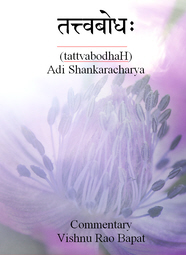
Part 22 of the commentary by Dr. VIshnu Bapat on Shankara’s Tattvabodha.This is a key work which introduces all of the key concepts of Advaita in a systematic manner.

The commentary is based upon those by several other authors, together with the audio lectures of Swami Paramarthananda. It includes word-by-word breakdown of the Sanskrit shloka-s so should be of interest to everyone, from complete beginners to advanced students.

Part 22 begins the enquiry into the statement ‘That thou art’ (tat tvam asi) and looks at the differences between AtmA and jIva.

There is a hyperlinked Contents List, which is updated as each new part is published.

Tattvabodha – Part 19

Part 19 of the commentary by Dr. VIshnu Bapat on Shankara’s Tattvabodha.This is a key work which introduces all of the key concepts of Advaita in a systematic manner.

The commentary is based upon those by several other authors, together with the audio lectures of Swami Paramarthananda. It includes word-by-word breakdown of the Sanskrit shloka-s so should be of interest to everyone, from complete beginners to advanced students.

Part 19 looks at the traditional description of the formation of the mental aspects from the sattvika qualities of the five elements and the formation of the organs of action from the rajasika aspects.

There is a hyperlinked Contents List, which is updated as each new part is published.